
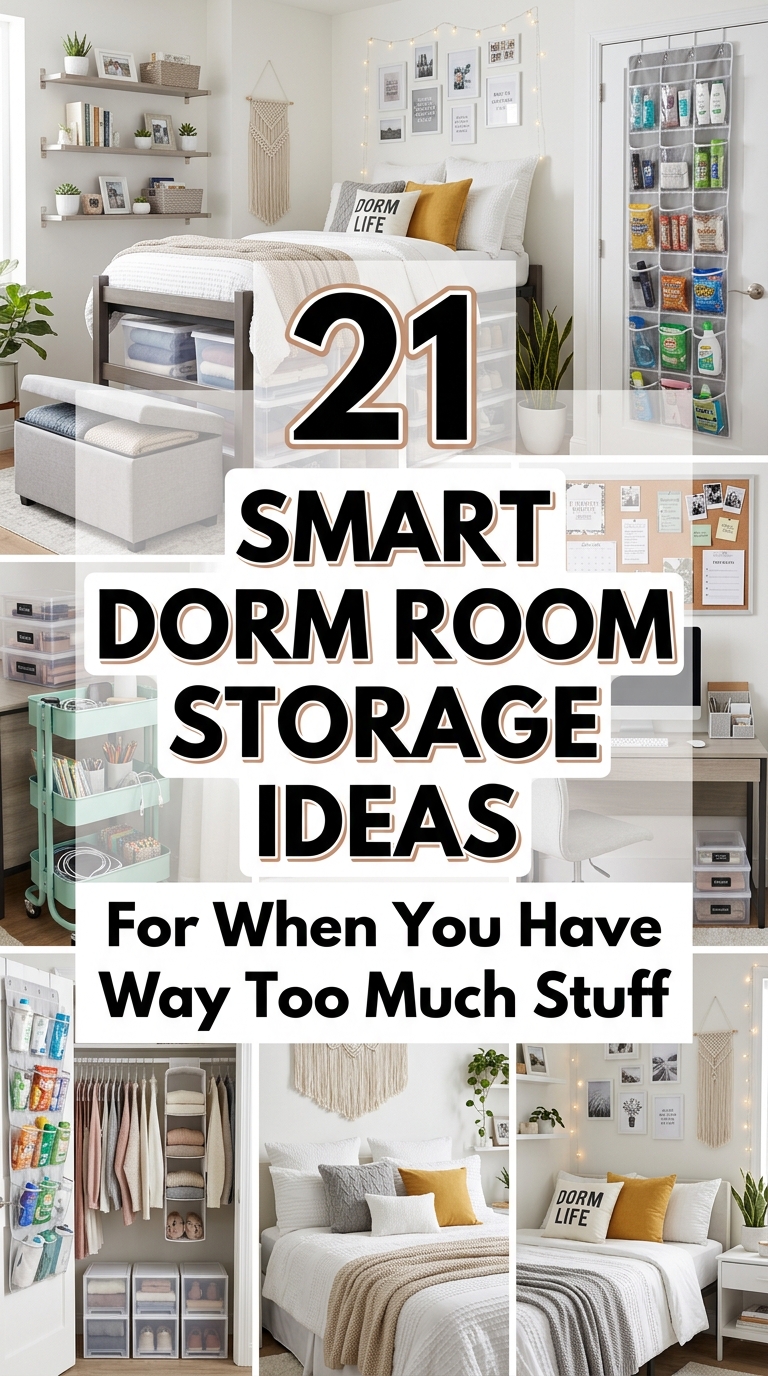
You packed your whole life into three suitcases, two boxes, and one very overstuffed tote bag. And then you walked into your dorm room and just… stood there. Because where on earth is any of it supposed to go?
That’s the moment every college student knows. The closet looks like it belongs in a dollhouse, the dresser has exactly four drawers, and your roommate has already claimed the better side of the room. A tiny dorm room doesn’t have to feel like a disaster zone — it just needs a system.
This post covers 21 of the smartest, most practical dorm room storage ideas out there, from the classic under-bed setup to creative closet tricks most people never think of. Whether you’re working with a $15 budget or ready to actually invest in your space, there’s something here for every kind of dorm room and every kind of student. Let’s get into it.
Raise Your Bed With Risers and Turn Dead Space Into a Storage Zone
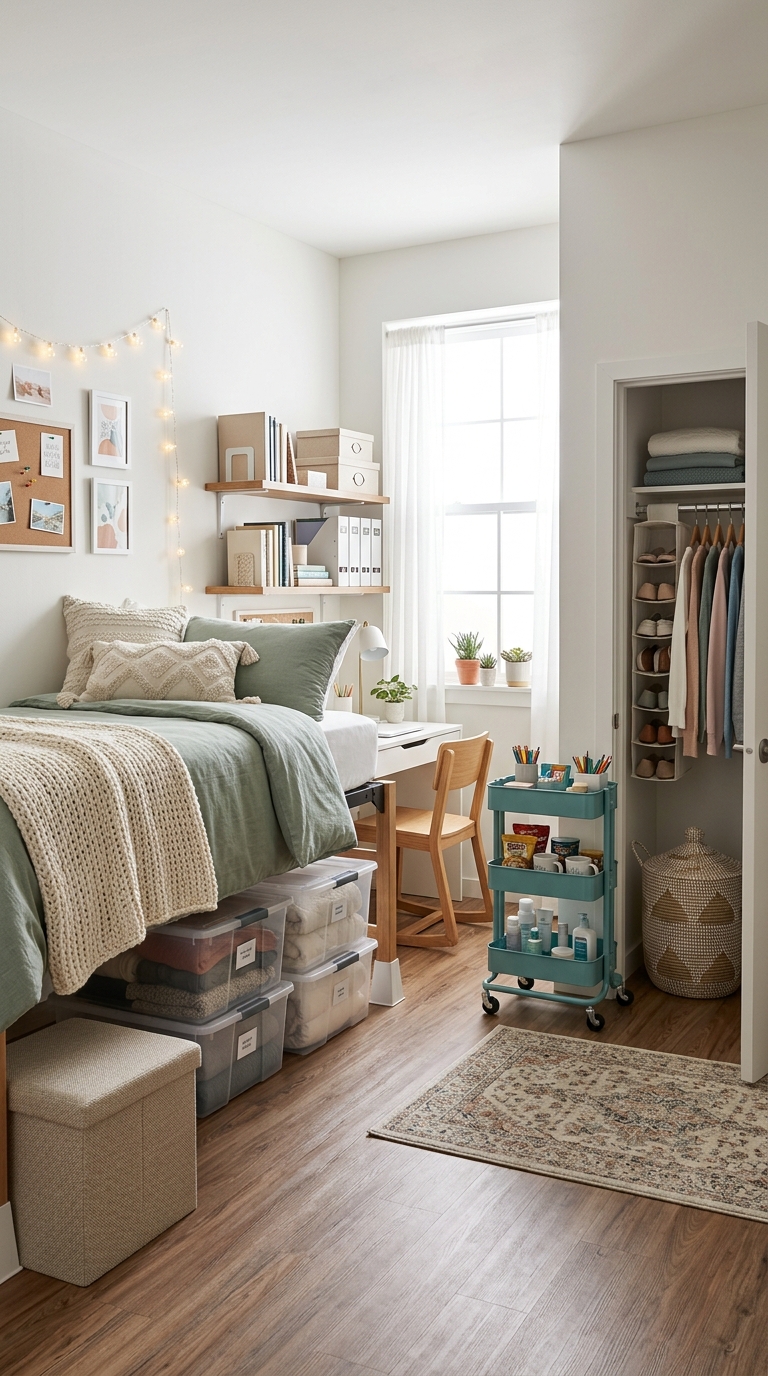
Let’s start with the biggest win available to you in any dorm room — the space under your bed. In most dorms, a standard bed frame sits maybe four or five inches off the floor, which is enough clearance for exactly nothing useful. The moment you add a set of bed risers, that same space suddenly fits full-size storage bins, a pair of suitcases, extra bedding, and a shoe collection. Six-inch risers are the sweet spot for most storage bins, while eight-inch risers give you even more flexibility for larger containers — just look for a non-slip grip and a notched top that locks the bed frame in place.
The type of bin you choose matters more than people think. Rolling bins are the most practical since you can pull them straight out without getting on the floor, flat lidded bins work well for things you don’t need daily, and vacuum compression bags are a game-changer for anything bulky — a winter comforter compresses down to about the size of a small backpack. Add a bed skirt that drapes to the floor and the whole setup looks clean, hiding the organized chaos underneath while you keep every bit of the storage.
Styling Tip: Use matching white or natural canvas bins under the bed for a cohesive look — mismatched containers look messy even when they’re hidden.
Best Color Palette: White + Gray + Natural Canvas
Best For: All dorm rooms, especially those with limited closet space
Use an Over-the-Door Organizer on Every Single Door — Not Just the Main One
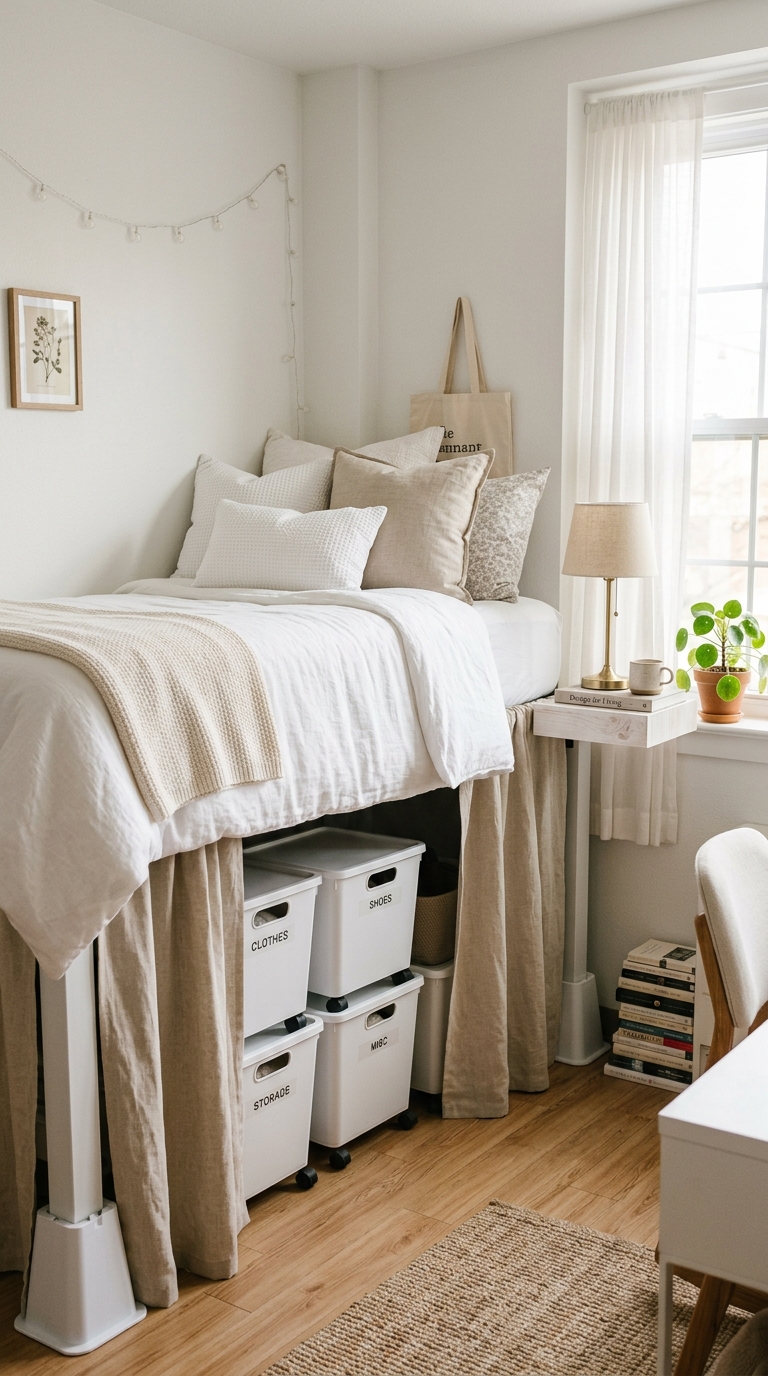
Most students buy one over-the-door organizer for the main room door and call it done, but the closet door is just as much of a door and almost always completely empty on the inside. The main door is best for things you grab multiple times daily — keys, a small mirror, sunscreen, a backup charger — with clear pocket organizers working well since you can see everything at a glance. The closet door is great for shoes, accessories, and hair tools you need before leaving the room but don’t want to take up dresser space.
There’s a version of this organizer for every need: fabric pocket organizers look better in photos, clear plastic ones are the most functional, and mesh versions are lightweight for toiletries or gym gear. Matching the organizer color to your room palette makes it feel like a design choice, and the best part is that over-the-door organizers require zero installation — they hook over the top of the door and hold it securely without any tools, damage, or permission from your RA.
Styling Tip: Line the pockets with matching items — all skincare in one row, all accessories in another — so the organizer looks styled when the door is open.
Best Color Palette: White + Clear + Soft Blush
Best For: Shared dorm rooms, students with lots of small accessories or beauty products
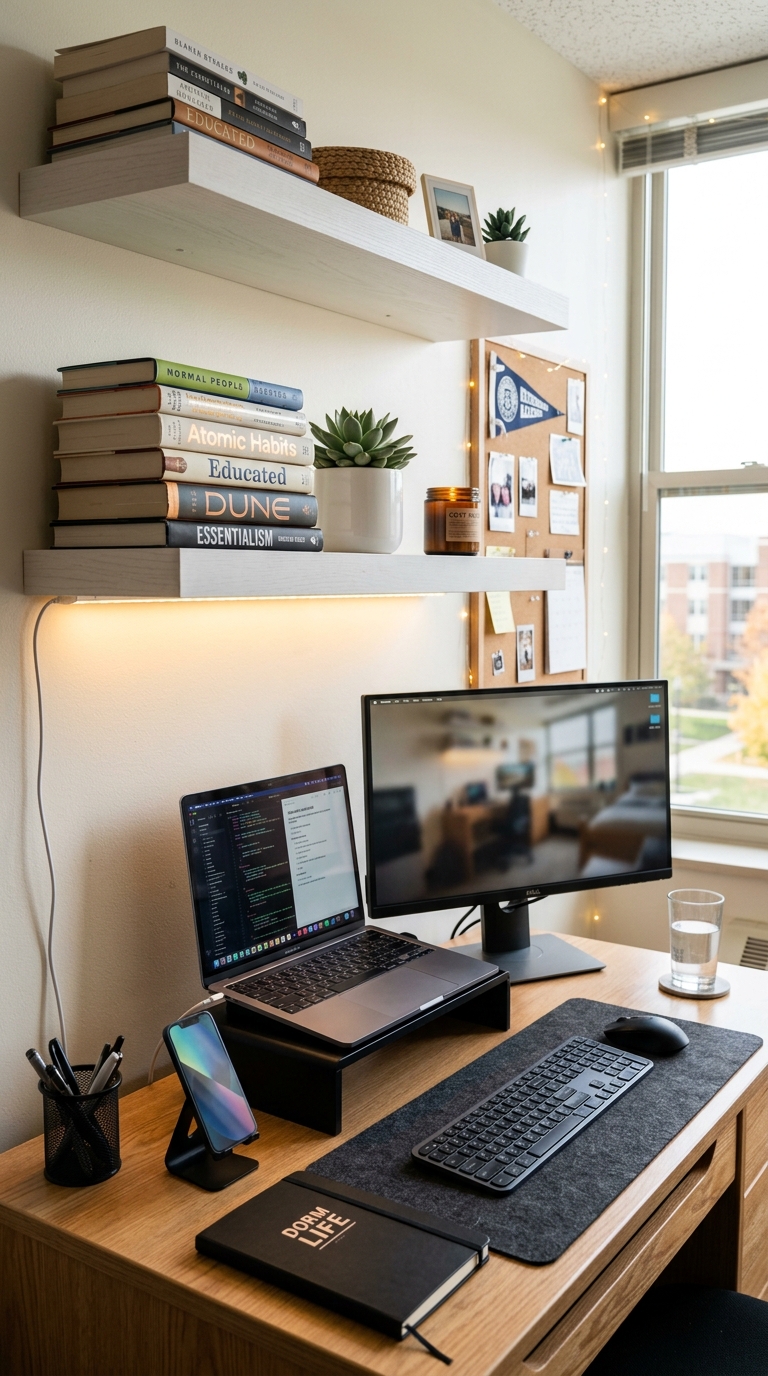
Install Command Strip Floating Shelves Above Your Desk
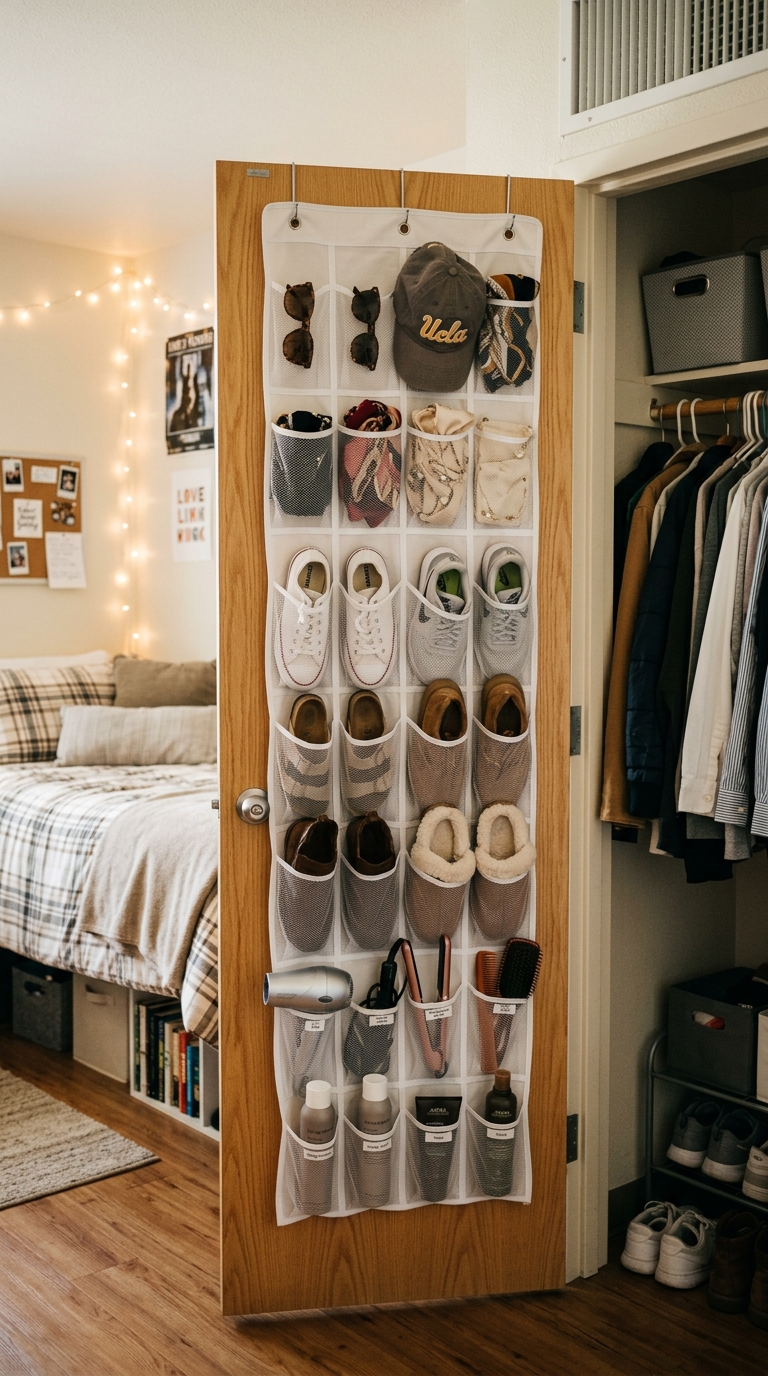
Your desk surface is some of the most valuable real estate in your dorm room, and every inch you give to storage is one less inch you have to actually work on when midterms hit. Floating shelves mounted above the desk move everything vertical and free up your surface. Command strip shelves are the go-to choice since they require no drilling, leave no real damage, and hold more than you’d expect when installed correctly — just follow the weight limits exactly and stick to lighter items like books, small plants, skincare products, and a charger.
Arrange the shelf contents the way a photographer would style a flat lay: mix heights, keep one third of the shelf open so it doesn’t look crammed, and include one organic element like a trailing pothos or a small vase of dried stems. That combination of functional and decorative is what makes the desk setup look intentional, and warm LED strip lights installed under the shelf add a soft glow that makes studying feel slightly less awful at night.
Styling Tip: Keep two-thirds of the shelf functional and one-third purely decorative — the mix of purpose and beauty is what photographs best.
Best Color Palette: Matte Black + Natural Wood + Warm Cream
Best For: Students who spend a lot of time at their desk, small dorm rooms with limited surface space
Get a Rolling Cart and Put It Wherever You Need It Most
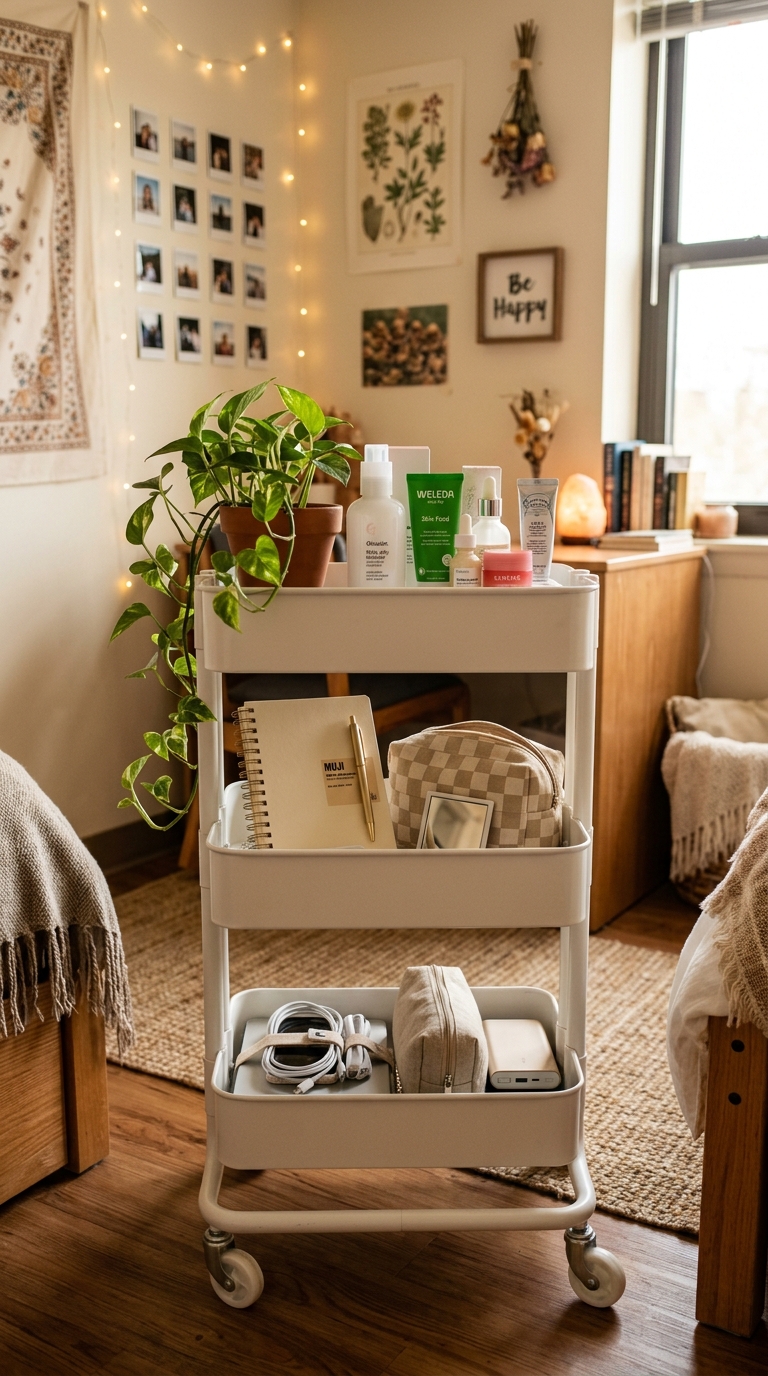
The rolling cart might be the single most versatile storage piece you can bring to a dorm room because, unlike any other furniture, it moves. You can wheel it to your desk during study sessions, pull it to the mirror when getting ready, or tuck it under a lofted bed when you need the floor space back — it works in every zone of the room and adapts as your needs change. The most popular option is the IKEA RÅSKOG: three sturdy tiers, plenty of color choices, and affordable enough that it doesn’t feel like a big commitment, though Amazon has solid alternatives too.
What you put on each tier matters for how functional it actually is. Top tier should hold things you reach for multiple times a day, like skincare and a water bottle; middle tier holds things you need once or twice daily, like a makeup organizer or snacks; and the bottom tier is for occasional-use items like extra chargers or a planner. Styled well — with a matching color palette, a small plant, and neatly arranged items — a rolling cart looks like an intentional design decision rather than just a storage solution.
Styling Tip: Style the top tier like a mini vignette — one functional item, one small plant, one decorative piece. It photographs like a proper styled shelf.
Best Color Palette: White + Sage Green + Natural Rattan
Best For: All dorm rooms, students who need flexible multi-zone storage
Hang a Pegboard or Wire Grid Panel Above Your Desk
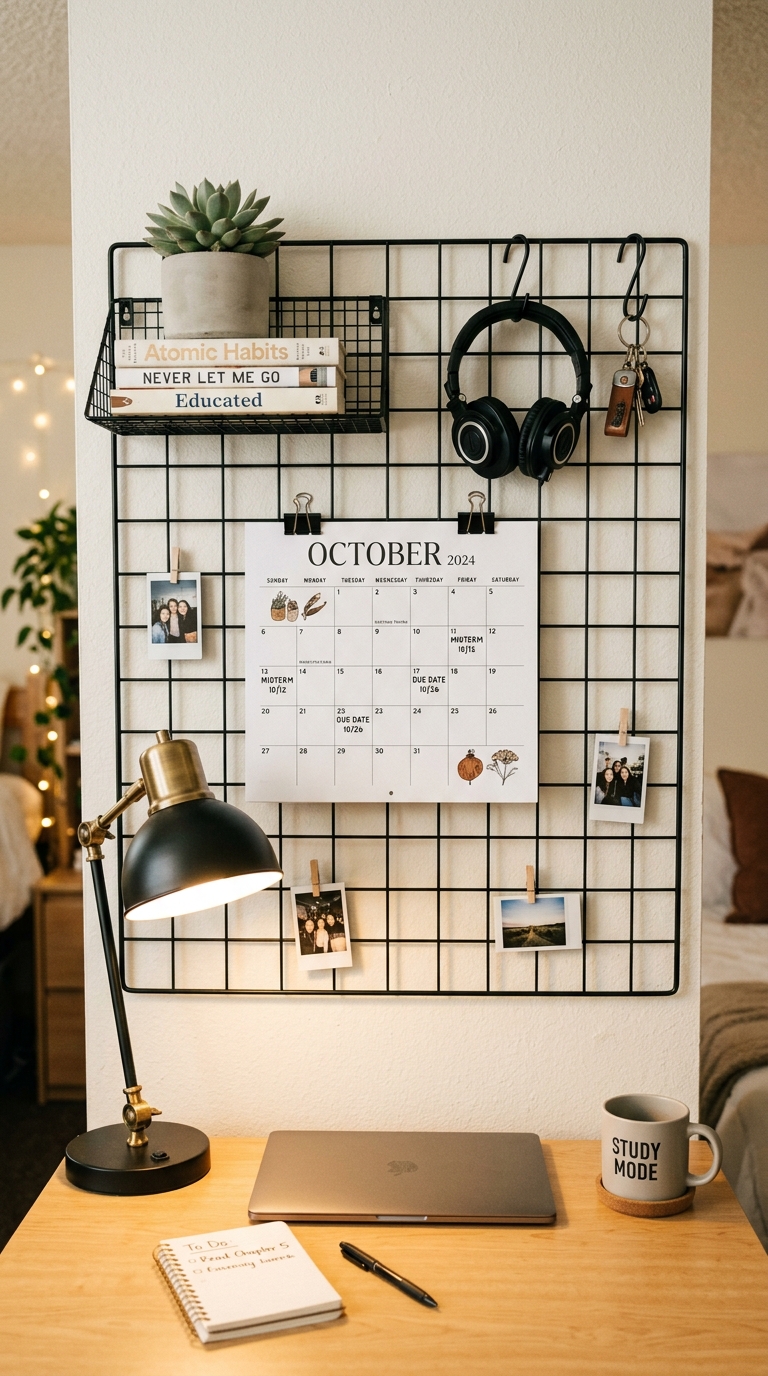
If the floating shelf is the practical choice for above-desk storage, the wire grid panel is the aesthetic and most customizable one. A black metal grid panel mounted above your desk lets you add S-hooks for headphones and keys, small wire shelves for plants and books, clips for photos, small baskets for overflow, and a magnetic board for your class schedule — everything visible and within arm’s reach, none of it touching your desk surface. Installation options include command strips rated for heavier loads or tension mounting, and the grid itself is lightweight enough for a pair of heavy-duty command strips to handle reliably.
What makes the grid panel work visually is the mix of practical and personal items on it. A grid that’s only school supplies looks like an office, while a grid that’s only decorative looks like wasted space — the sweet spot is a calendar clip and supply hooks alongside a small plant shelf and a photo strip. Functioning with personality is the goal, and everything rearranges anytime without wall damage.
Styling Tip: Always include one living element on your grid — a small potted plant or dried stems in a clip-on vase makes the whole thing look styled rather than purely utilitarian.
Best Color Palette: Matte Black Grid + White Wall + Natural Wood Shelf Accents
Best For: Students who need a lot of desk organization, visual learners who like everything in sight
Quick Designer Tip: Before you start buying storage products, take a photo of your empty dorm room and list everything you need to store. Divide it into zones — sleeping, studying, getting ready, clothes — and buy storage for each zone separately. Buying randomly always leads to things that don’t fit, don’t work together, and end up on the floor anyway.
Use Tension Rods Inside Your Closet to Double Hanging Space Instantly
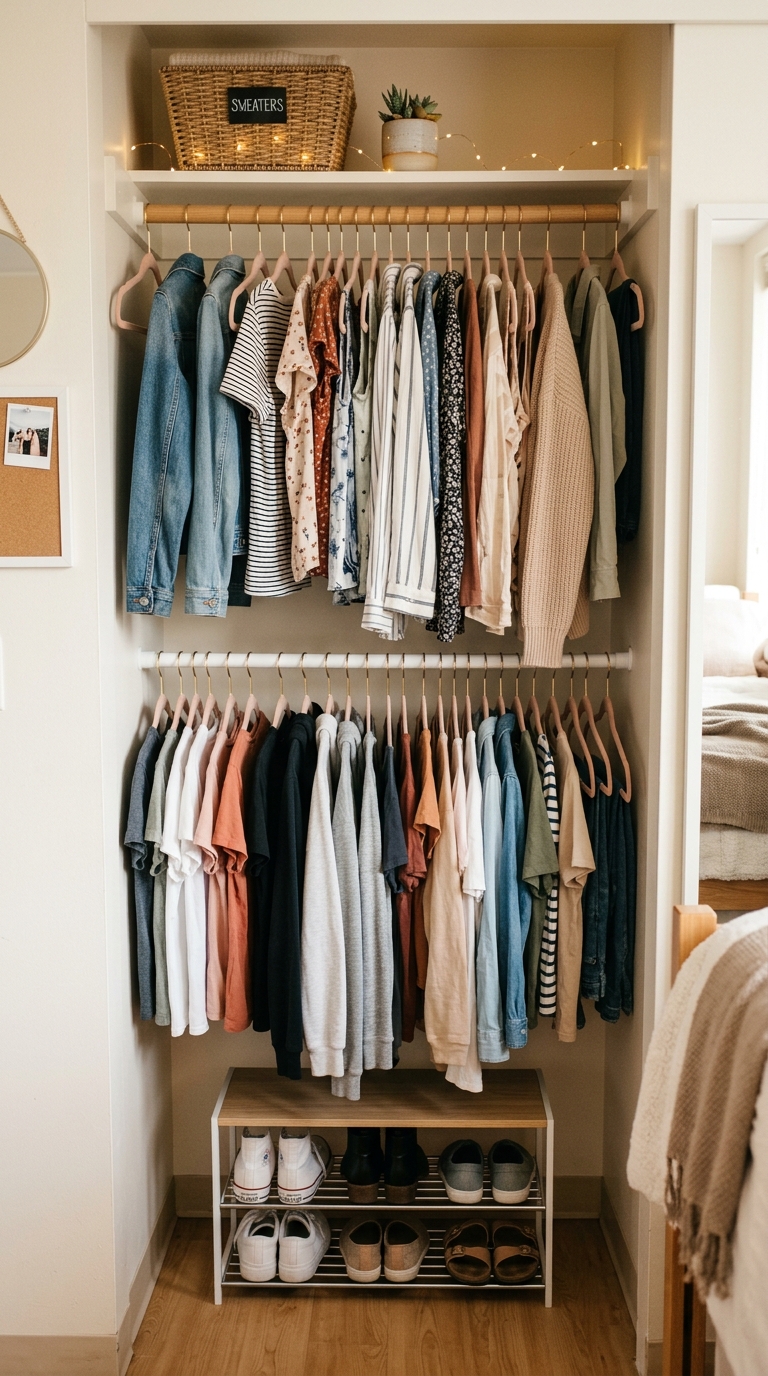
This is one of those dorm room tricks that feels almost too simple until you try it — a tension rod installed below the existing closet rod effectively turns one hanging level into two. Every short item you own (shirts, jackets, hoodies, blazers) now takes up half the vertical space it used to, and the area below the bottom rod can hold a small bin or shoe organizer. Tension rods require no drilling, no tools, and no permission; they expand to fit the closet width, press firmly against both walls, and hold a surprising amount of weight when sized correctly.
The organizational system that works best is hanging longer items like dresses and coats on one side of the closet, and using the double-rod system on the other side for everything that hits mid-thigh or above. That way you keep the space under the lower rod clear on the long-item side — perfect for a small bin or shoe rack — while doubling capacity on the short-item side for under $10 and about two minutes of work.
Styling Tip: Use matching velvet hangers on both rods — the consistency makes even a packed closet look clean and organized.
Best Color Palette: Natural Wood + Ivory + Blush
Best For: Students with lots of clothes and too little closet space
Stack Cube Storage Bins Under a Lofted Bed Like Built-In Furniture
If your dorm allows lofted beds, the area underneath is one of the most valuable zones in the entire room — but only if you treat it like its own space rather than a place to shove random stuff. Cube storage bins arranged in a grid make it look like built-in furniture, functioning as a wardrobe, bookshelf, and display surface all at once. A standard 2×2 or 2×3 cube organizer fits under most lofted beds, and filling some cubes with fabric bins while leaving others open for books, a speaker, or a plant is what makes it look designed rather than just functional.
Add a small rug on the floor of the lofted nook and a string of fairy lights along the frame above, and the whole thing transforms into a cozy little zone — part storage, part sitting area, part personality. If you want to take the under-loft nook even further, check out these pink maximalist bedroom ideas for kids — the layered storage and bold personality of that aesthetic translates surprisingly well into a lofted dorm setup.
Styling Tip: Arrange cube bins in a checkerboard pattern of open and closed — alternating fabric bins with open display cubes creates a visual rhythm that looks intentional from across the room.
Best Color Palette: White Cubes + Natural Fabric Bins + Warm Oak Accents
Best For: Students with lofted beds, maximalists who need storage and a cozy vibe
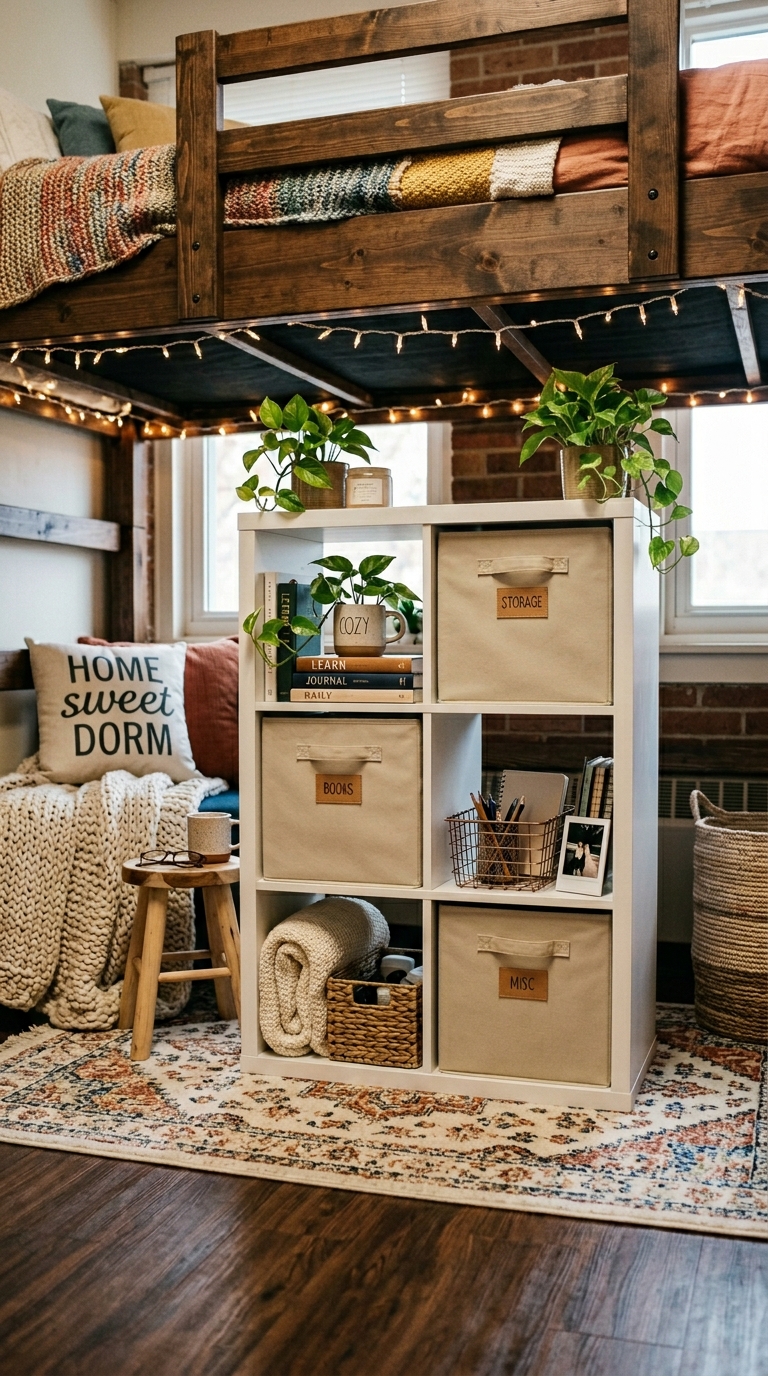
Use the Top Shelf of Your Closet — It’s Always Empty and Always Wasted
Walk into most dorm closets and you’ll find the same thing: a shelf above the rod that holds absolutely nothing because it’s too high for daily use. But that shelf is typically twelve to fourteen inches deep and runs the full width of the closet, which is a lot of square footage to ignore. It’s perfect for things you need occasionally but don’t want taking up floor or dresser space — luggage, bulky winter accessories, extra bedding, or bulk snacks.
Accessibility is the only challenge, and the solution is simple: a small folding step stool that stores flat under the bed when you’re not using it, taking up virtually no space while solving the reach problem entirely. Use shallow bins or baskets to contain things up top so nothing is loose and sliding — it’s much easier to pull one bin down than to hunt for a single item on a cluttered shelf.
Styling Tip: Use matching baskets across the top shelf so it looks cohesive when the closet is open — it’s a small detail that makes the whole closet feel more organized.
Best Color Palette: Natural Seagrass Baskets + White Shelf + Warm Cream
Best For: Students with too much stuff and not enough closet floor space
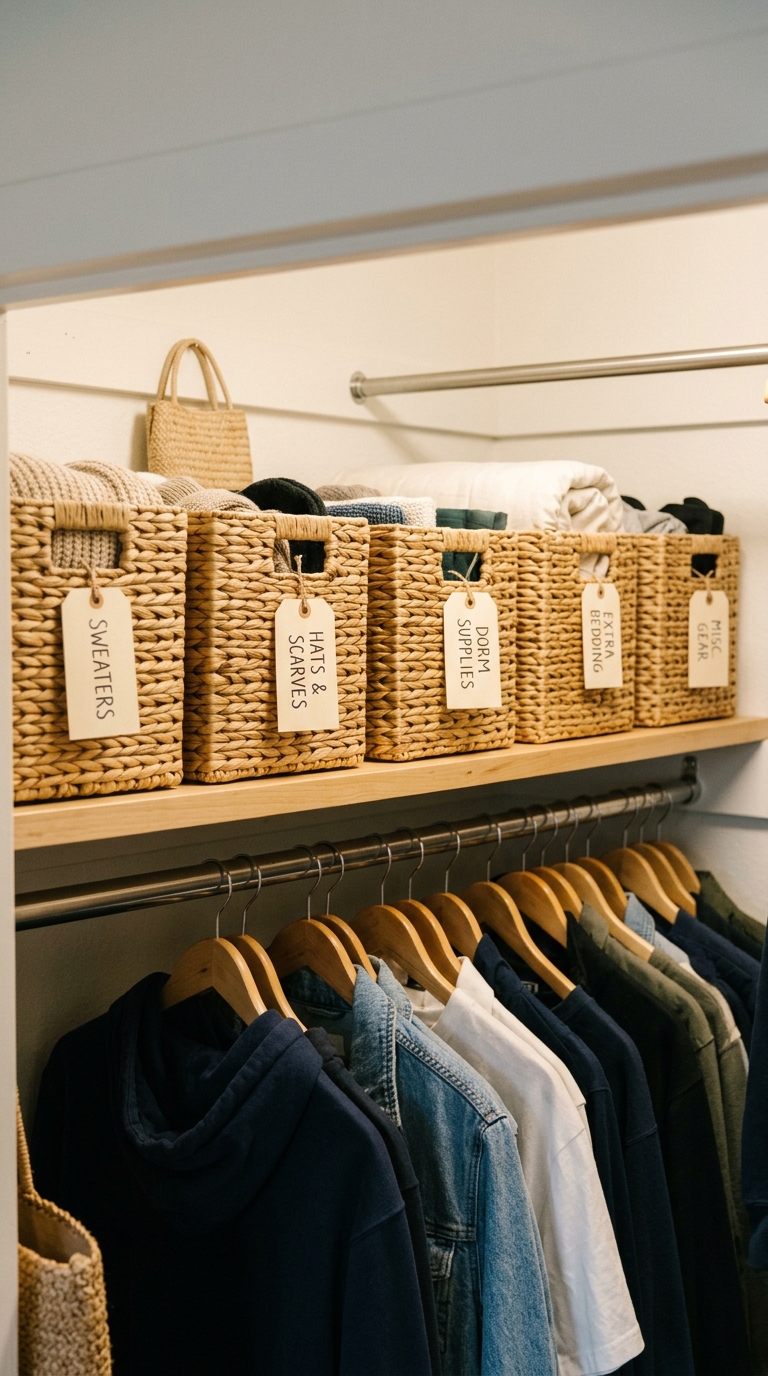
Swap Regular Hangers for Slim Velvet Ones and Double Your Closet Space
This is the lowest-effort, highest-impact closet upgrade on this list. Standard plastic hangers are thick and slippery, letting clothes fall off constantly while eating up far more rod space than they need to. Slim velvet hangers are roughly a third of the thickness with a non-slip texture that keeps even slippery fabrics in place — swapping a full closet of plastic hangers for velvet ones typically recovers enough rod space for about fifteen to twenty additional items.
Buy one set, spend twenty minutes switching everything over, and your closet immediately looks cleaner and holds more. Organize the hangers by color family for a genuinely satisfying open-the-door moment, and pair them with a tension rod below the main rod (Idea 6) for a closet that basically doubles in capacity for under $20 total — one of the best returns on investment in any dorm room.
Styling Tip: Color-organize your hanging clothes from lightest to darkest along the rod — it photographs beautifully and makes choosing an outfit significantly faster.
Best Color Palette: Velvet Blush Hangers + Ivory + Natural Wood Shelf
Best For: All dorm rooms, anyone who struggles with a packed and chaotic closet
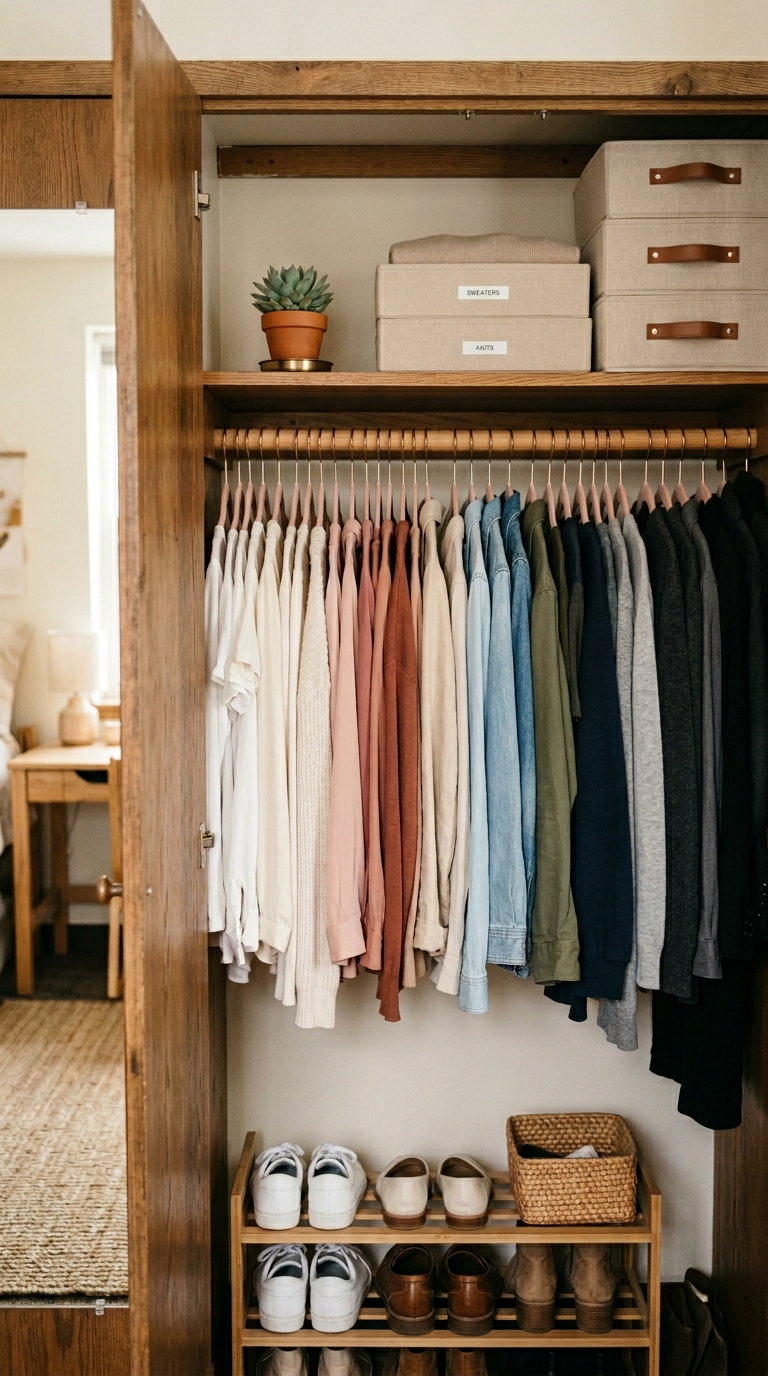
Use Drawer Dividers So Your Dresser Actually Stays Organized
Here’s the honest truth about dorm dresser drawers: without dividers, they last about four days before becoming a pile you’re digging through every morning. It’s not a discipline problem — it’s a system problem, since putting everything into one open space means everything gets mixed together. Drawer dividers create defined sections so each item has a place it belongs, and the best ones for dorm rooms are expandable bamboo or adjustable plastic, letting you customize section sizes for tops, bottoms, underwear, socks, and accessories rather than mixing categories.
Apply the same thinking to your desk drawers — a small tray organizer in the top drawer keeps pens, highlighters, and chargers separated so nothing is ever buried. The “one category per section” rule is what makes the system stick long-term, and the five seconds you save not hunting for a pen, multiplied by however many times a day you need one, adds up to something real.
Styling Tip: Fold clothes using the KonMari vertical fold method before adding dividers — seeing everything upright instead of stacked means you can find every item without disturbing the rest.
Best Color Palette: Natural Bamboo Dividers + White Drawer Lining + Warm Neutrals
Best For: All dorm rooms, students who struggle with maintaining organization after the first week
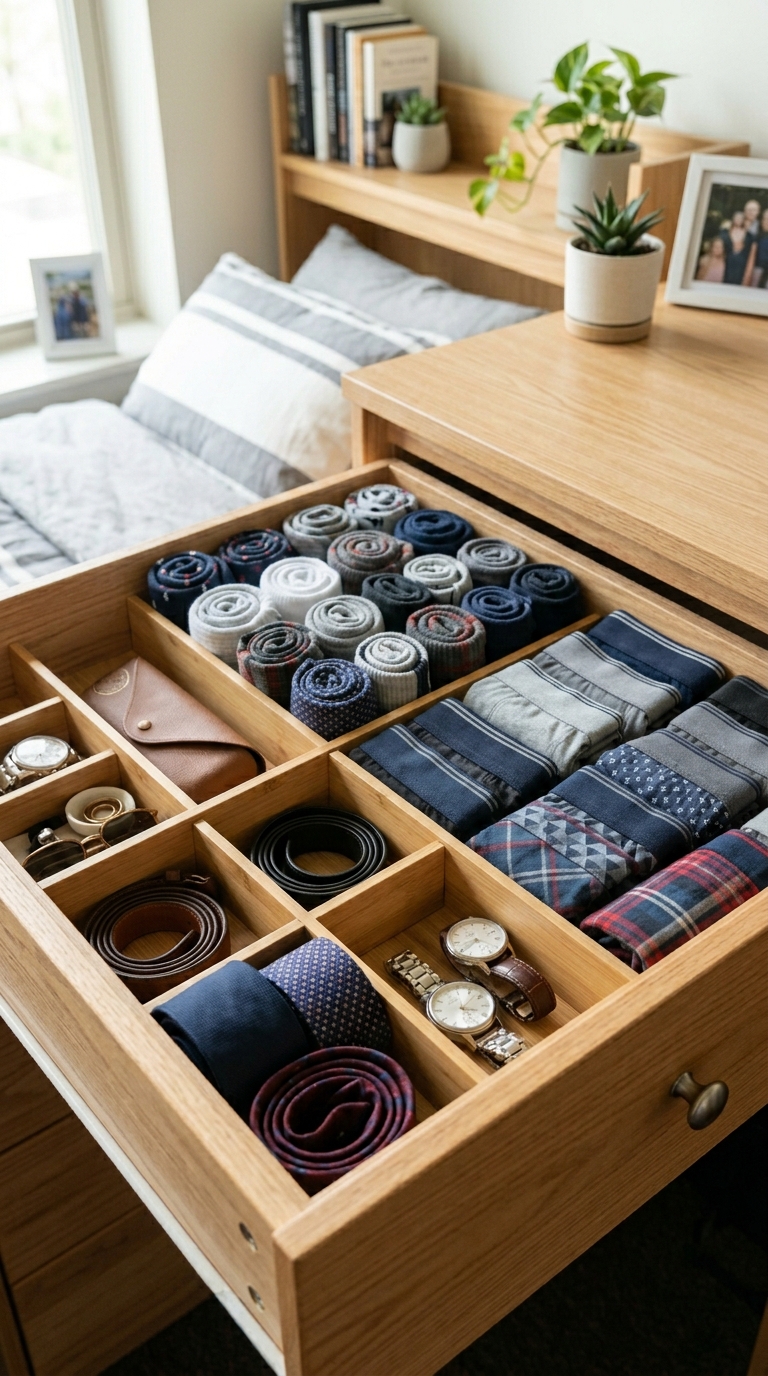
Add a Bedside Caddy So Everything You Need at Night Is Actually There
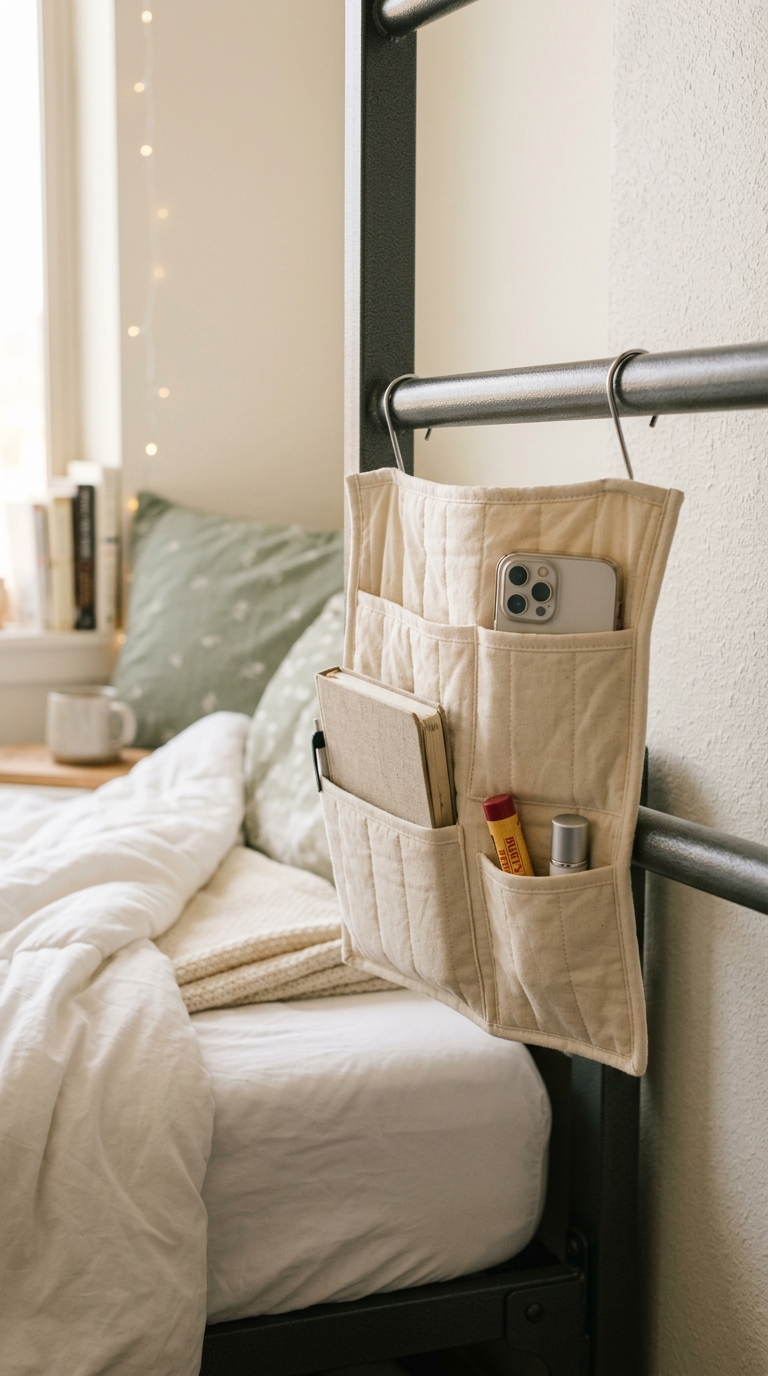
It’s 11:30pm, you’re in bed, your phone is at 4% battery, and the charger is on your desk — every college student knows this scenario. A bedside caddy is the fix: these hanging organizers attach to the side of your mattress or bed frame and create pockets for everything you reach for most at night, like your phone and charger, lip balm, a hair tie, a journal, or earbuds. Everything stays accessible without moving, and your nightstand surface stays completely clear.
There are genuinely cute options now in quilted cotton, linen, and multi-pocket designs that coordinate with your bedding so the caddy looks like part of your styled bed rather than an obvious add-on. Tuck it on the wall side of your bed where it’s hidden in photos but completely accessible from where you sleep.
Styling Tip: Match your bedside caddy fabric to your throw blanket or pillow color — it disappears into the overall bed styling instead of looking like a separate storage item.
Best Color Palette: Cream Linen + Warm Brown + Soft White
Best For: Students without a nightstand, anyone who uses their phone in bed
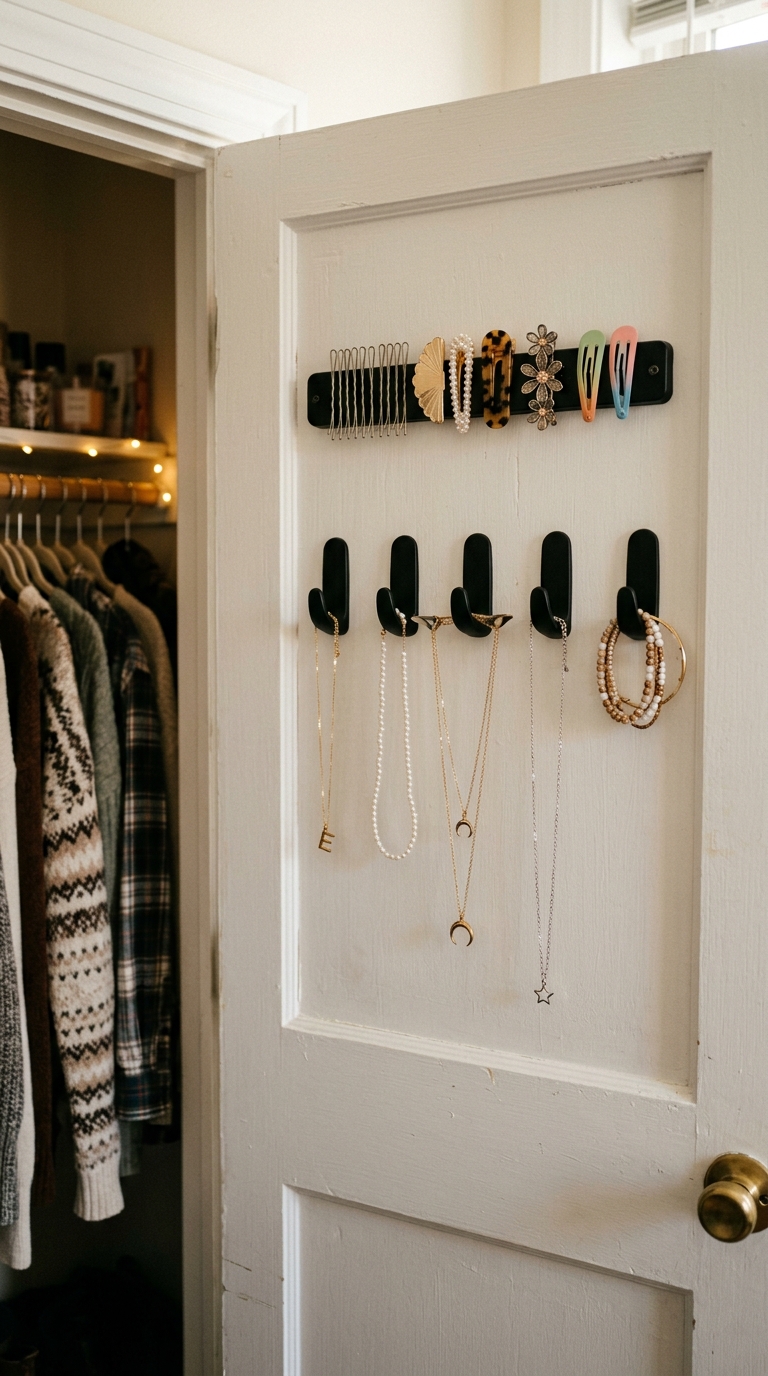
Use Magnetic Strips and Hooks Inside Your Closet Door for Small Accessories
Small accessories are the most annoying things to store in a dorm room — hair clips, bobby pins, earrings, and elastic bands are tiny, go everywhere, and are always missing when you need them. The solution is giving them a dedicated home that’s actually in the right place: inside your closet door, right next to your clothes. A magnetic strip mounted inside the door with command strips acts as a hair accessories holder, while command hooks a few inches below hold necklaces individually so they don’t tangle, plus bracelets and a small bag for earrings.
This setup takes up exactly zero floor, drawer, or desk space — it lives inside the door where nobody sees it unless the closet is open. Getting ready in the morning becomes noticeably faster when you’re not hunting through a pile of jewelry on your dresser for the one thing you want.
Styling Tip: Arrange your necklaces on hooks by length — shortest at the top, longest at the bottom. It looks like a jewelry display when the closet opens.
Best Color Palette: Matte Black Hooks + White Door + Gold Jewelry
Best For: Students with jewelry and accessories, shared dorm rooms where surfaces need to stay clear
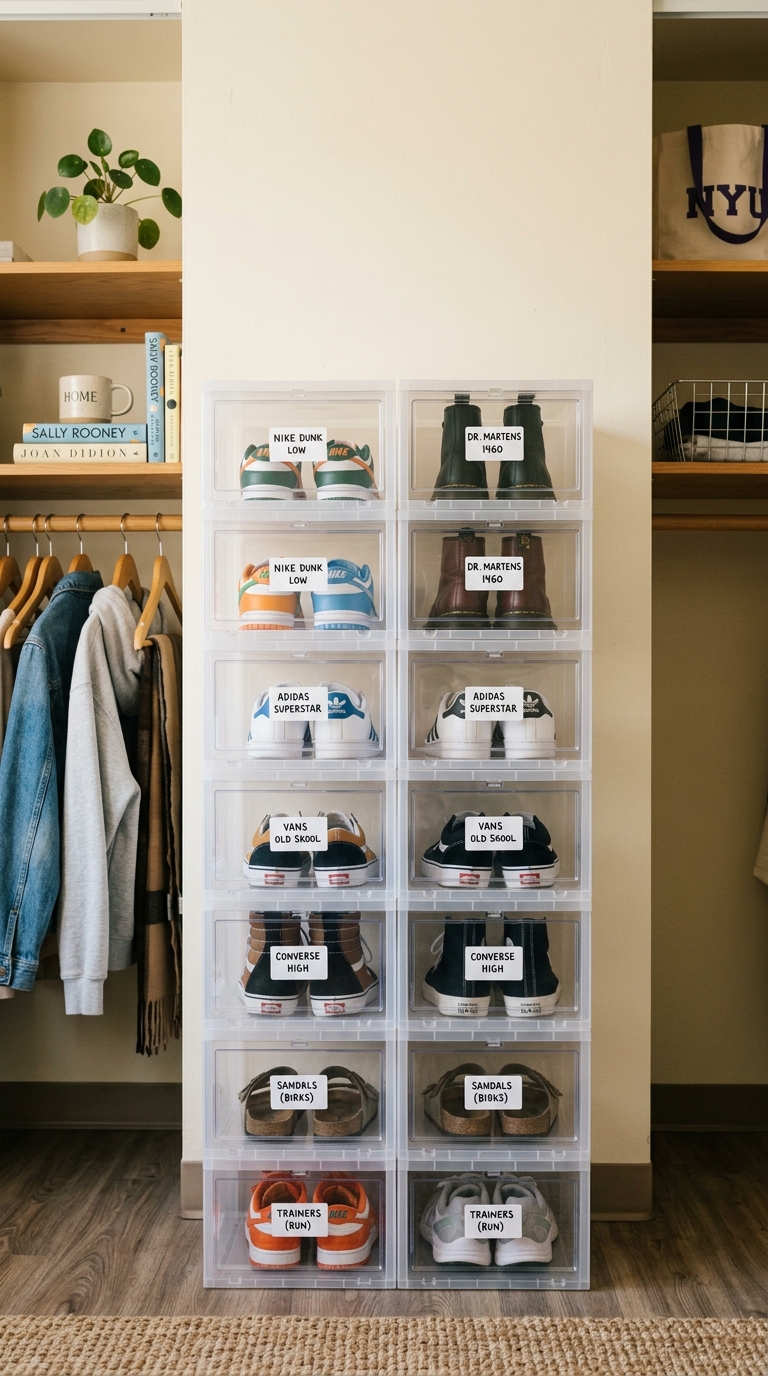
Store Shoes in Clear Stackable Boxes Instead of a Shoe Rack
A floor shoe rack takes up real estate that could hold something else, and unless it’s very small, it tends to look cluttered even when organized. Clear stackable shoe boxes solve the visibility problem — you can see every pair without opening anything — while stacking vertically up the wall rather than spreading horizontally across the floor. A neat tower of them against a wall or inside the closet genuinely looks like a styled display rather than a storage solution.
Keep your most-worn shoes in the bottom few boxes and reserve the higher stacks for occasion shoes, boots, or anything seasonal. The system works even better if you declutter to your actual most-used pairs before arriving on campus, because fewer shoes stored well always looks and functions better than more shoes stored randomly.
Styling Tip: Stack boxes from largest at the bottom to smallest at the top — the tapering creates a visual structure that looks more editorial than a uniform tower.
Best Color Palette: Clear Boxes + White Labels + Natural Wood Floor
Best For: Students with a decent shoe collection, small closets with no floor rack space
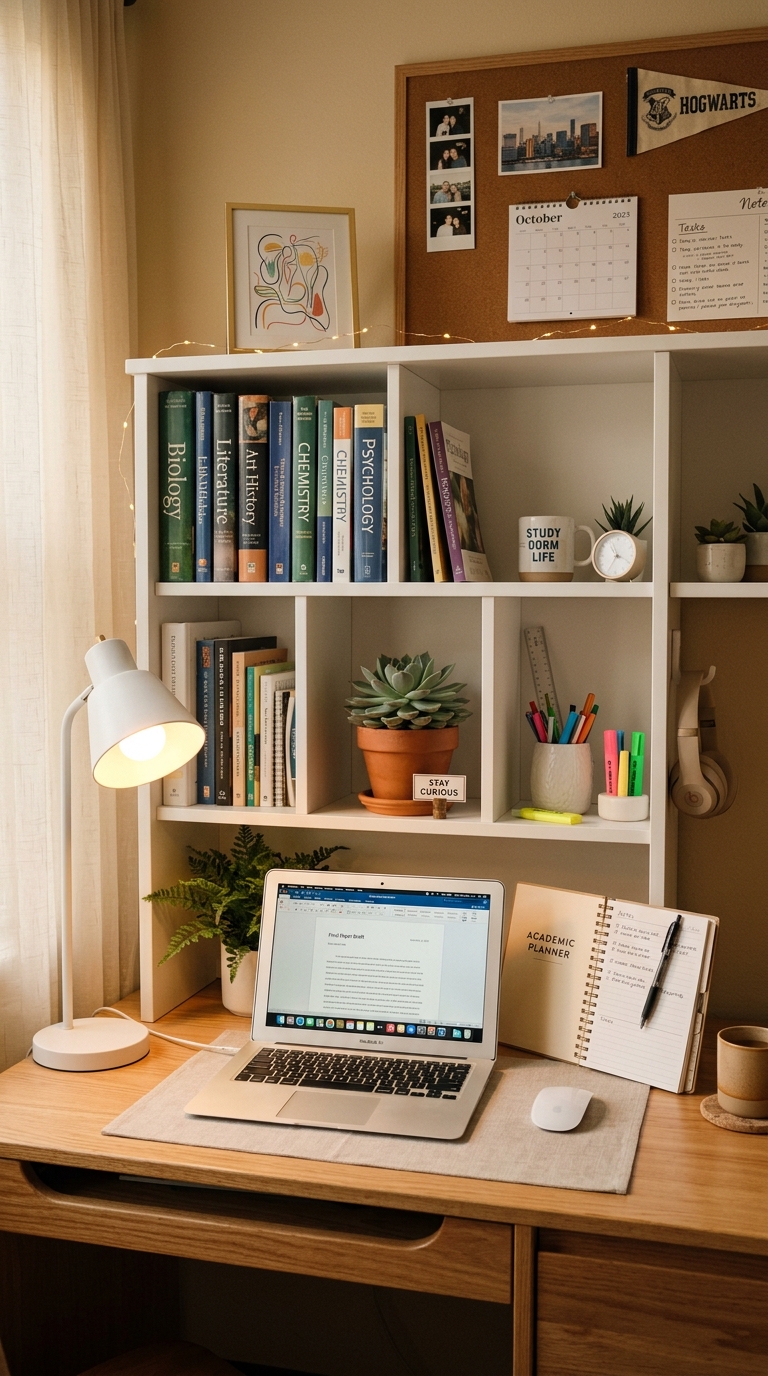
Build a Desk Hutch to Turn Vertical Desk Space Into Real Storage
A desk hutch is essentially a shelf unit that sits directly on top of your desk, converting the vertical space above your flat, limited desk surface into additional organized storage without touching the walls, using floor space, or requiring any installation. Most dorm desk hutches are designed to fit standard desk dimensions, so you typically don’t need to measure — you get a row of cubbies or open shelves that can hold textbooks, binders, a small plant, a charging station, and whatever else has been piling up on your desk surface.
The desk becomes two-tiered: the lower surface stays clear for working while the hutch above holds everything else. Unlike a floating shelf that requires installation, a hutch is completely freestanding — you can take it home at the end of the year with no evidence it was ever there.
Styling Tip: Style the top tier of the hutch with one non-academic item — a small plant, a candle holder, or a framed print — so it feels like a real desk rather than a library carrel.
Best Color Palette: White Hutch + Warm Wood Desk + Cream Accessories
Best For: Students who spend a lot of time at their desk, anyone burying their workspace in stuff
Use a Narrow Freestanding Shelf in Any Corner That’s Sitting Empty
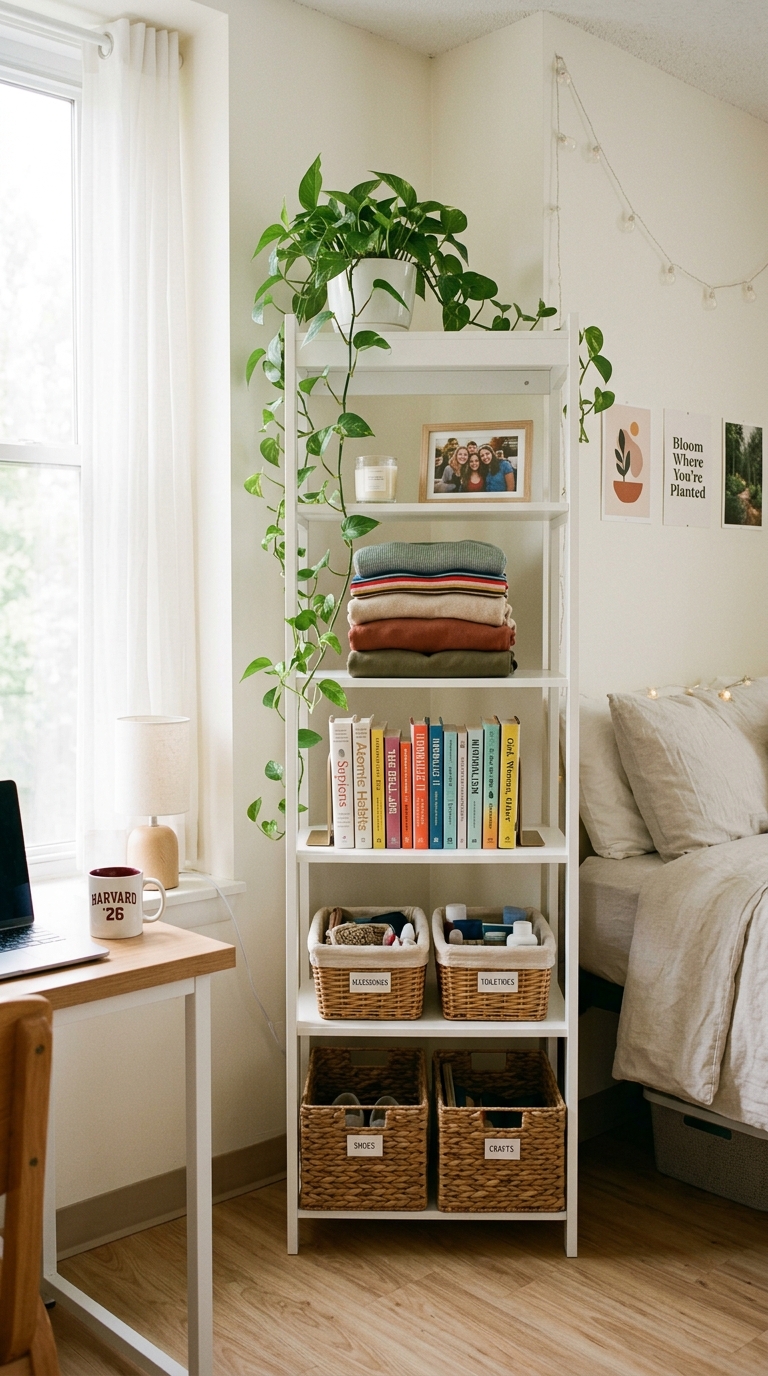
Every dorm room has at least one corner that no furniture naturally reaches — that awkward strip of wall between the desk and the closet, or the gap between the dresser and the door — collecting nothing but the occasional hoodie draped over the edge of something nearby. A narrow freestanding shelf unit, typically twelve inches deep or less, fits exactly into those gaps and transforms them into real storage, with a four or five-tier unit giving you more shelf space than an entire dresser’s worth of drawers.
No-drill freestanding shelves are specifically designed for apartments and dorms — stable on their own without any wall attachment, which means you can rearrange them whenever you want and take them home at move-out with zero effort. Use each tier for a different category: shoes on the bottom, folded clothes in the middle, books and decor above, and a plant at the very top where natural light can reach it.
Styling Tip: Vary the heights of items on each shelf tier — a tall item next to a short one next to a medium one creates visual interest that reads as intentional styling.
Best Color Palette: White Shelving + Natural Baskets + Dusty Green Plant
Best For: Students who need overflow storage, small dorm rooms with unused corners
Store Toiletries in a Two-Caddy System — One for the Shower, One for Your Desk
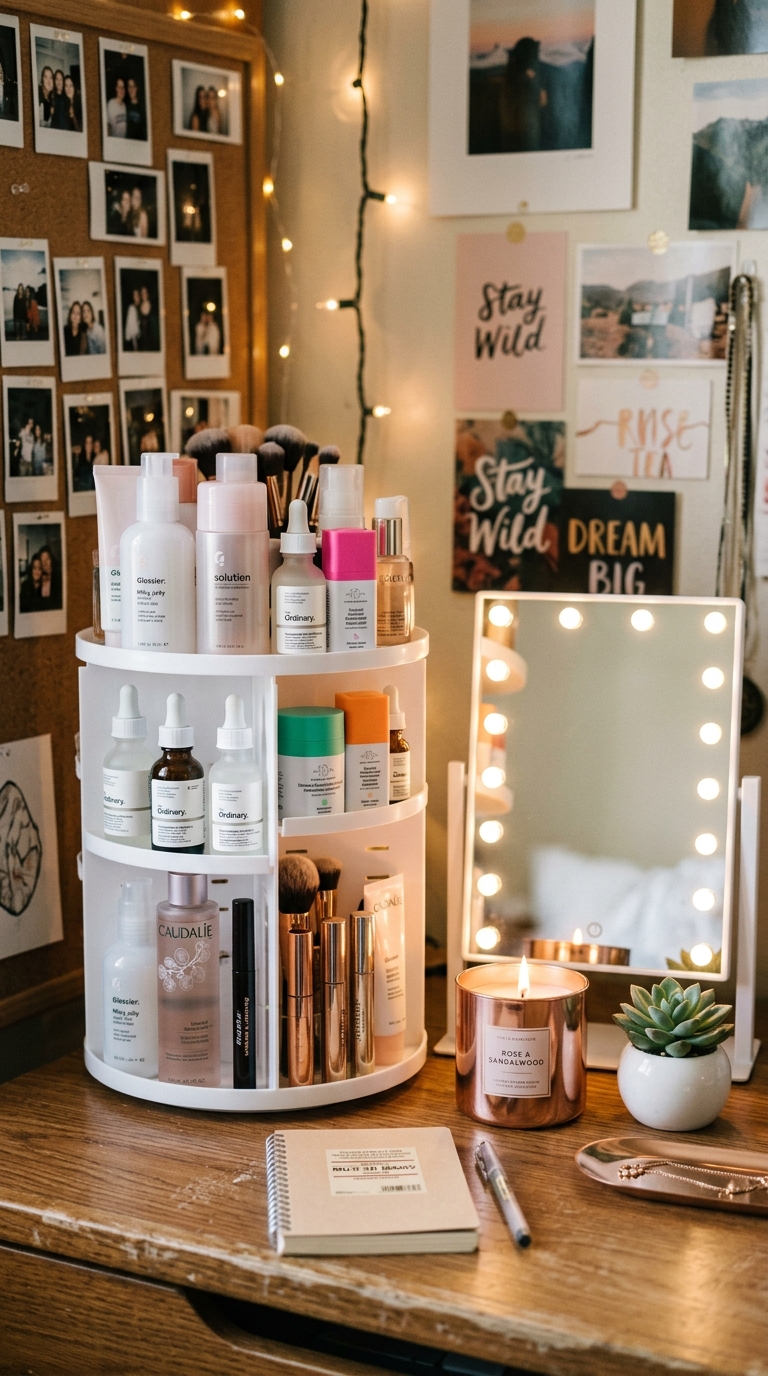
Most dorm students have a single shower caddy that lives on a hook by the door and gets carried to the bathroom when needed, but that’s only half an organization strategy. The piece it’s missing is a separate small organizer for daily skincare, dental items, and get-ready essentials that stays at your desk or dresser all the time. The two-caddy system keeps everything separated by function: your shower caddy holds shampoo, conditioner, and body wash for the shared bathroom, while your desk organizer holds moisturizer, SPF, and face wash for use in your room.
The result is a cleaner desk surface, faster routines since you’re not hunting through a shared caddy, and less risk of forgetting your shower caddy in the bathroom. A tiered rotating organizer or a handled acrylic caddy on your desk keeps daily items organized and looks genuinely nice as a decor element alongside your mirror.
Styling Tip: Choose a desk caddy in a material that matches your room palette — marble-pattern acrylic, white ceramic, or rose gold metal all read as decor rather than storage.
Best Color Palette: Marble White + Rose Gold + Soft Pink
Best For: Students in dorms with shared bathrooms, anyone with a significant skincare or beauty routine
Use Vacuum Storage Bags for Seasonal Clothes to Free Up 80% of the Space They Take
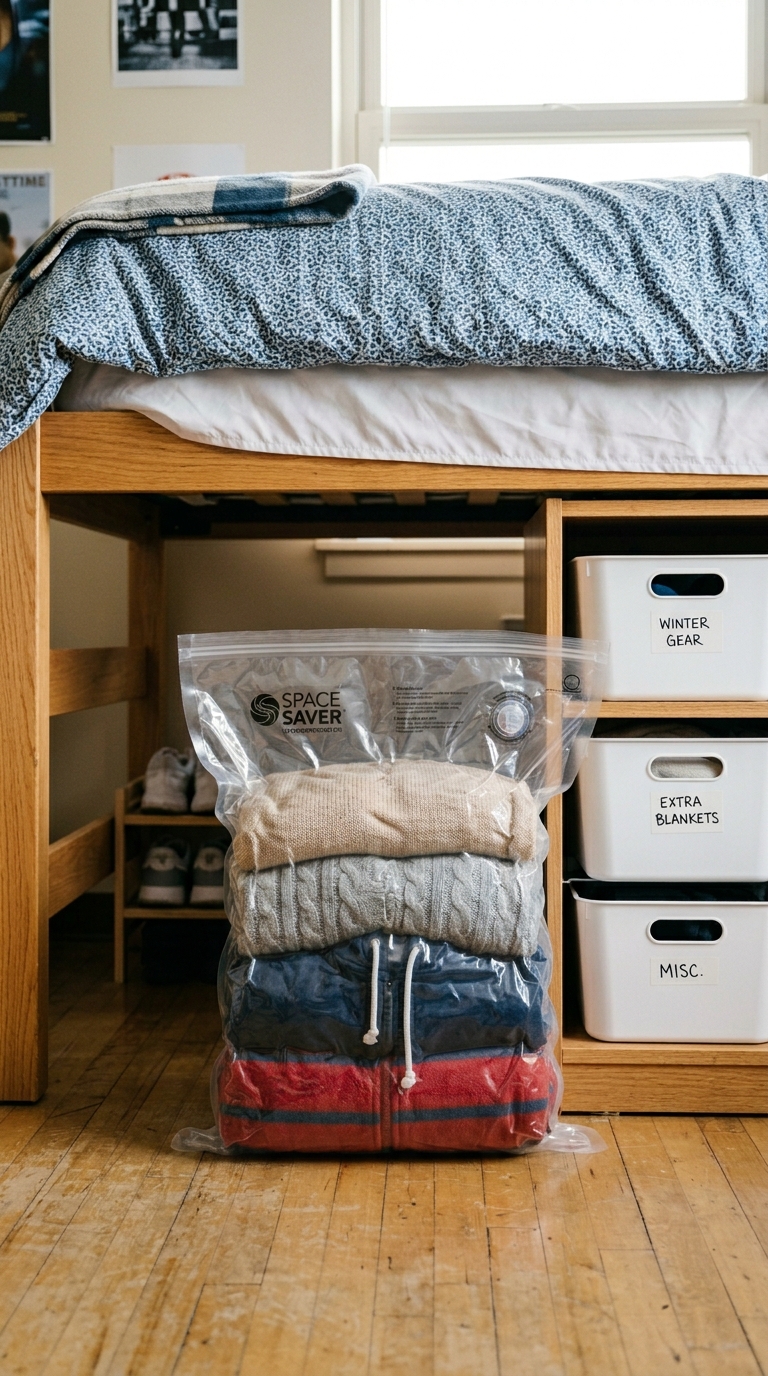
A thick winter coat takes up as much closet space as five regular shirts, and a chunky knit sweater can fill three drawers on its own. Bulky, seasonal items are some of the biggest space wasters in any dorm room, especially when you’re in a warm-weather semester and they’re just sitting there waiting for November. Vacuum storage bags compress soft items — sweaters, hoodies, blankets, jackets — by removing the air from inside the bag, so a full-size duvet becomes something the size of a large book.
The bags are reusable and require no special equipment — most compress by pressing out the air through a valve and sealing, though a vacuum attachment speeds up the process. Once compressed, store the bags under your bed, on the top closet shelf, or flat in a suitcase you’d otherwise be storing empty anyway — one of the most effective volume-reduction storage ideas for a small dorm room.
Styling Tip: Label each vacuum bag with a small card tucked inside listing the contents — it’s much easier than opening bags to find what’s in them mid-semester.
Best Color Palette: Clear Bags + White Labels + Natural Canvas Bin
Best For: Students in climates with seasonal weather changes, anyone with limited closet space
Turn Your Empty Suitcase Into a Storage Unit After Move-In
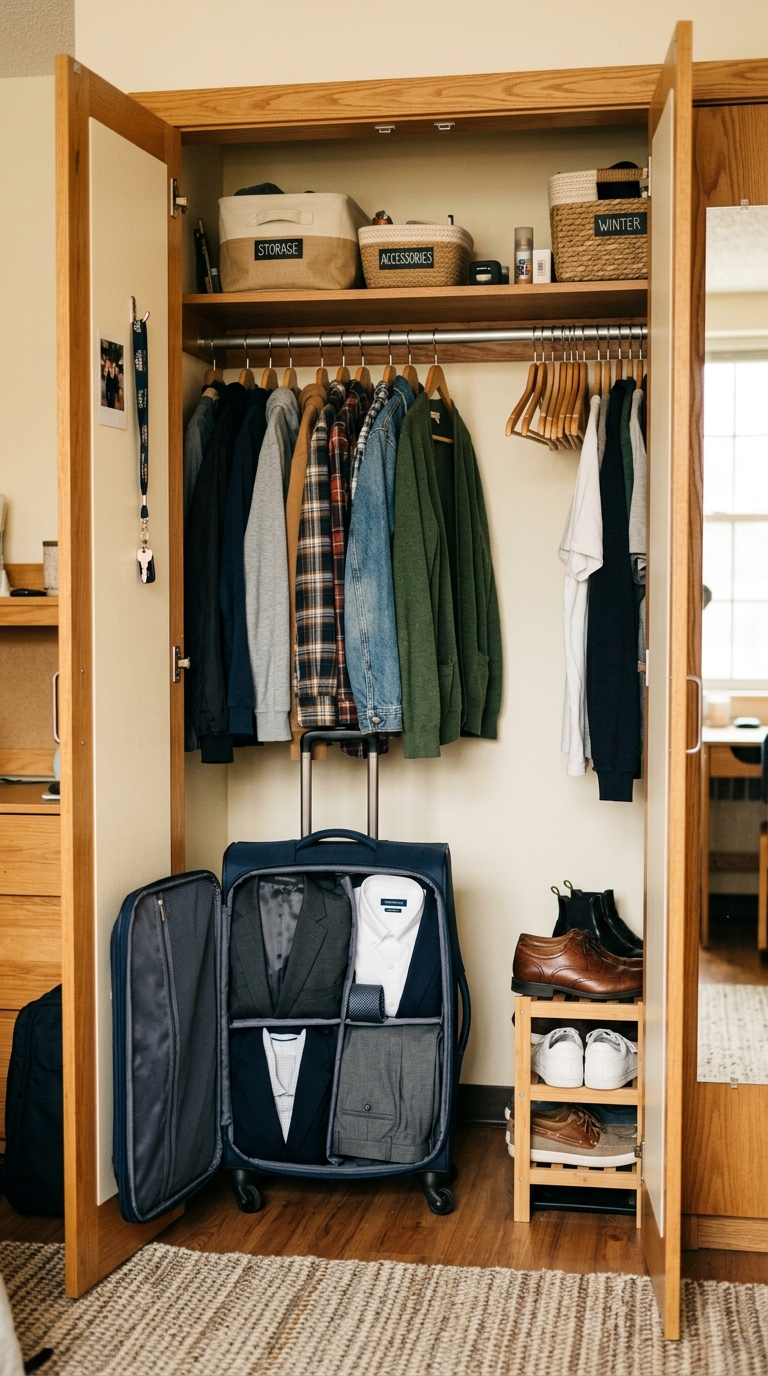
After move-in day, your suitcase sits empty and takes up space it could be earning. Most students shove it under the bed or into the corner of the closet where it occupies a huge footprint while doing absolutely nothing. A hard-shell suitcase can instead hold extra shoes on the bottom, formal wear laid flat, and a layer of accessories on top, taking up less visual space closed than an open shelf would; a soft duffel stores flat under the bed when empty, and a larger rolling suitcase stored vertically in the closet acts like a slim wardrobe tower.
The key insight is that a suitcase is a structured, closeable container — basically the definition of good storage. Using it only for travel means it’s empty eleven months out of the year, while using it for storage means it’s working constantly and takes up no more space than it would when empty.
Styling Tip: Store your suitcase in the closet standing vertically with a label on the outside noting the contents — it becomes part of the closet organization system rather than just clutter.
Best Color Palette: Neutral Luggage Tones + White Closet Interior
Best For: Students who brought large suitcases to campus, anyone needing overflow storage
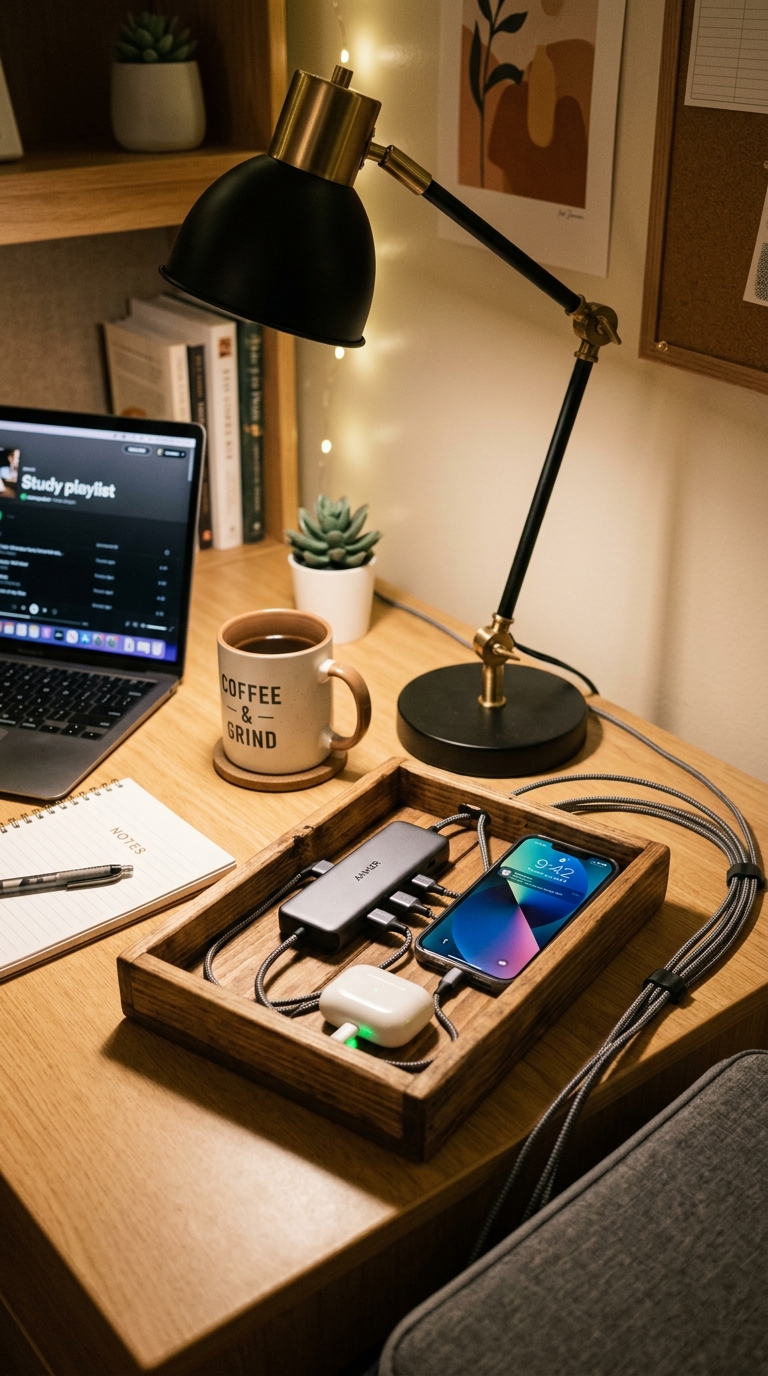
Build a Charging Station So Your Desk Isn’t Buried in Cords
Cords are one of the most visually distracting things in a dorm room, and one of the easiest problems to solve. A multi-port USB charging hub consolidates every device charge into one compact unit, so instead of multiple wall chargers and crossing cables, everything routes to one hub in one spot. A small decorative tray or box placed near the hub creates a designated “device drop zone” where your phone, earbuds, and watch all live when charging, and binder clips or command-stripped clips along the desk edge keep cords routed neatly so they don’t hang across the surface.
For a fully cord-free desktop look, run cables along the back edge of the desk under any floating shelves, secured with small adhesive cable clips. The desk surface stays completely open, cords are managed, and the whole setup photographs far more cleanly — which matters whether you’re taking class notes or just living in the space every day.
Styling Tip: Place the charging hub inside a small open-top box or tray so the hub itself is hidden but the tray reads as a styled surface detail.
Best Color Palette: Matte Black Hub + Warm Wood Tray + Cream Wall
Budget Level: Budget Friendly to Mid-Range
Best For: Students with multiple devices, anyone whose desk surface disappears under cords
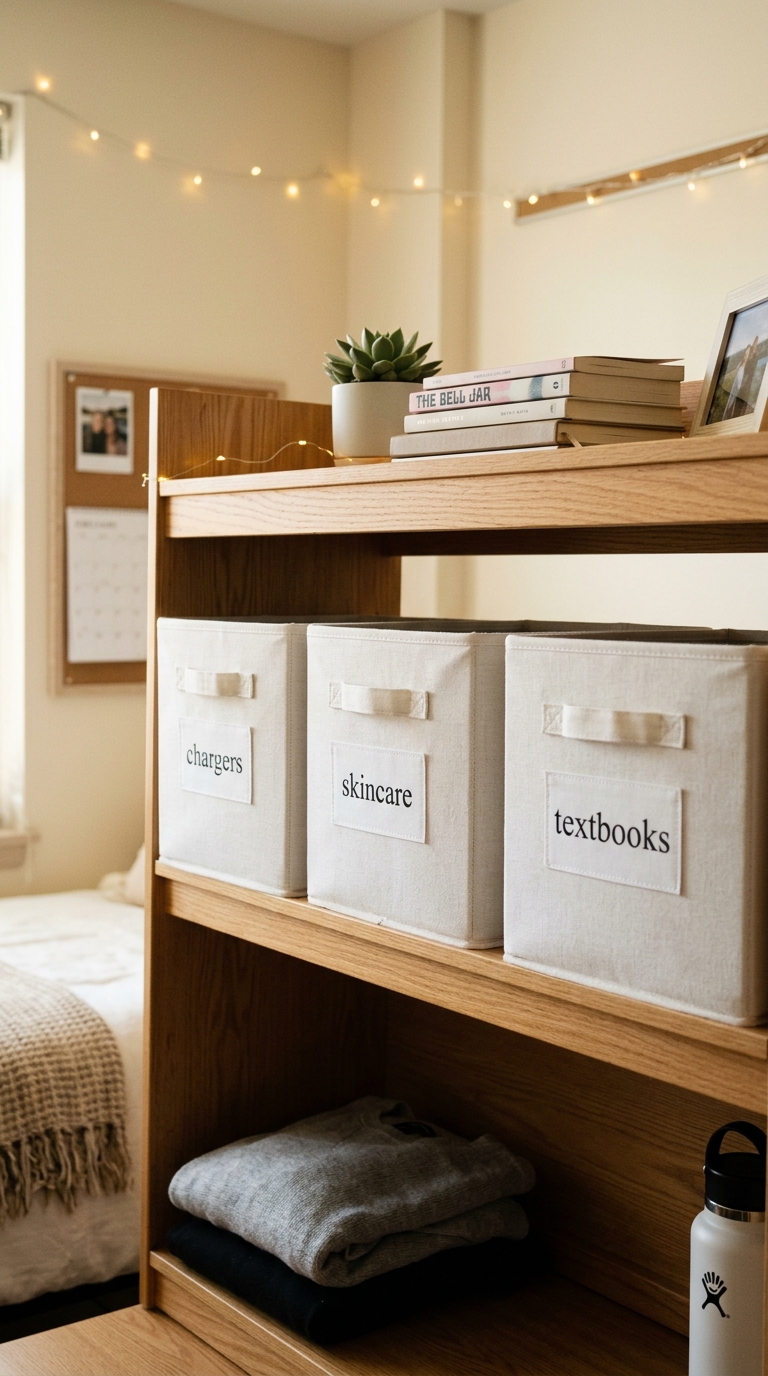
Label Every Single Bin, Basket, and Box So the System Actually Lasts
Organization systems fall apart in dorm rooms for one reason more than any other: nothing has a labeled home. When you’re tired at 1am after a study session, you don’t reorganize — you put things wherever they fit, and two weeks later the system you spent move-in weekend setting up has completely unraveled. Labels fix this at the root: when every bin has a name, there’s only one correct place for each item to go, and putting things back becomes thoughtless and automatic rather than a decision.
Aesthetic labeling options make the whole thing look better rather than institutional — printed labels in a nice font, chalk labels on small tags tied with twine, or washi tape borders around a written label. The visual consistency of well-labeled storage, especially with matching bins throughout, is one of those details that makes a dorm room look like someone genuinely thought it through.
Styling Tip: Use the same label style throughout the room — same font, same size, same material — for a cohesive look that reads as a designed system rather than afterthought labeling.
Best Color Palette: White Bins + Black Labels + Natural Twine
Best For: All dorm rooms, students who have good organizational intentions but struggle to maintain them
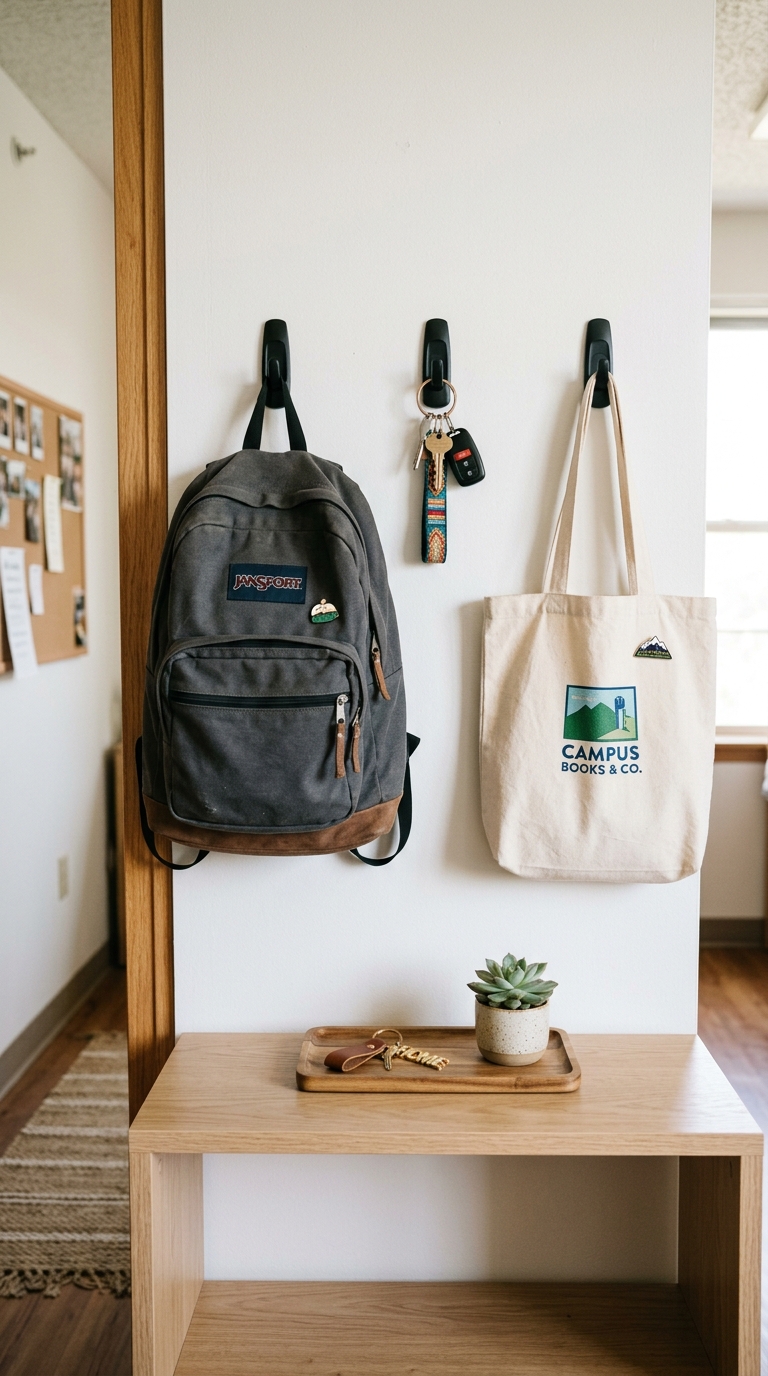
Set Up a Drop Zone Near the Door for Backpack, Keys, and Daily Essentials
The last storage idea on this list is also the one that has the biggest effect on how the room feels to live in day-to-day. A drop zone is a designated spot near the door where your daily carry items live — backpack, keys, student ID, sunglasses, and everything else that travels with you and comes back with you every single day. Without one, these items land wherever you happen to set them down, never in the same place twice, costing you a few stressed minutes every morning hunting for your keys and ID.
The setup is simple: a hook strip near the entrance, a small tray or bowl on the nearest flat surface, and a hook specifically for your backpack so it’s off the floor. Everything daily goes there when you walk in and leaves from there when you walk out — a five-minute setup that saves time and frustration every single day of the school year. For more ideas on making a small space feel intentional and personal beyond just storage, these pink maximalist bedroom ideas for kids are a surprising source of inspiration.
Styling Tip: Style the drop zone tray with one small decorative element — a tiny plant or a pretty dish — so it reads as an intentional decor moment rather than just a catch-all spot.
Best Color Palette: Matte Black Hooks + White Wall + Natural Wood Tray
Best For: All dorm rooms — this is a non-negotiable setup for any small shared space.
Conclusion
A small dorm room doesn’t have to feel cramped, chaotic, or like a temporary situation you’re just tolerating. With the right storage system — one built around your actual habits, your specific stuff, and your real dorm room layout — it can feel genuinely comfortable, like a space you actually want to be in. You don’t need all 21 of these ideas; start with the three that solve your biggest problems: bed risers and under-bed storage if your floor is buried, an over-door organizer if your surfaces are cluttered, or drawer dividers and velvet hangers if your closet and dresser have already given up on you.
Then build from there throughout the semester. Add a rolling cart when you realize you need more flexible storage, set up the drop zone when the morning key hunt becomes unbearable, and build out desk organization when midterms make a clear workspace feel urgent. The best dorm room storage system isn’t the one that’s perfect on move-in day — it’s the one that actually works for how you live.