

What if the crack in your favorite mug is not bad, but actually beautiful? And what if your old wooden chair is special because it has memories? This is what wabi-sabi living room ideas are all about — seeing beauty in simple and imperfect things.
Wabi-sabi is a Japanese style. It teaches us to like simple, natural, and not perfect things. In a living room, this means using soft colors, natural wood, simple furniture, and cozy items. You don’t need expensive or perfect decor. You just need a space that feels calm and real.
If you want a home that feels peaceful, simple, and cozy, these wabi-sabi living room ideas will help you create a space you truly love.
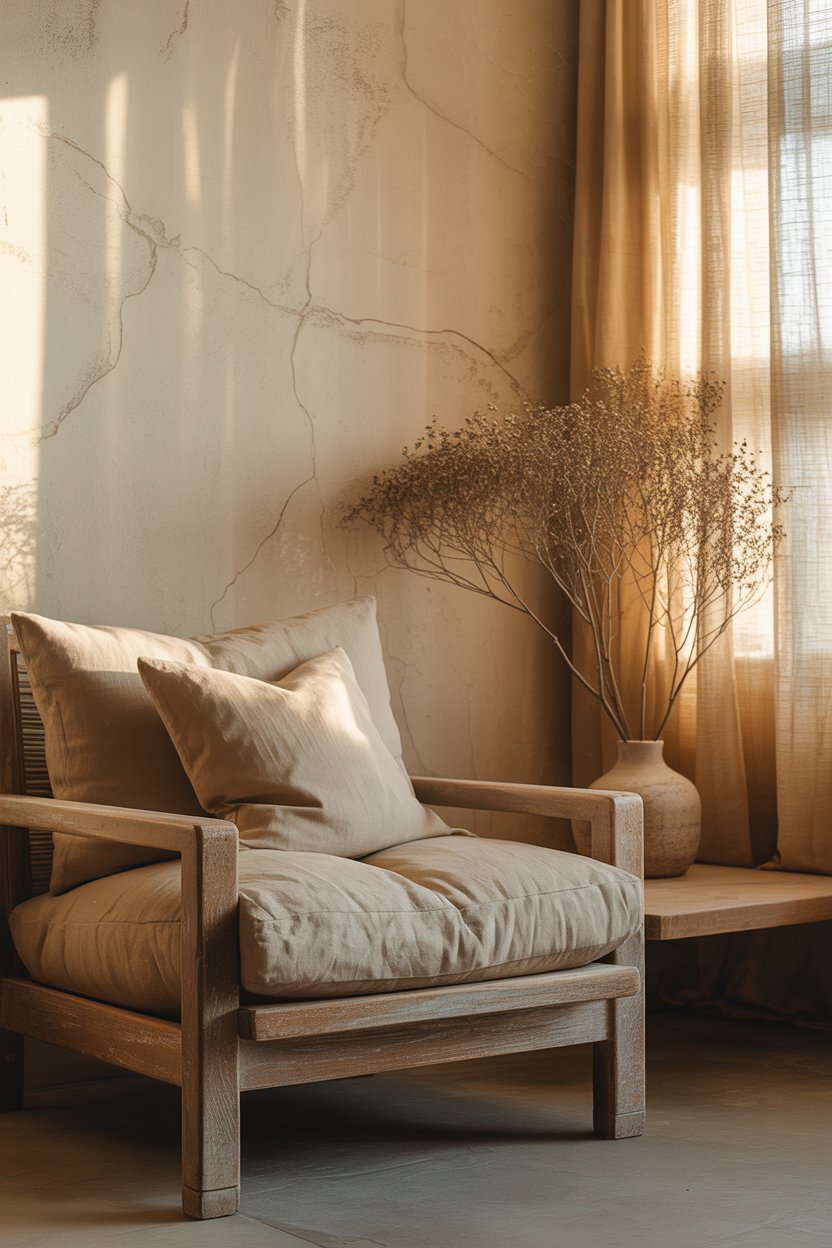
The Wabi Sabi Color Palette: Earthy, Muted & Quietly Beautiful
The first thing to understand about wabi sabi color is what it’s not — it’s not trendy, it’s not bold, and it’s definitely not trying to impress anyone. The palette is built around colors you’d find in nature on a quiet morning: warm oatmeal, ash white, soft clay, muted olive, rusted iron, and the kind of grey that feels warm rather than cold. These colors don’t shout. They settle.
If you love calm, nature-inspired interiors, these 16 stunning earthy boho living room ideas for a warm, inviting home will give you plenty of inspiration to create a cozy and welcoming vibe.
Undertones matter more than most people realize here. Every color in a wabi sabi living room should lean warm — even the whites and greys. A cool, stark white feels sterile and sharp, which is the opposite of what you’re going for. Think of it this way: if the color would look at home on a clay pot or a piece of driftwood, it probably belongs in this palette.
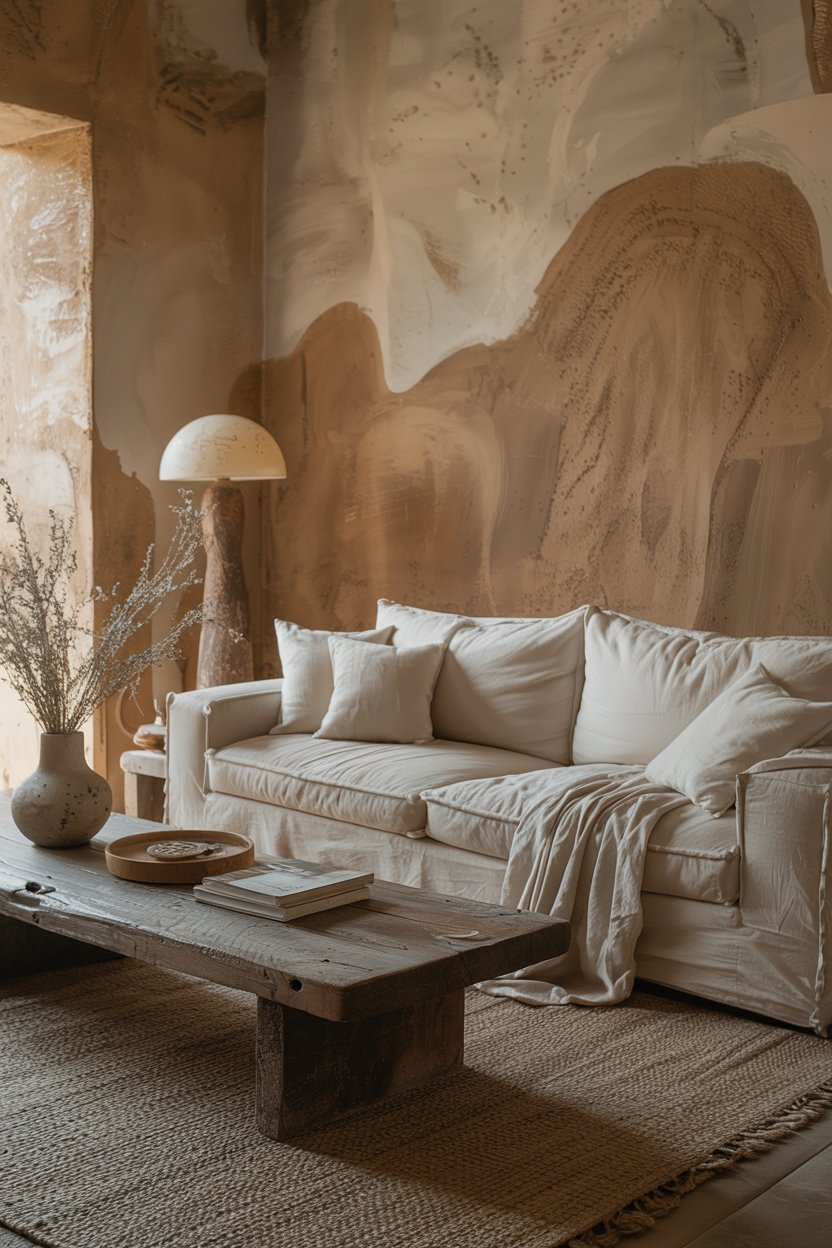
Limewash, Raw Plaster & Textured Walls
Smooth, perfect walls are honestly the enemy of this aesthetic. And I say that having once spent a weekend getting my walls absolutely flawless before realizing the result felt more like a hotel lobby than a home. Wabi sabi walls are supposed to have character — visible brush marks, tonal variation, a slight unevenness that catches the light differently at different times of day.
Limewash paint is the easiest way to get there. It goes on in layers and creates this beautiful, naturally varied effect that looks like the wall has been there for a hundred years. Raw plaster is even more authentic — that slightly rough, matte, organic surface is genuinely stunning against natural wood and linen. For apartments where you can’t touch the walls, textured wallpaper in a plaster or concrete finish can work surprisingly well.
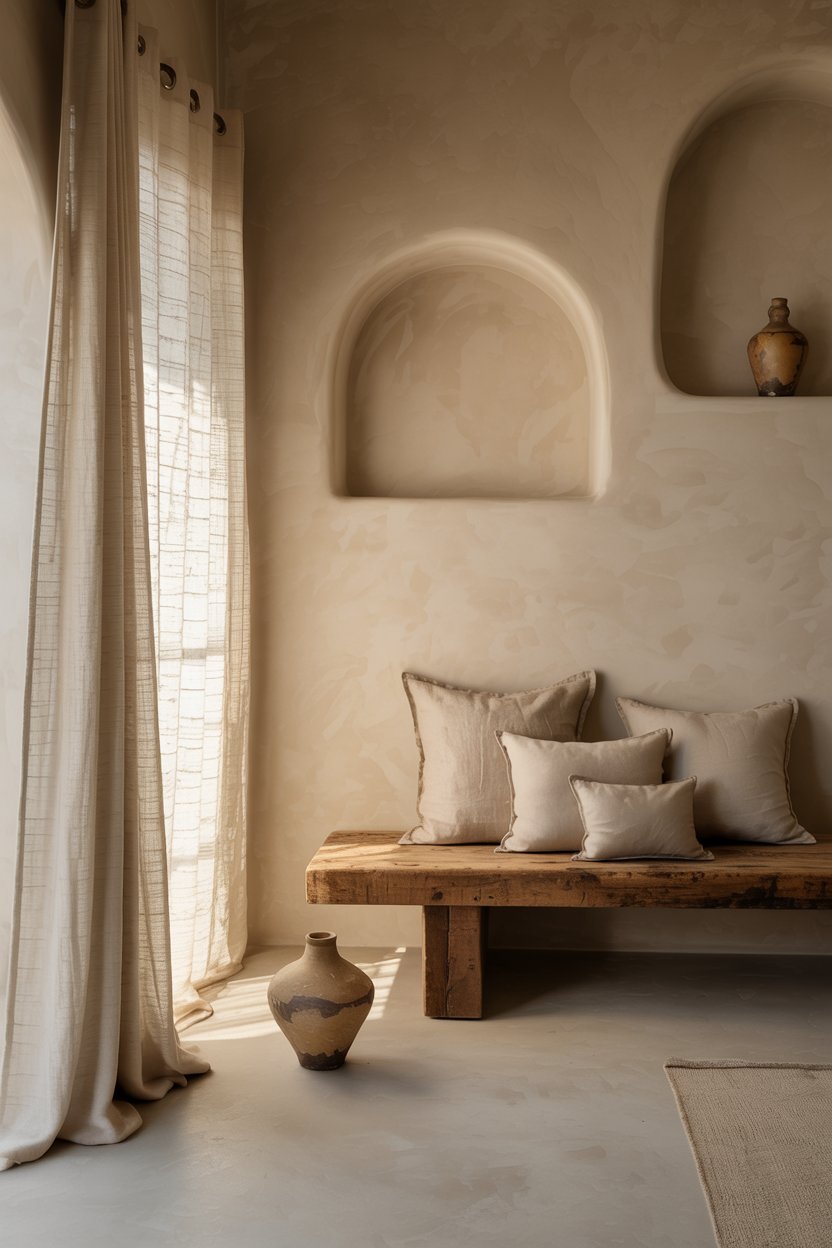
Natural Light as a Design Element in the Wabi Sabi Living Room
In most design styles, lighting is something you add. In wabi sabi, it’s something you work with. Natural light is treated almost like a living element — the way it moves across a raw plaster wall throughout the day, the shadows it casts through sheer linen curtains, the warmth it gives to wooden surfaces in the late afternoon. That shifting quality is something no artificial light can replicate.
The goal is to let light behave naturally rather than controlling it too tightly. Sheer linen or cotton curtains filter light into something soft and warm without blocking it. If privacy isn’t an issue, bare windows work beautifully in this aesthetic — the raw, unadorned look is very much in keeping with the philosophy. Position your main seating area where the best natural light falls, and let the room organize itself around that.
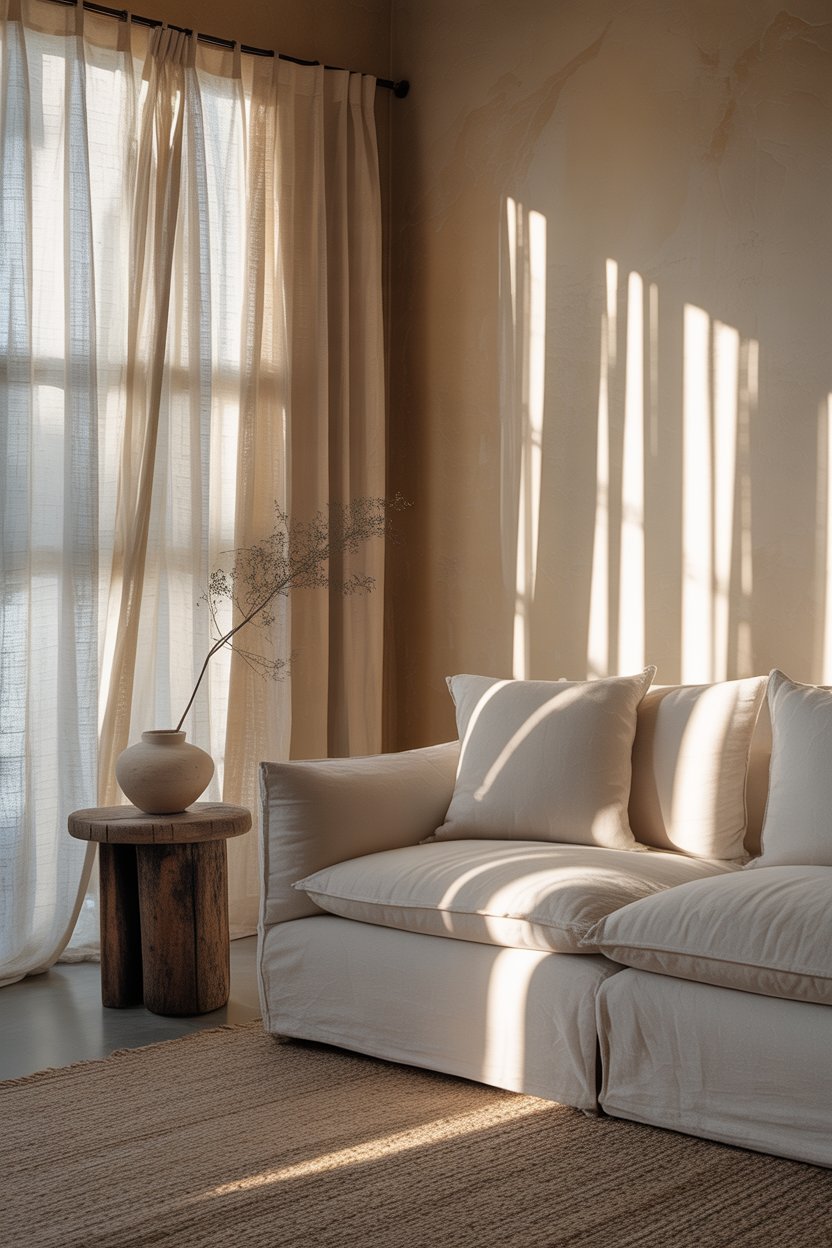
Negative Space: Why Wabi Sabi Rooms Feel So Calm
There’s a Japanese concept called “ma” — it means meaningful empty space. Not emptiness as a lack, but emptiness as something intentional and valuable. It’s the pause between notes in music, the breath between sentences. In a wabi sabi living room, ma is what makes every object feel significant rather than lost in a crowd of stuff.
Creating negative space usually means removing things, not adding them. Go through your living room and ask honestly: Does this object earn its place? Is it beautiful, meaningful, or functional in a way that matters? If not, it’s visual noise. The first time I edited a room down this aggressively, I was surprised by how much more I noticed and appreciated what remained. One beautiful handmade ceramic bowl on a shelf becomes art. Surrounded by fifteen other objects, it disappears.
Reclaimed Wood Furniture: Where Age and Imperfection Become the Point
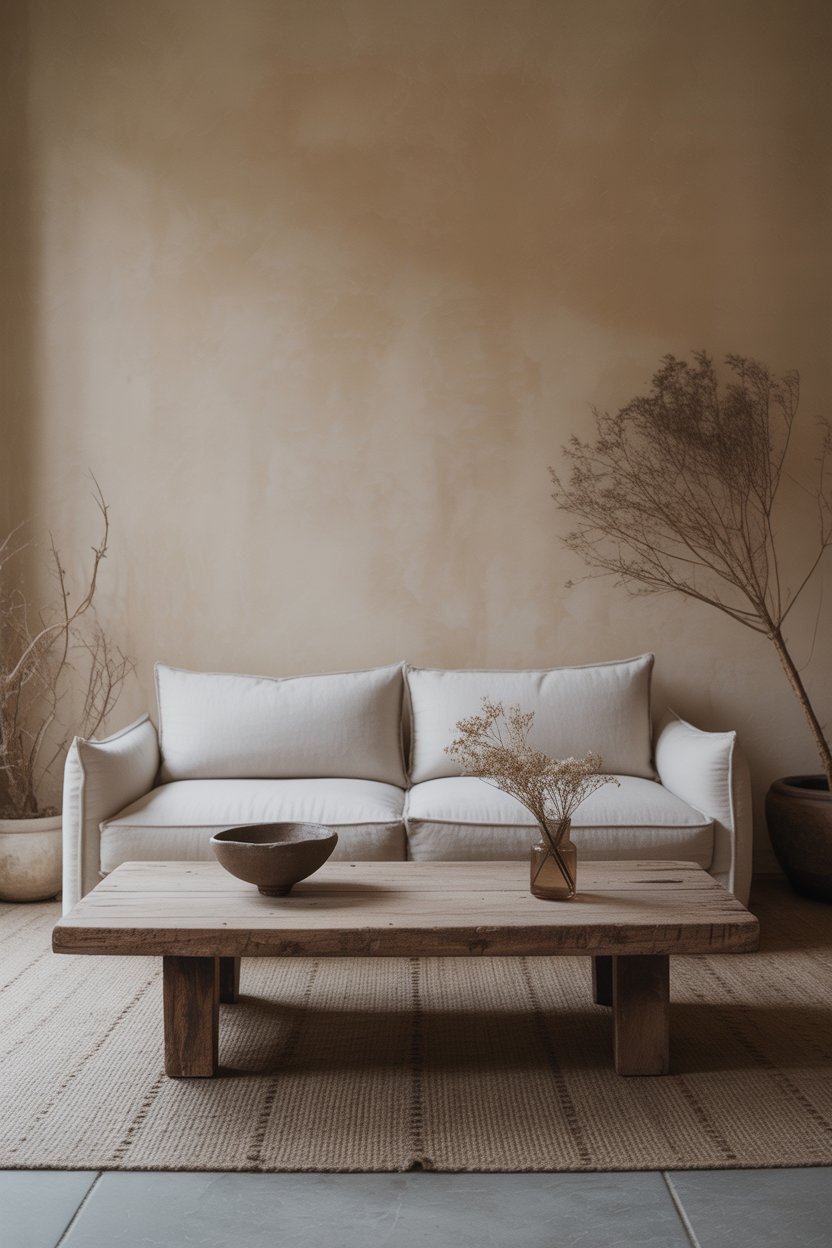
Reclaimed wood is probably the single most important material in a wabi sabi living room. And what makes it special is exactly what would make most furniture stores apologize — the knots, the cracks, the uneven grain, the color variations from years of use and weather. These aren’t flaws. They’re the entire point. A piece of reclaimed wood carries a history, and that history is visible.
For living rooms, the best reclaimed wood pieces are coffee tables, low benches, side tables, and open shelving. A live-edge coffee table — where one or both sides follow the natural edge of the original tree — is one of the most stunning wabi sabi furniture choices you can make. It’s completely one-of-a-kind, visually interesting, and deeply connected to the natural world in a way that a perfect, factory-finished table simply isn’t.
Raw Stone, Concrete & Terracotta: Grounding the Wabi Sabi Living Room
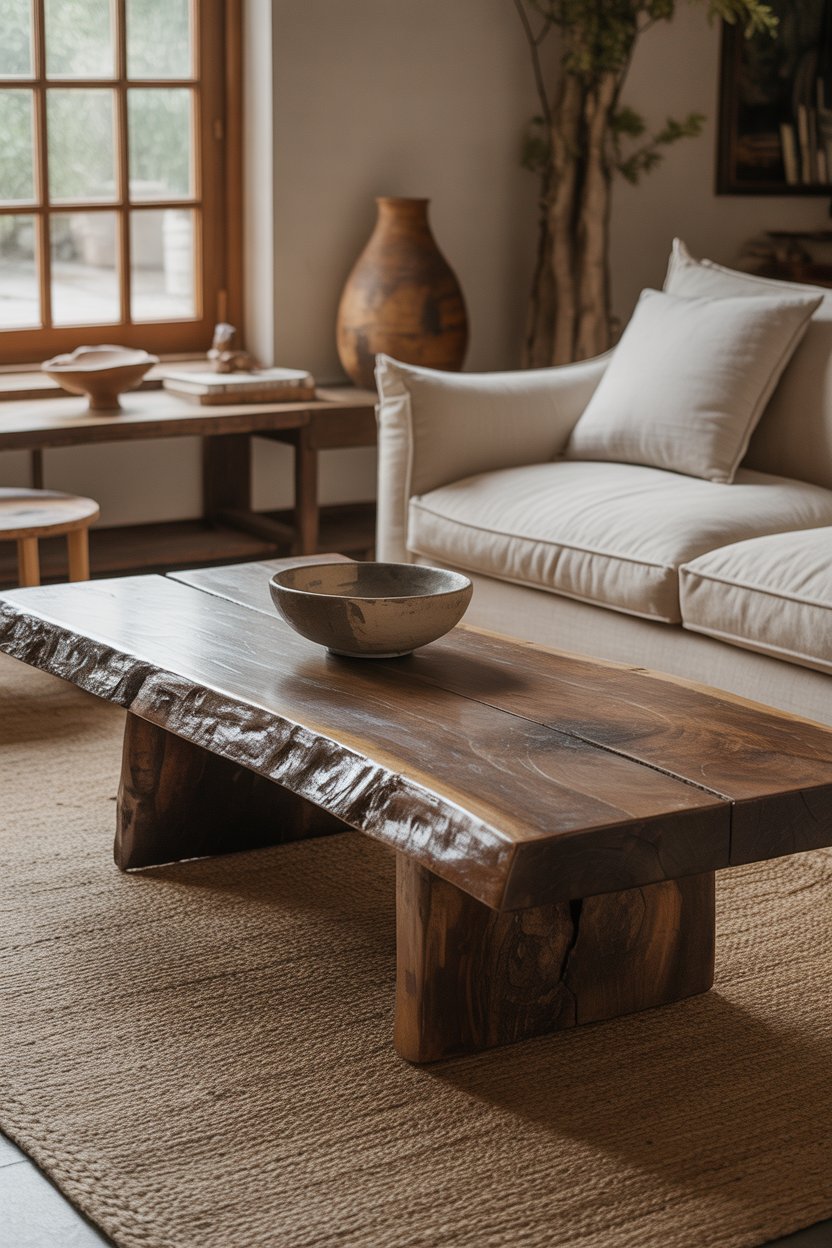
There’s something about raw stone that immediately makes a room feel ancient and calm. It’s heavy, honest, and completely indifferent to trends — which is exactly the wabi sabi spirit. In a living room, stone works beautifully as a fireplace surround, a coffee table base, or even as small decorative objects — smooth river stones grouped simply on a shelf or windowsill.
Terracotta brings warmth that stone can’t quite match. Terracotta floor tiles have that handmade, slightly uneven quality that’s genuinely beautiful, and they develop a richer patina over time with use. Concrete coffee tables and side tables work well in more contemporary wabi sabi spaces — that raw, industrial heaviness balanced against soft linen and warm wood creates a beautiful tension. The key with all of these hard materials is balancing them with soft, organic textiles so the room doesn’t feel cold.
Handmade Ceramics as Wabi Sabi Decor: The Beauty of the Imperfect Object
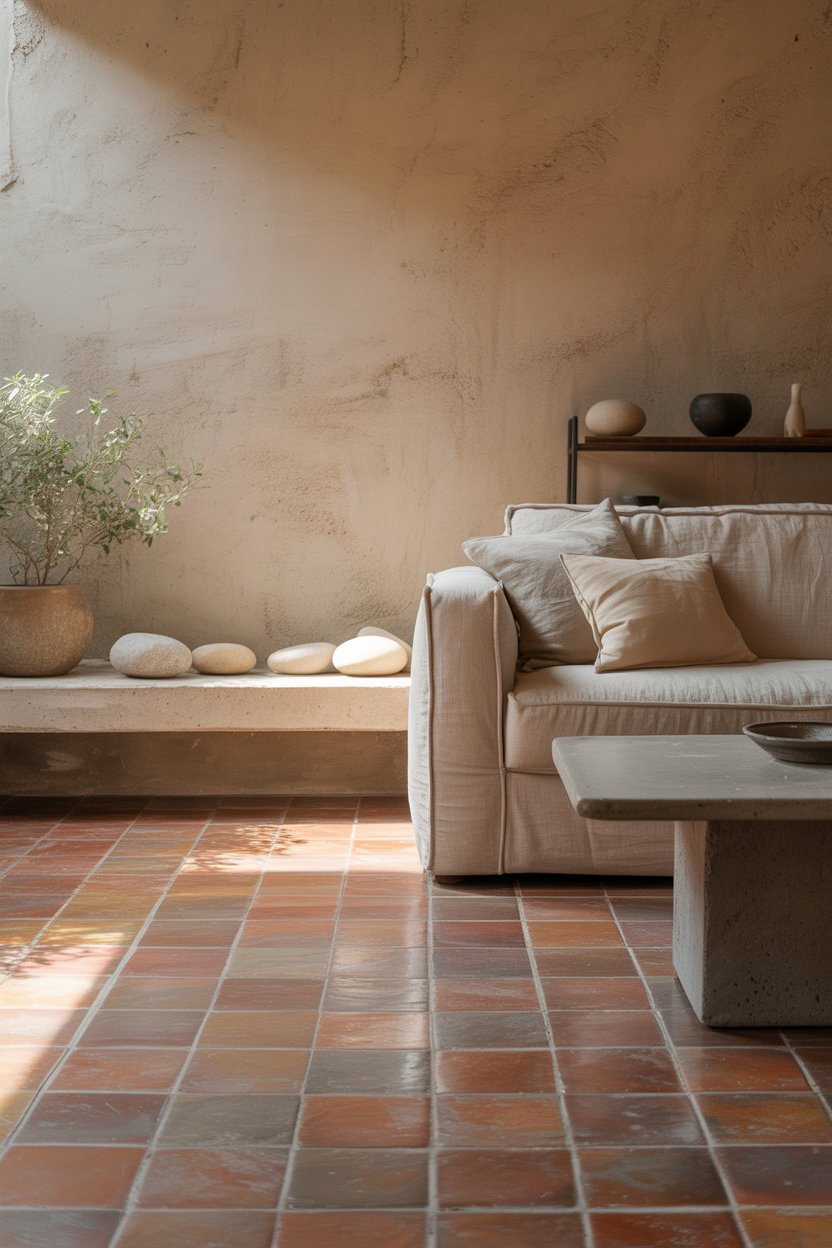
Ceramics are central to wabi sabi philosophy in a way that goes beyond decoration. The Japanese tea ceremony — where wabi sabi first took shape as an aesthetic — valued imperfect, handmade vessels above perfectly crafted ones. A bowl with a slightly uneven rim, a vase with visible throwing marks, a mug with a crackle glaze — these things are more beautiful because of their imperfections, not despite them.
For your living room, look for handmade ceramics with matte finishes, organic shapes, and earthy tones — cream, sand, ash, warm grey, soft terracotta. A single beautiful ceramic piece on an otherwise empty shelf can anchor an entire corner of the room. And if you know about kintsugi — the Japanese art of repairing broken ceramics with gold — that’s the ultimate expression of wabi sabi beauty. The repair doesn’t hide the damage; it celebrates it.
Woven Textures: Jute Rugs, Rattan Furniture & Linen Throws
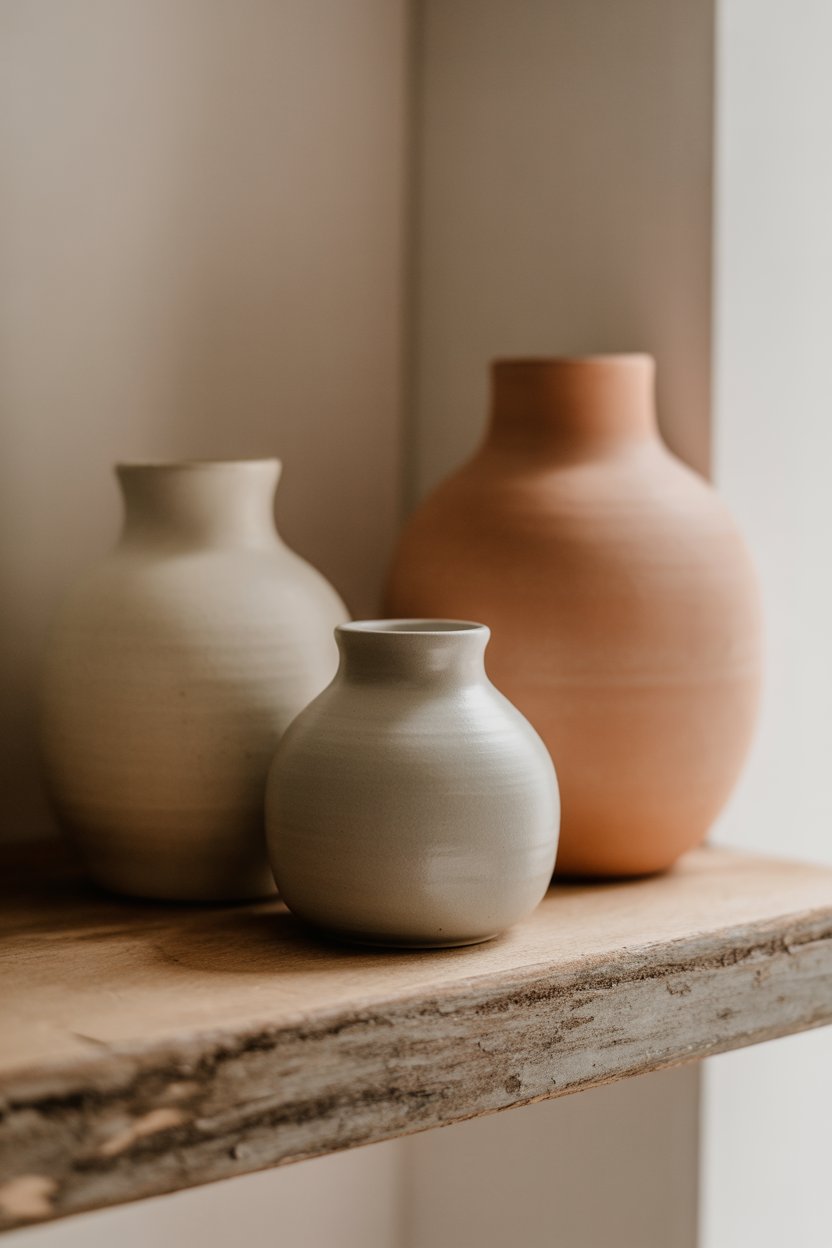
Woven textures are what give a wabi sabi living room its tactile depth — the quality of a space that makes you want to reach out and touch things. A jute rug underfoot, a rattan chair in the corner, a linen throw casually draped over a sofa arm. These aren’t just decorative choices; they’re sensory ones. The room should feel as good as it looks.
Jute and sisal rugs are probably the most important woven elements. They’re natural, slightly rough, beautifully imperfect in their weave, and they ground the whole room with organic warmth. Rattan and bamboo furniture bring organic shapes that are impossible to replicate in manufactured materials — no two rattan pieces look the same, which is precisely the point. Linen throws work best when they’re slightly wrinkled and casually arranged, not folded perfectly over the armrest like a hotel display.
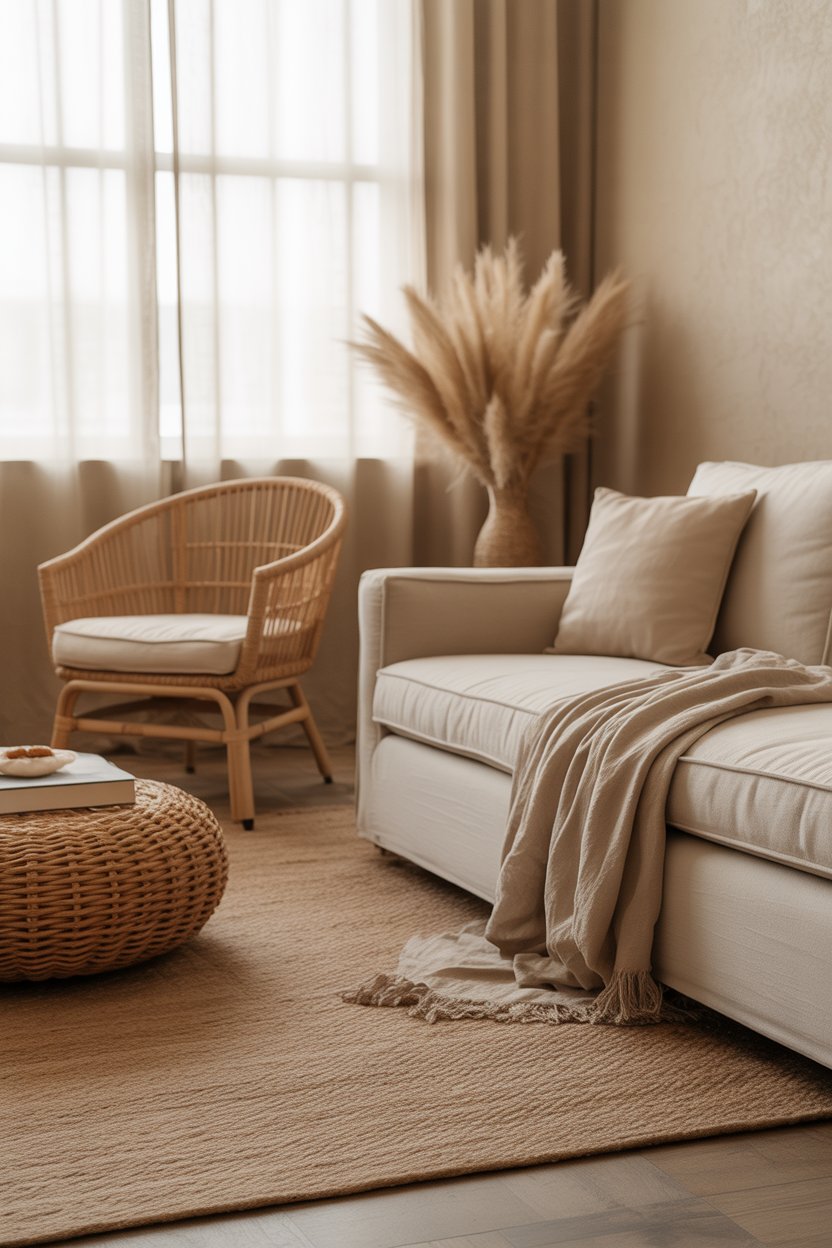
The Wabi Sabi Sofa: Linen Slipcovers, Low Profiles & Lived-In Comfort
The sofa is the heart of any living room, and in a wabi sabi space, it has one job: to look genuinely comfortable and completely unpretentious. Natural linen slipcovers are the ideal choice — and here’s the thing that surprises most people: the wrinkles are a feature. A slightly crumpled linen sofa looks lived-in and real in a way that a tightly upholstered, perfect sofa never can. It looks like someone actually sits on it, reads on it, and falls asleep on it.
Low-profile sofas carry a Japanese influence that works beautifully here — closer to the ground, more relaxed in posture, and more connected to the other low elements in the room, like floor cushions and low coffee tables. Colors should be natural and undyed where possible: warm oatmeal, soft clay, natural cotton white.
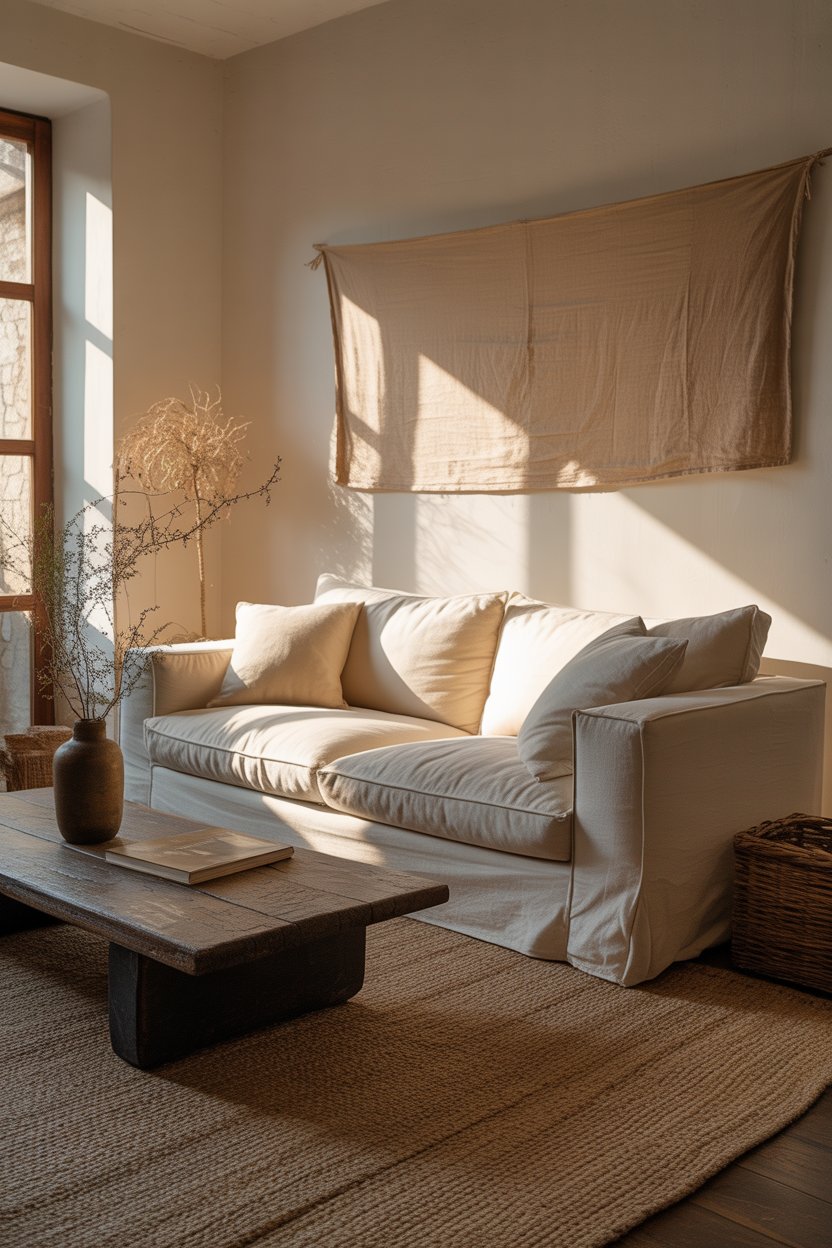
Low Coffee Tables, Floor Cushions & the Art of Slow Living Furniture
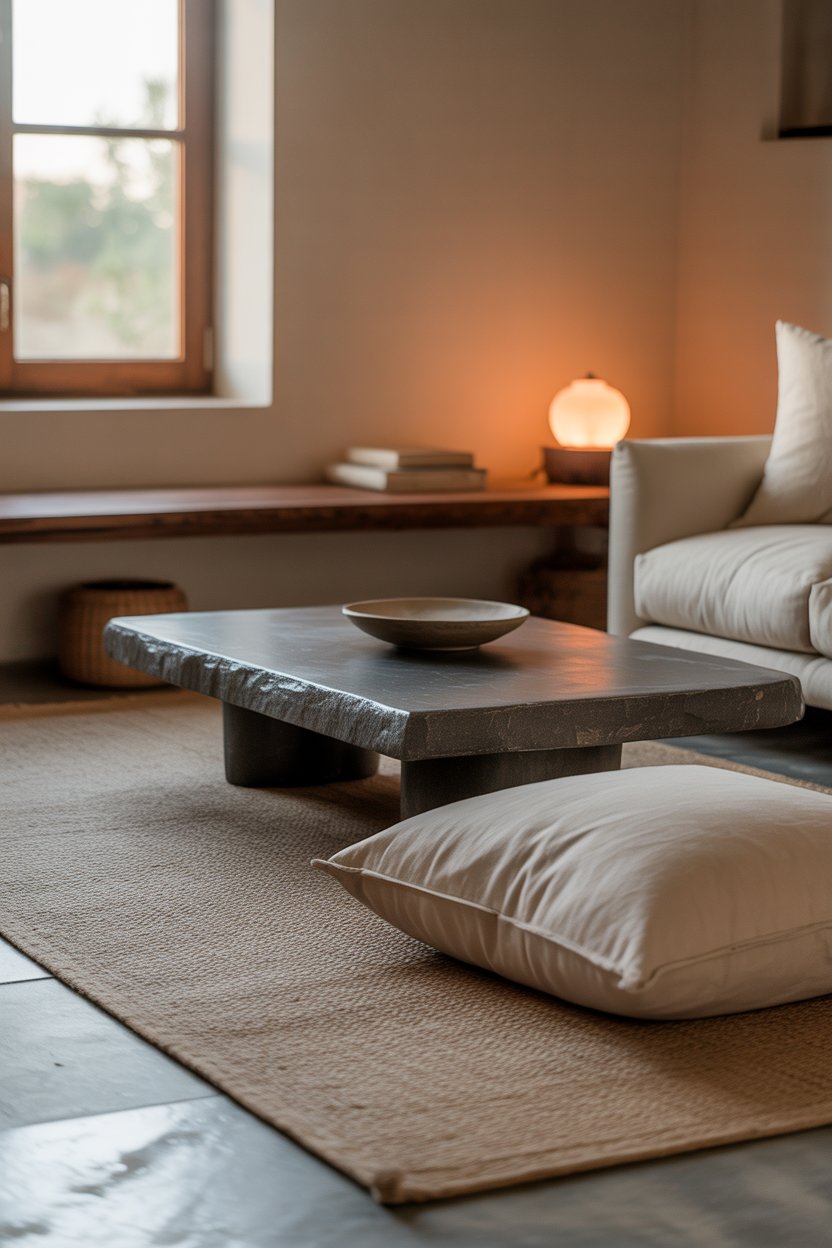
There’s something that happens to a room’s energy when the furniture sits lower. It becomes more relaxed, more casual, more inviting of the kind of slow, unhurried time that wabi sabi is philosophically about. A low coffee table brings the eye down toward the natural materials on the floor — the rug, the grain of the wood, the smoothness of a stone. Floor cushions take that further, giving the room a flexibility that conventional furniture never offers.
The best coffee table materials for this aesthetic are live-edge wood, raw stone slab, and concrete — all of which have that honest, unfinished quality that wabi sabi celebrates. Style the surface simply: one handmade ceramic bowl, a small stack of books with interesting spines, a single candle. That’s enough. The emptiness around those objects is as important as the objects themselves.
Open Shelving With Soul: Displaying Objects the Wabi Sabi Way
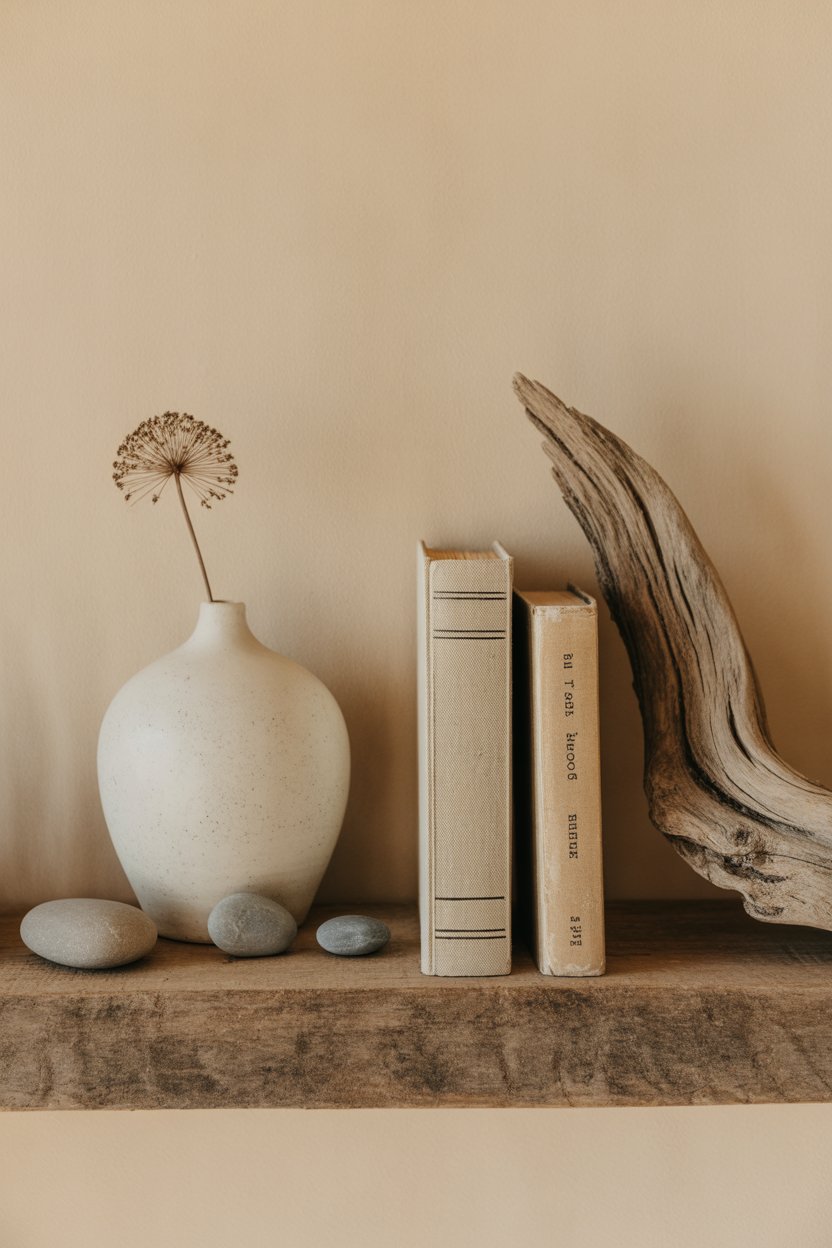
Most open shelving looks like either a storage problem or an Instagram performance. Wabi sabi shelving is neither — it’s a quiet, intentional collection of things that matter. And the difference comes down to one word: curation. Not how many things you display, but how thoughtfully each thing is chosen and placed.
What belongs on a wabi sabi shelf: handmade ceramics, smooth river stones collected from somewhere meaningful, dried botanical stems in a simple vase, a few books with beautiful or worn spines, a small piece of driftwood or sculptural natural material. What doesn’t belong: plastic of any kind, shiny or metallic decorative objects, mass-produced figurines, anything that looks like it came from a big box store. The arrangement should feel slightly asymmetrical — like it was placed naturally, not styled perfectly.
Paper Lanterns, Ceramic Lamps & Organic Pendant Lights
Harsh overhead lighting is probably the single fastest way to destroy the atmosphere of a wabi sabi living room. A bright ceiling fixture floods everything evenly, eliminating the shadows and warm pools of light that give this aesthetic its depth and soul. The goal is always soft, diffused, layered light from multiple sources at different heights — never one harsh source from above.
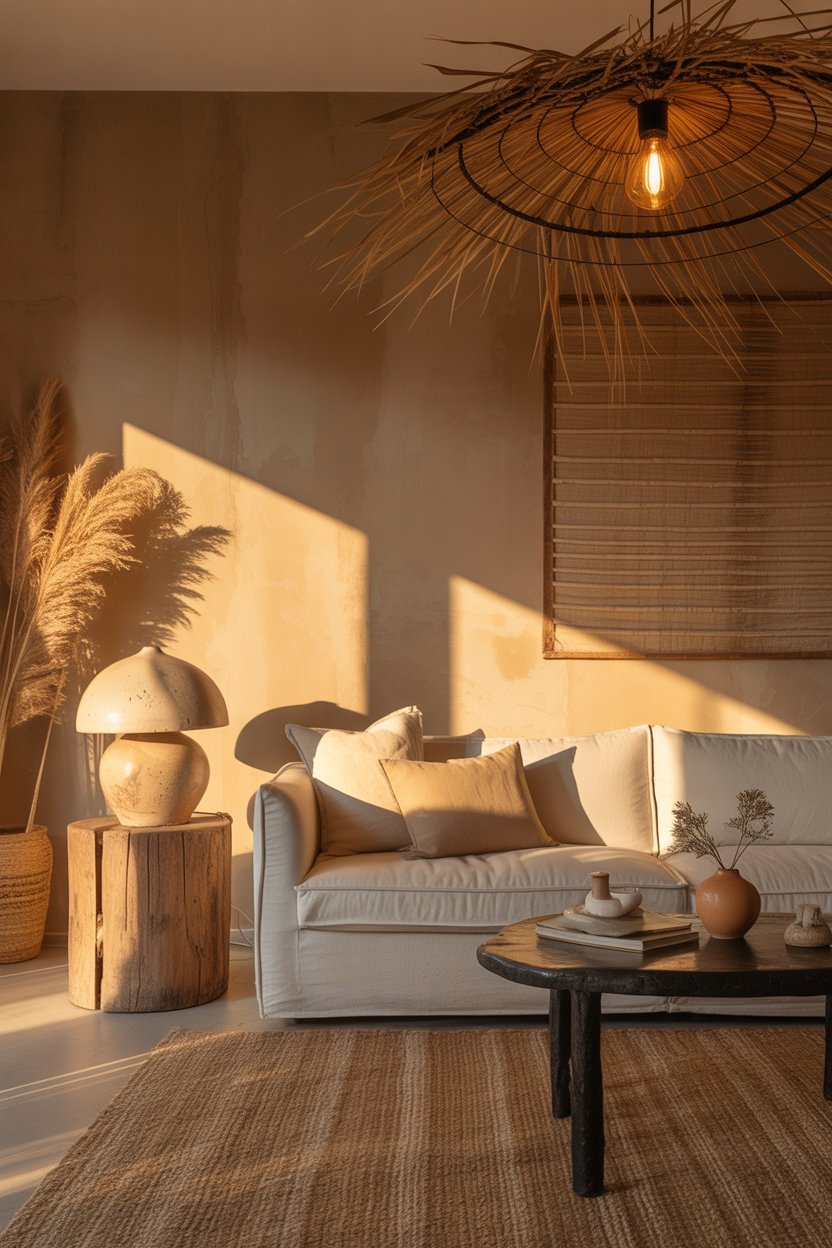
Paper lanterns are the most authentically Japanese choice — the light they produce is warm, slightly diffused, and incredibly gentle on any space. Handmade ceramic table lamps with matte finishes and organic, irregular shapes work beautifully on side tables and shelves. For overhead lighting, look for woven rattan pendant shades, sculptural clay pendants, or hand-blown glass in warm amber tones. The material of the shade matters as much as the light itself — it should be natural, tactile, and slightly imperfect.
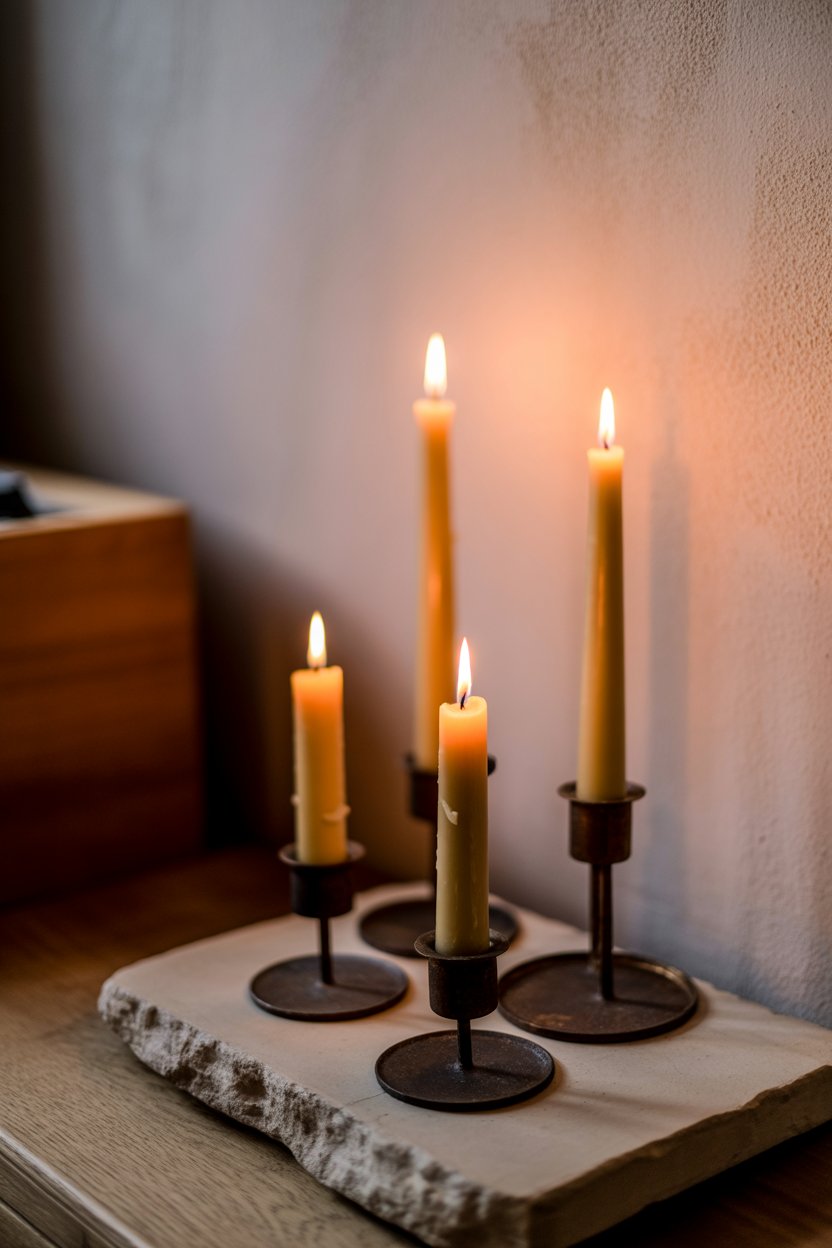
Candlelight and Ambient Warmth
There’s a reason the Japanese tea ceremony — the birthplace of wabi sabi philosophy — was always conducted by candlelight. Flame is alive. It moves, it flickers, it responds to the air in the room. And what it does to natural textures — the way it plays across raw plaster walls, catches the grain of reclaimed wood, makes a handmade ceramic glow — is something no electric light can replicate.
Beeswax candles in simple holders are the most natural choice — they burn cleanly and have a warm, subtle honey scent that adds another sensory layer to the room. Group them in odd numbers at varying heights for the most natural-looking arrangement. Simple iron or clay candlestick holders work better here than anything ornate or decorative. And honestly, even one candle burning on an otherwise empty coffee table can shift the entire mood of a room in seconds.
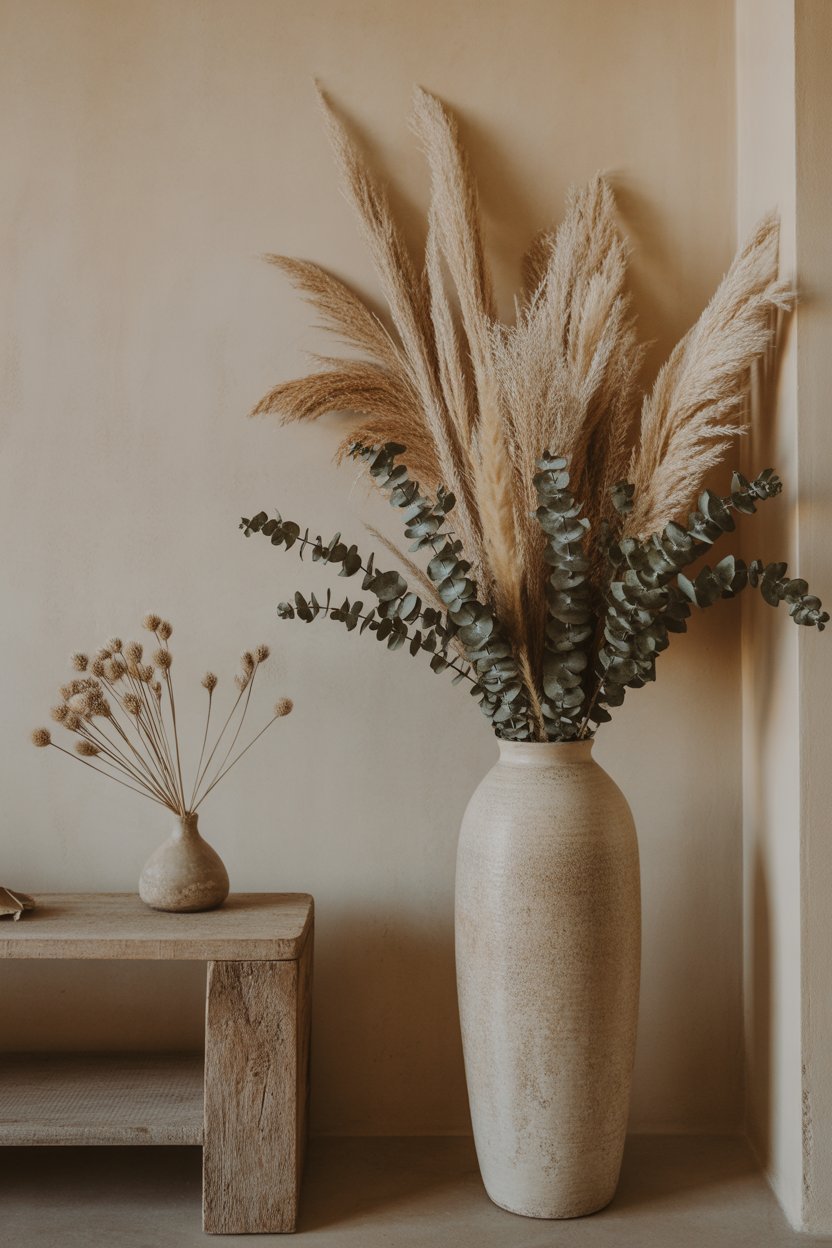
Dried Botanicals, Branches & Foraged Nature in the Wabi Sabi Living Room
Fresh flowers are beautiful, but they’re also trying very hard to be perfect — bright, upright, symmetrical. Dried botanicals have let go of all of that. A dried stem of pampas grass, a bundle of eucalyptus that’s slowly fading from green to silver, a branch of dried seed pods — these things have accepted their impermanence and are more beautiful for it. Which is, when you think about it, the most wabi sabi thing possible.
The best dried botanicals for this aesthetic are pampas grass (especially the softer, smaller varieties), dried eucalyptus, cotton stems, dried seed pods, and foraged branches or twigs in interesting shapes. Place them in simple handmade ceramic vases or just lean tall stems directly in a floor vase with no water and no fuss. Pressed leaves and botanical specimens in simple frames make genuinely beautiful wall art that costs almost nothing.
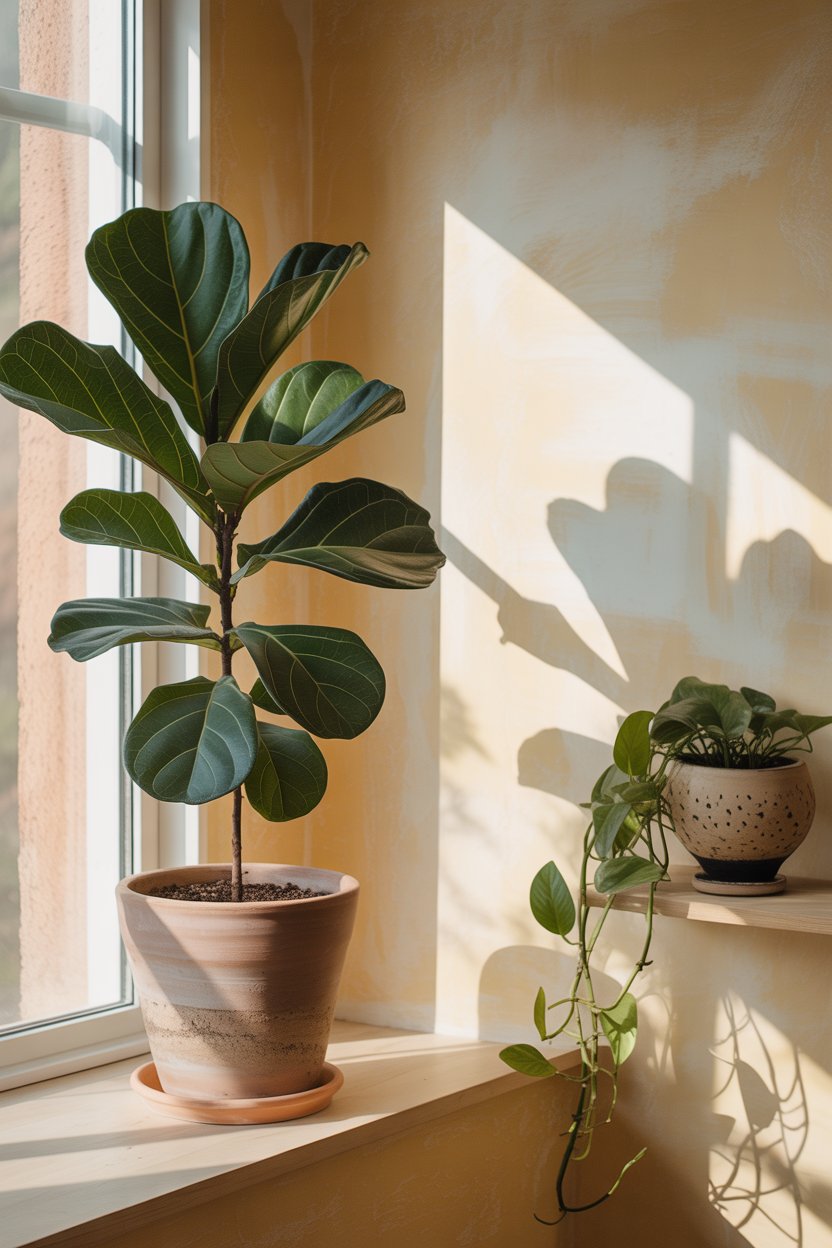
Living Plants in Wabi Sabi Spaces: Choosing the Right Greenery
The thing about plants in a wabi sabi room is that they shouldn’t look arranged. They should look like they live there — leaning slightly toward the light, growing a bit unevenly, doing whatever plants naturally do. An over-styled, perfectly symmetrical plant arrangement feels too controlled for this aesthetic. One beautiful fiddle leaf fig in the corner, doing its own thing, is perfect.
The plants that suit this aesthetic best are ones with organic, slightly irregular shapes: fiddle leaf figs, trailing pothos, monstera, snake plants, and — for the most authentic wabi sabi touch — a carefully tended bonsai. The container matters as much as the plant. Take anything out of its plastic nursery pot and put it in a handmade ceramic or raw terracotta vessel, and the whole thing immediately looks intentional. Natural terracotta develops a beautiful white mineral bloom over time as water evaporates — that patina is a wabi sabi feature, not something to clean off.
Wabi Sabi Living Room on a Budget
Here’s the most important thing about wabi sabi and money: this aesthetic is philosophically anti-consumerist. It doesn’t want you to go out and buy a new room. It wants you to slow down, look at what you already have, and start noticing the beauty that’s already there. The worn wooden table you’ve been meaning to replace? That wear is patina. That’s character. That’s wabi sabi.
Start by editing — remove the things that don’t serve you, the decorative pieces that don’t mean anything, the furniture that’s just filling space. Then look at what remains with fresh eyes. One secondhand handmade ceramic piece, one jute rug, and warm lightbulbs are genuinely all you need to significantly shift the feel of a room. Thrift stores are perfect for this aesthetic — worn wooden frames, imperfect ceramics, linen-colored textiles. You’re not looking for pristine. You’re looking for real.
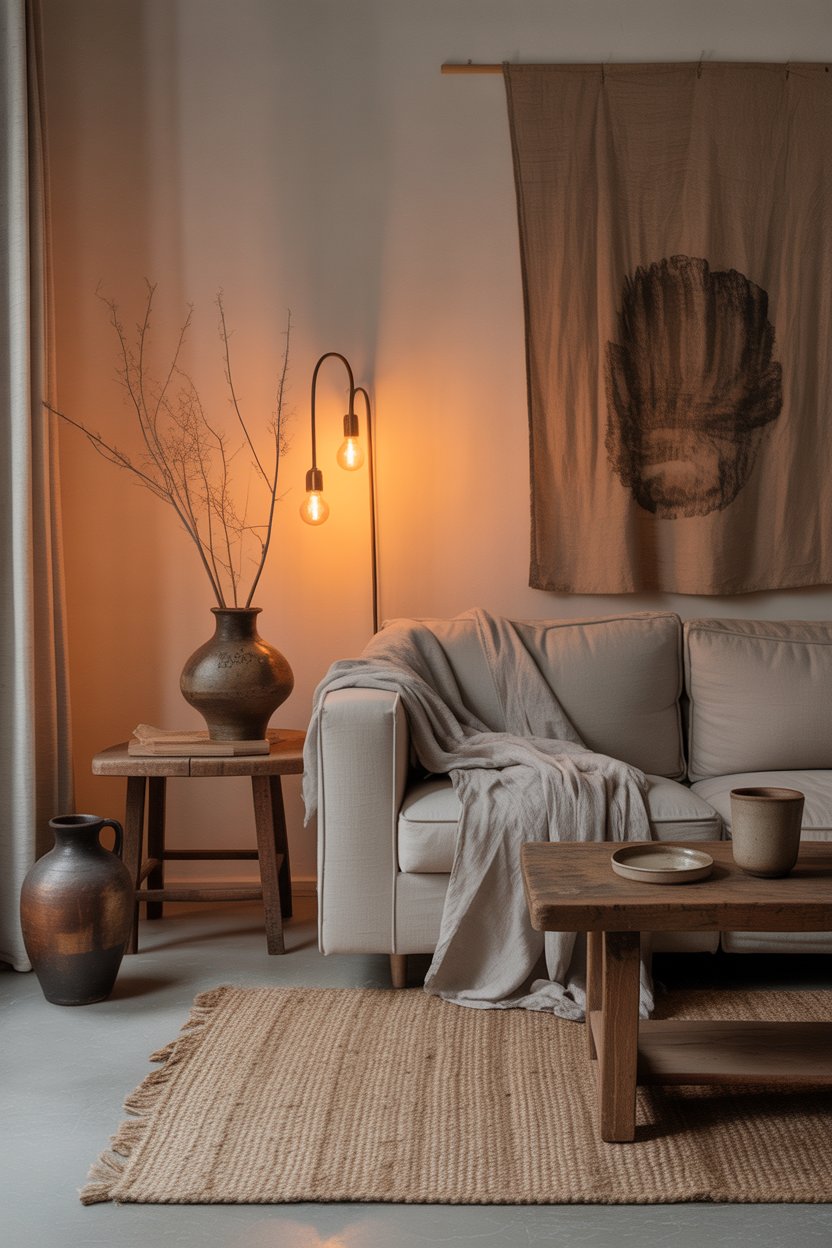
Small Wabi Sabi Living Room
Small rooms and wabi sabi philosophy are actually a natural match. The whole aesthetic is built around restraint — fewer things, more meaning, intentional simplicity. A small room forces exactly that. You can’t fill it with furniture and clutter, which means you’re already halfway to the wabi sabi spirit before you’ve changed a single thing.
In a compact living room, choose one beautiful statement piece — a reclaimed wood coffee table, a single velvet armchair, or an interesting floor vase — and build very quietly around it. Use vertical space with one simple open shelf rather than multiple pieces of competing furniture. A warm, earthy paint color actually works well in small wabi sabi spaces — it creates depth and warmth rather than making the room feel enclosed.
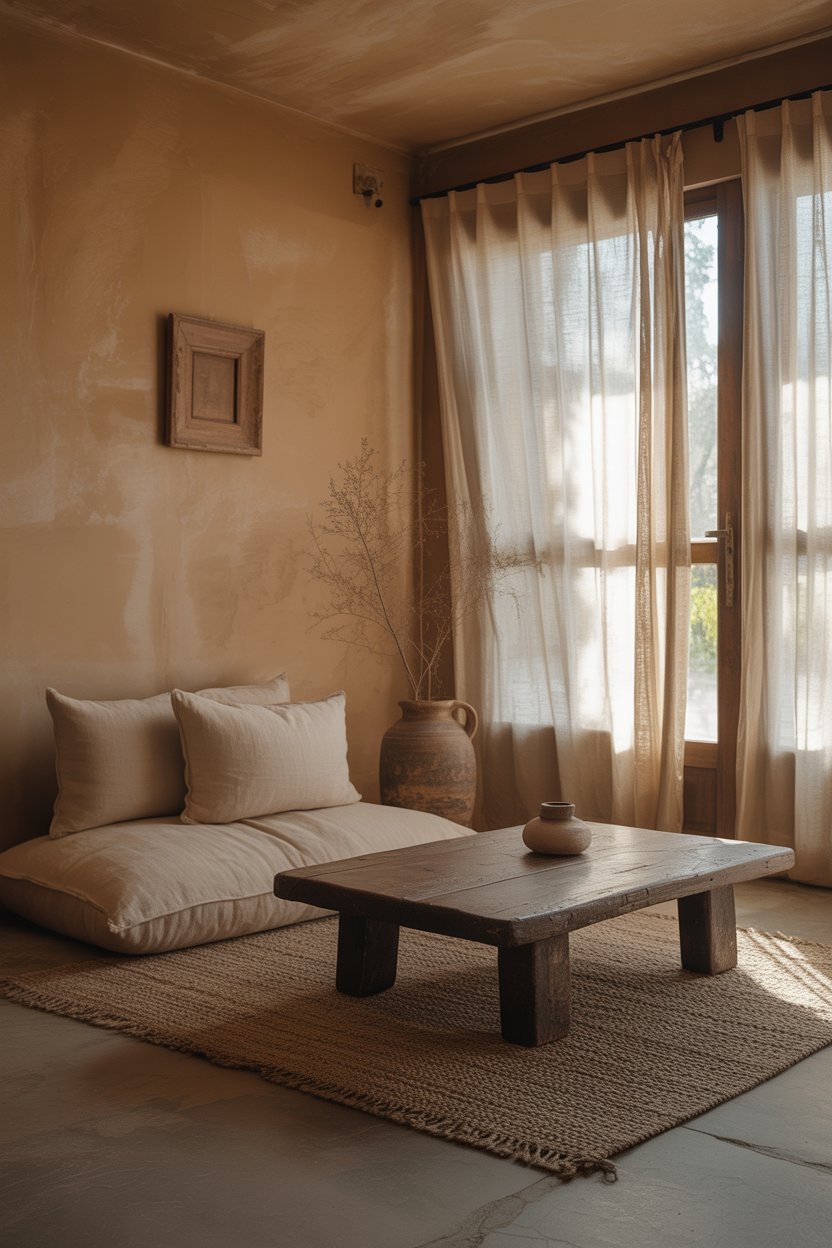
Modern Wabi Sabi Living Room: Blending Japanese Philosophy
Not everyone has exposed beams and stone floors to work with. Most of us live in new builds with flat white walls, neutral carpet, and modern fixtures — and that’s completely fine. Modern wabi sabi is a real direction, and in some ways, the contrast between clean contemporary architecture and honest natural materials is what makes it interesting.
In a modern home, lean into matte black as your dark anchor rather than dark wood. Clean-lined black furniture and black metal frames feel contemporary while still being in the spirit of the aesthetic. Then bring the wabi sabi soul through materials: one raw wood piece, handmade ceramics, a jute rug, linen textiles, and warm layered lighting. The contrast between the clean architecture and the imperfect natural materials is the design story, and it’s a compelling one.
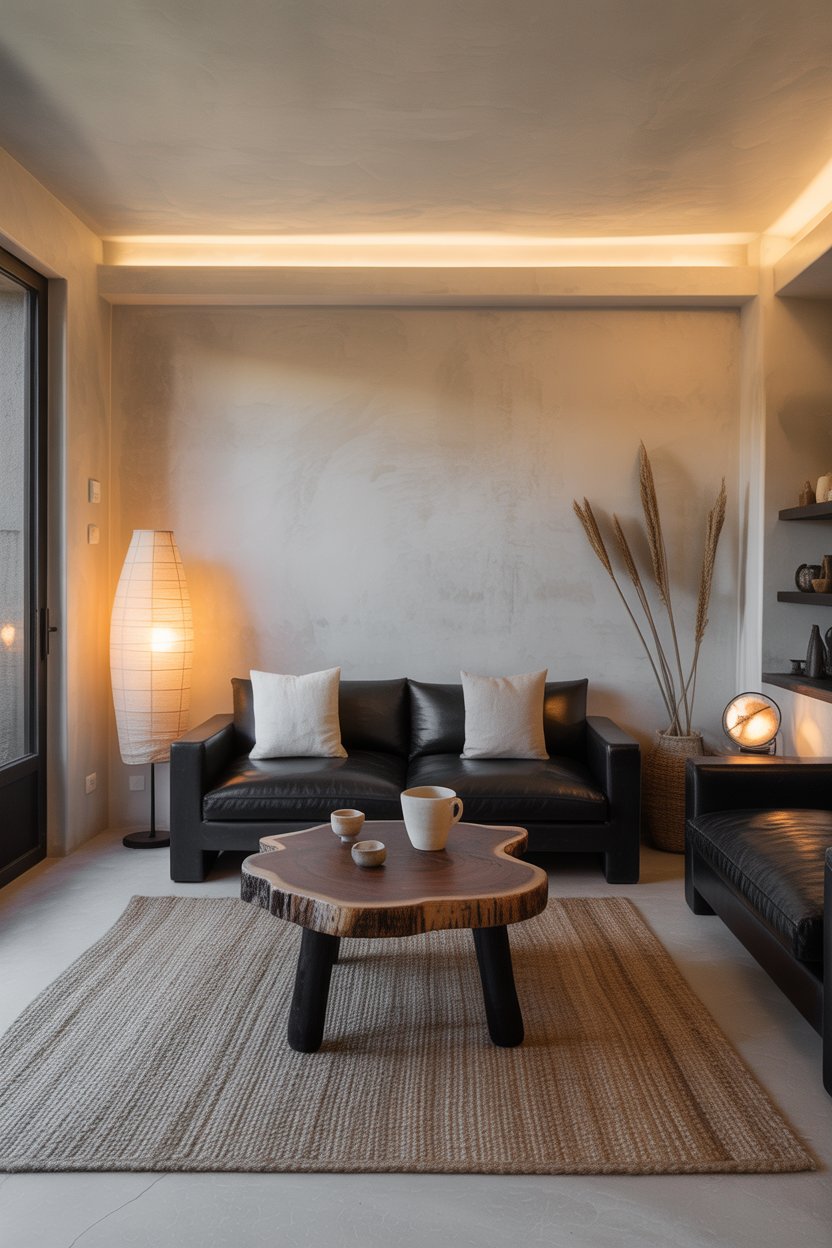
Wabi Sabi Meets Japandi: The Most Calming Living Room Style Combination
If you’ve been seeing “Japandi” everywhere lately, there’s a good reason — it’s the natural intersection of Japanese wabi sabi philosophy and Scandinavian functional simplicity. Both aesthetics value natural materials, muted palettes, and the idea that a home should feel calm rather than impressive. Together, they create something that’s arguably even more beautiful and liveable than either alone.
The overlap between the two styles is where the magic happens: reclaimed and natural wood, linen and wool textiles, handmade ceramics, neutral earthy tones, clean functional furniture, and an almost obsessive commitment to removing anything unnecessary. Where wabi sabi adds imperfection and philosophy, Japandi adds structure and function. The result is a living room that’s minimal but never cold, simple but never bare.
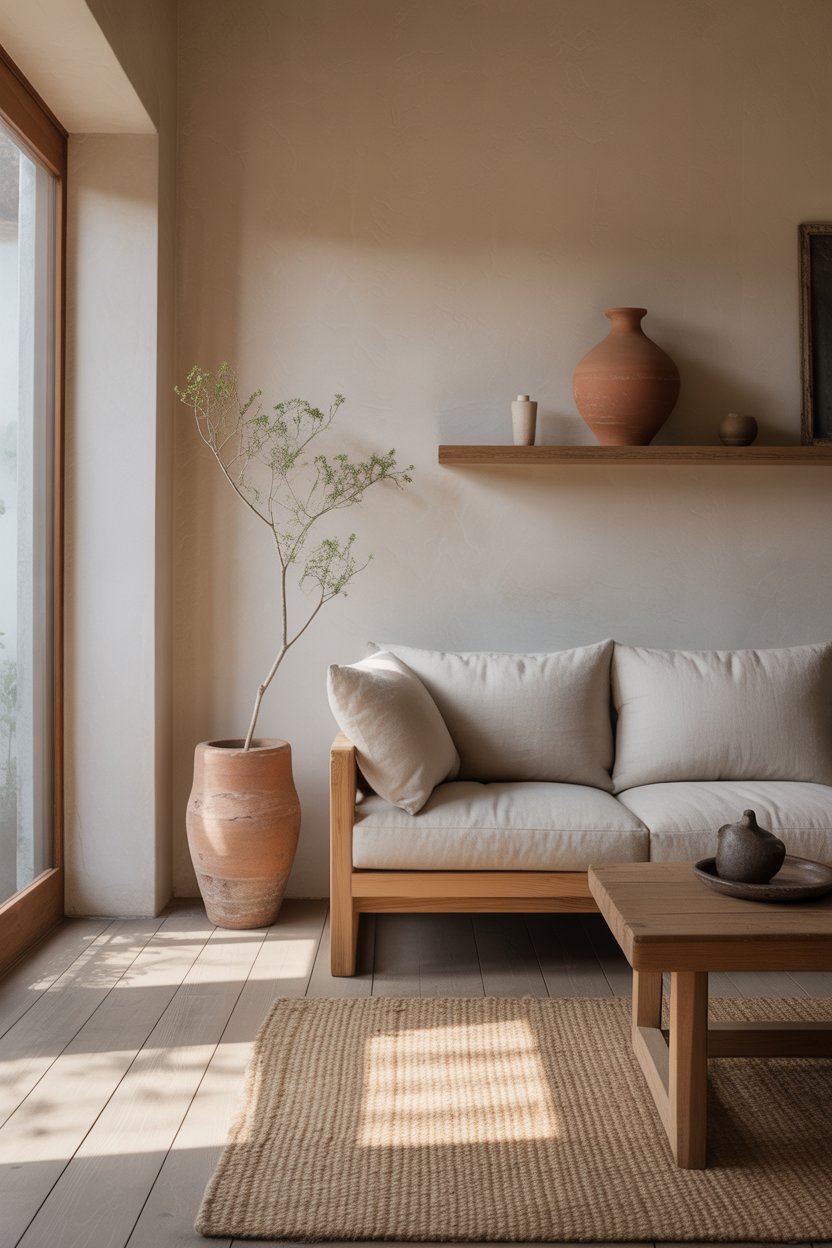
The Wabi Sabi Fireplace Corner
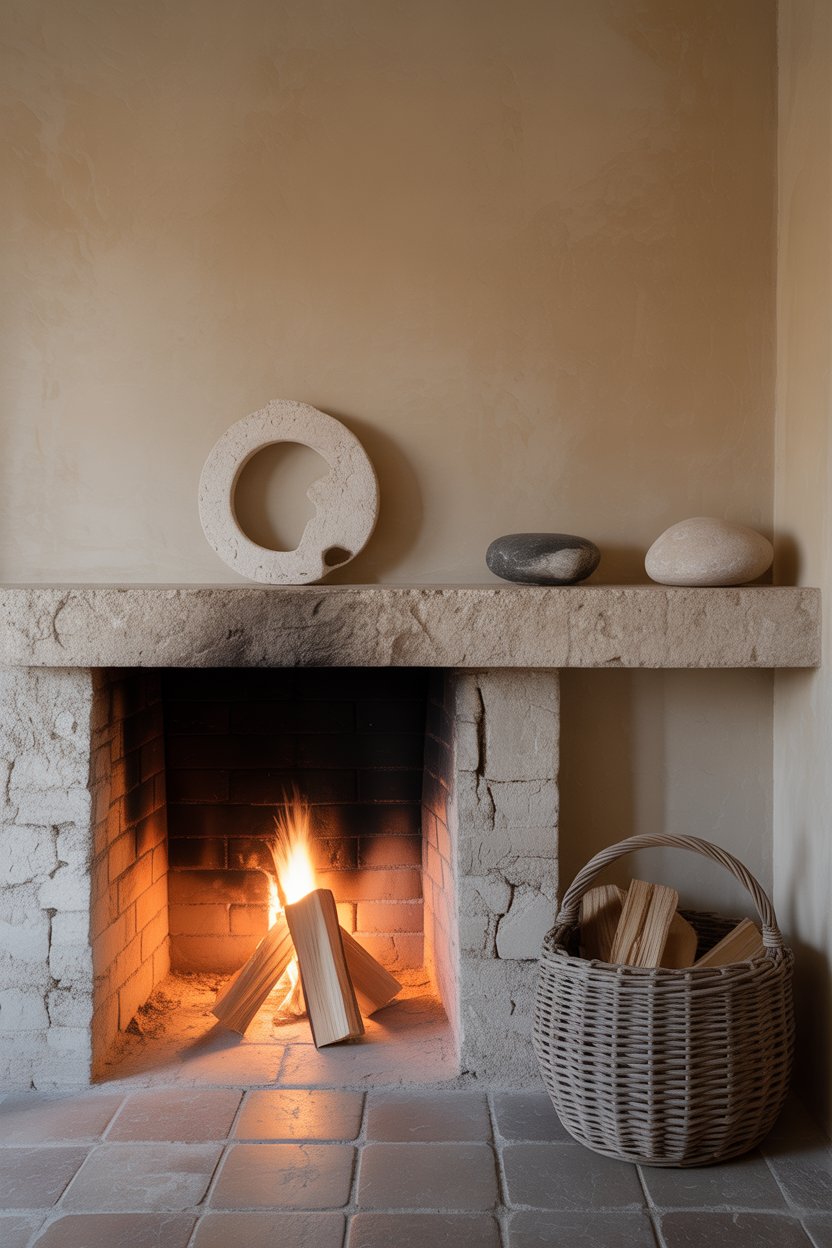
The fireplace is the most naturally wabi sabi element a living room can have. Flame is impermanent, unpredictable, and alive — three things that are at the very heart of this philosophy. And surrounding that fireplace with raw, honest materials makes the whole corner feel like the soul of the room.
A raw stone surround is the most authentic choice — irregular stone, visible mortar, completely unpolished and beautiful for it. A limewash plaster fireplace wall creates a softer version of the same idea. On the mantle, keep it extremely simple: one handmade ceramic piece, a small smooth stone, a single candle. That’s genuinely enough. The hearth area can hold a woven basket for firewood, a simple iron tool set, and maybe one trailing plant — nothing more.
Conclusion
Wabi sabi isn’t about making your living room look perfect. It’s actually about the opposite — letting go of perfection and finding something much better instead. Something real, warm, and genuinely yours.
The ideas in this guide aren’t rules. They’re invitations. You don’t need to follow all 20 of them. Pick two or three that feel right for your space and your life. Start small. Remove one thing that doesn’t belong. Add one handmade ceramic. Switch your lightbulbs to warm amber. You’ll be surprised how much those small shifts change the feeling of a room.
Want your space to feel like an old library? Explore these 20 dark academia living room ideas that feel like a scene from a gothic novel and bring timeless elegance into your home.
The best part about a wabi sabi living room is that it only gets better with time. That scratch on the wooden coffee table? Patina. The linen sofa that’s softened from use? Character. Are the dried botanicals slowly fading on the shelf? Beautiful impermanence. This is a space that grows richer the more you live in it — and that’s a rare and wonderful thing in a world obsessed with keeping everything new.