
There’s something quietly magical about a corner of your home that feels truly intentional. Where the light comes in soft, the textures are real, and nothing feels rushed. If your mornings feel chaotic and your kitchen feels cluttered, this post is for you.
Japandi design — the beautiful blend of Japanese wabi-sabi philosophy and Scandinavian hygge warmth — is the answer so many of us have been looking for. It’s calm without being cold. Minimal without feeling empty. And honestly? It makes your whole day feel better.
Below you’ll find 18 carefully curated Japandi breakfast nook ideas — from small-space hacks to full built-in transformations. Whether you’re starting from scratch or just want to refresh what you already have, there’s something here for every home.
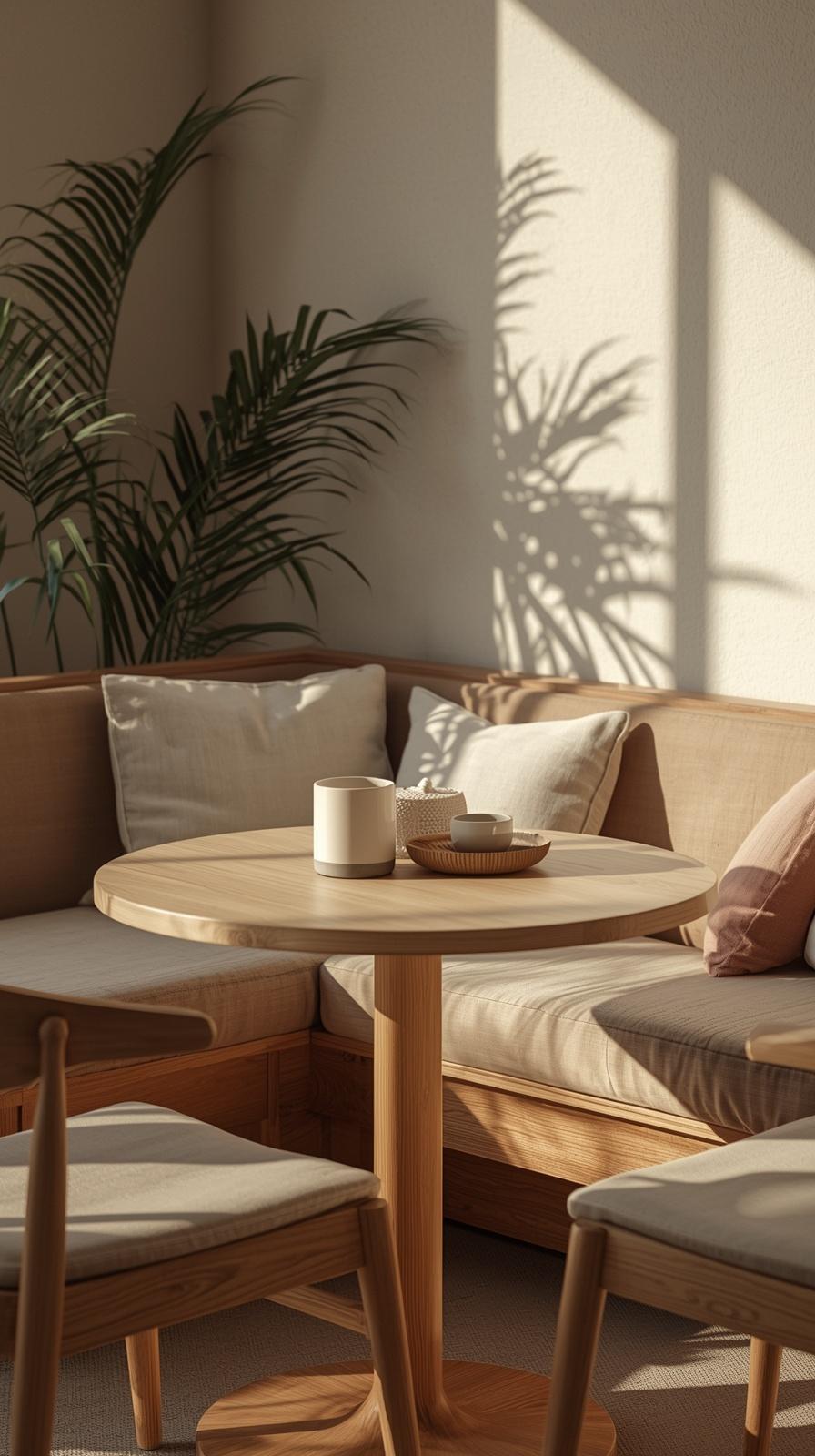
Built-In Bench With Raw Wood Finish — The Ultimate Japandi Foundation
If you’re going to do one thing for your breakfast nook, make it a built-in bench with a raw or lightly oiled wood finish. This is the heart of Japandi design — no paint, no fuss, just the natural grain doing all the talking.
Think ash, oak, or pine with a matte oil finish that lets the wood breathe. Pair it with a matching wood table in a slightly different tone for depth. No cushions required if the bench is padded — but if you add one, go linen in warm white or oat. The whole corner will look like it belongs in a Japanese countryside home mixed with a Copenhagen apartment.
Quick Styling Tips:
- Use unfinished or lightly oiled oak for the most authentic Japandi look
- Keep the cushion cover in undyed linen or warm sand tones
- Leave wall space behind the bench completely bare — negative space is part of the design
- Add one ceramic mug to the table as your only “decor.”
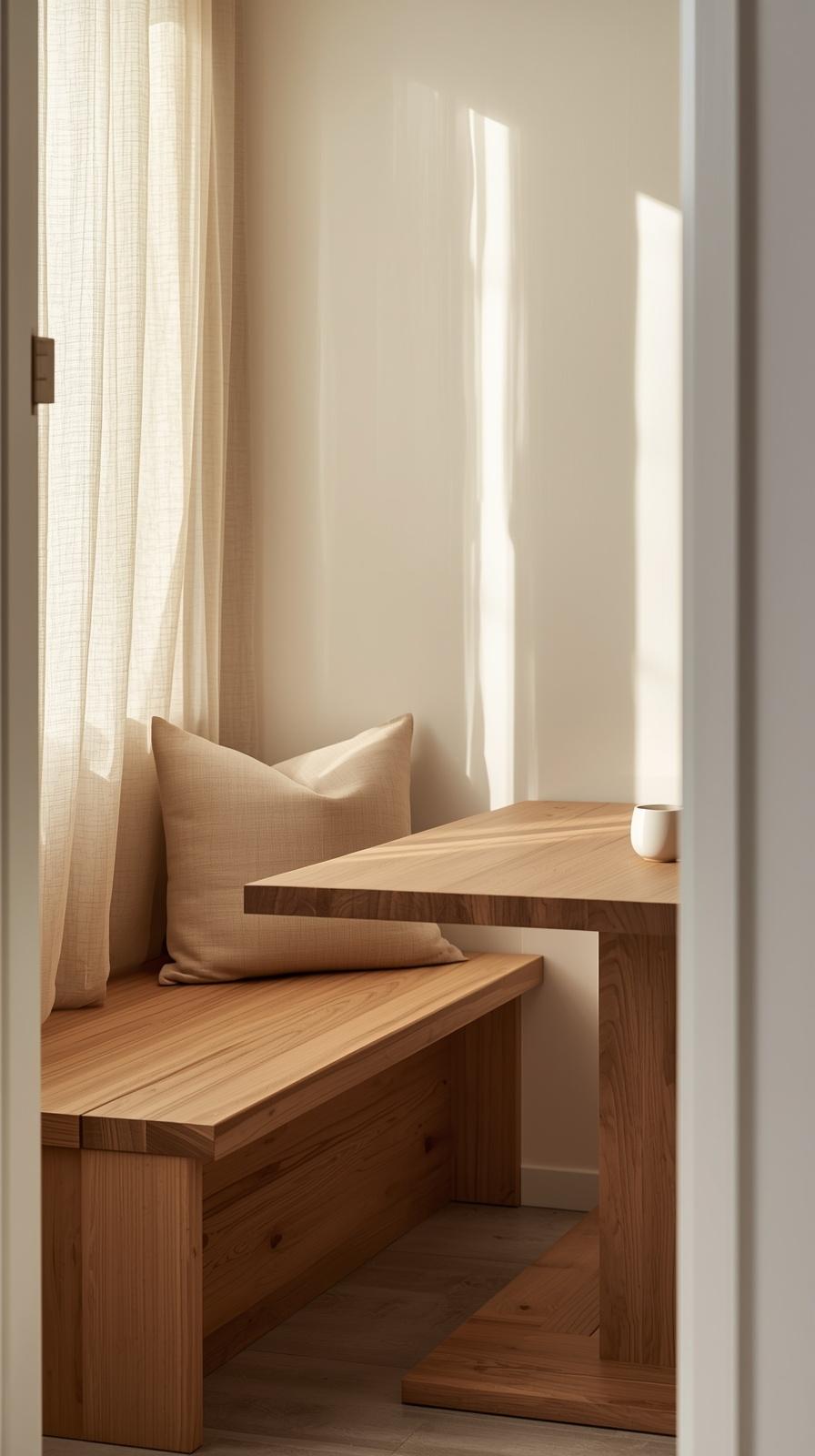
Floor-Level Seating With a Low Dining Table for That Zen Morning Feel
This one is pure Japanese influence — and it’s stunning. A floor-level breakfast nook with a low solid wood table and linen floor cushions creates the most serene morning space you can imagine.
It works beautifully in smaller homes or open-plan apartments because it doesn’t eat up visual space. Keep the cushions in clay, warm white, or muted sage. Add a small woven tray on the table for your tea set. This nook doesn’t just look calm — it makes you calm.
Quick Styling Tips:
- Use a low table no taller than 40cm for the authentic floor-seating feel
- Layer 2–3 flat linen cushions for comfort and visual texture
- Place a single bonsai or small plant just beside the table
- Natural jute flooring underneath ties the whole look together
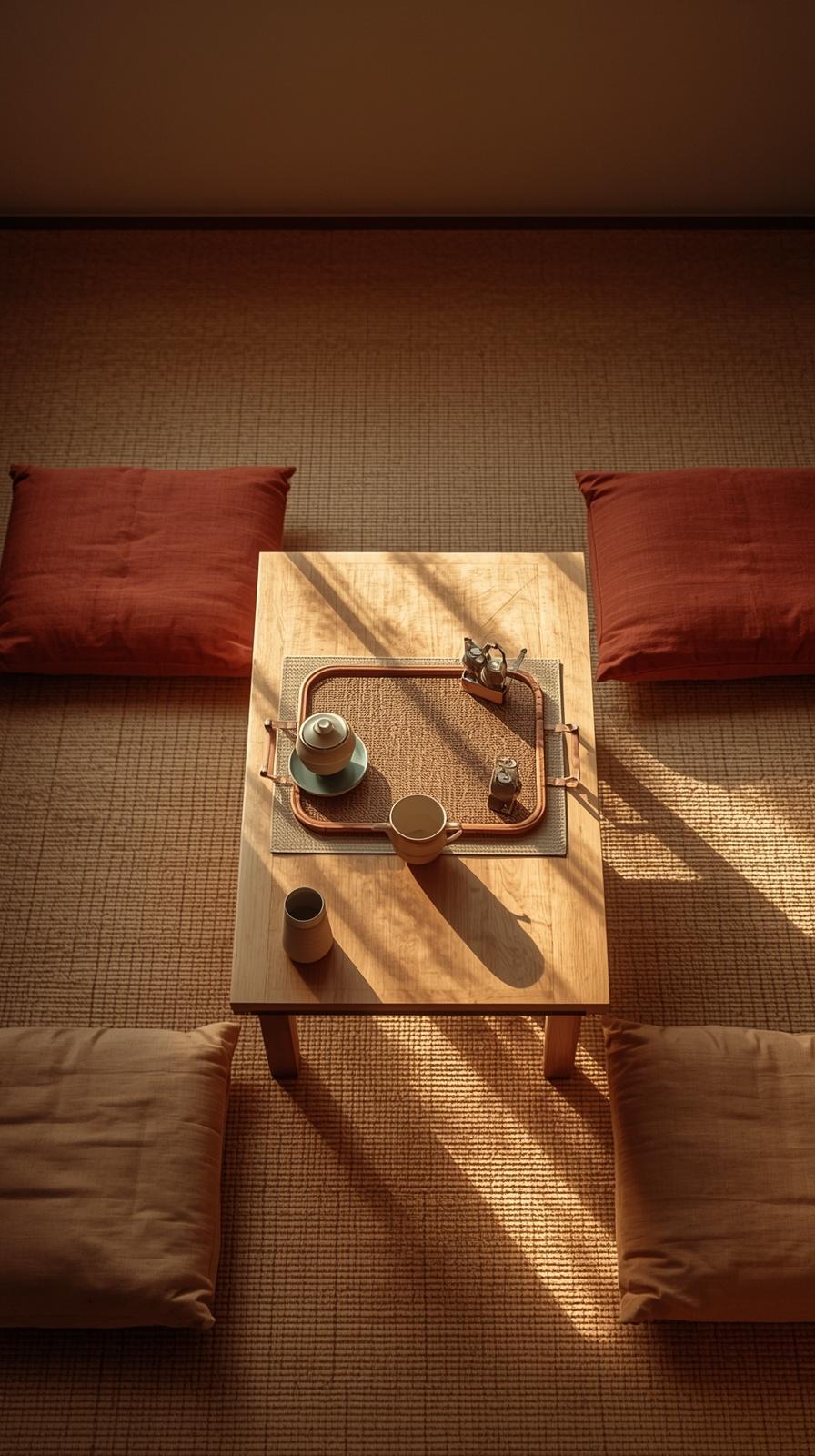
A Japandi Breakfast Corner Designed Around Natural Light
Here’s a principle that most people overlook — the best Japandi nooks are designed around light, not just placed somewhere in the kitchen. Find the window that gets the best morning sun and build your nook there.
Use sheer linen curtains that let the light diffuse naturally. No blinds. No heavy drapes. Just soft, warm, imperfect morning light washing over simple wood and linen. This is the wabi-sabi principle in its purest form — beauty found in the natural and uncontrolled.
Quick Styling Tips:
- East-facing windows give you the best soft morning glow
- Hang sheer linen curtains from the ceiling to the floor for drama
- Place a small potted plant on the windowsill to catch the light
- Keep the table surface clear — let light be the focal point
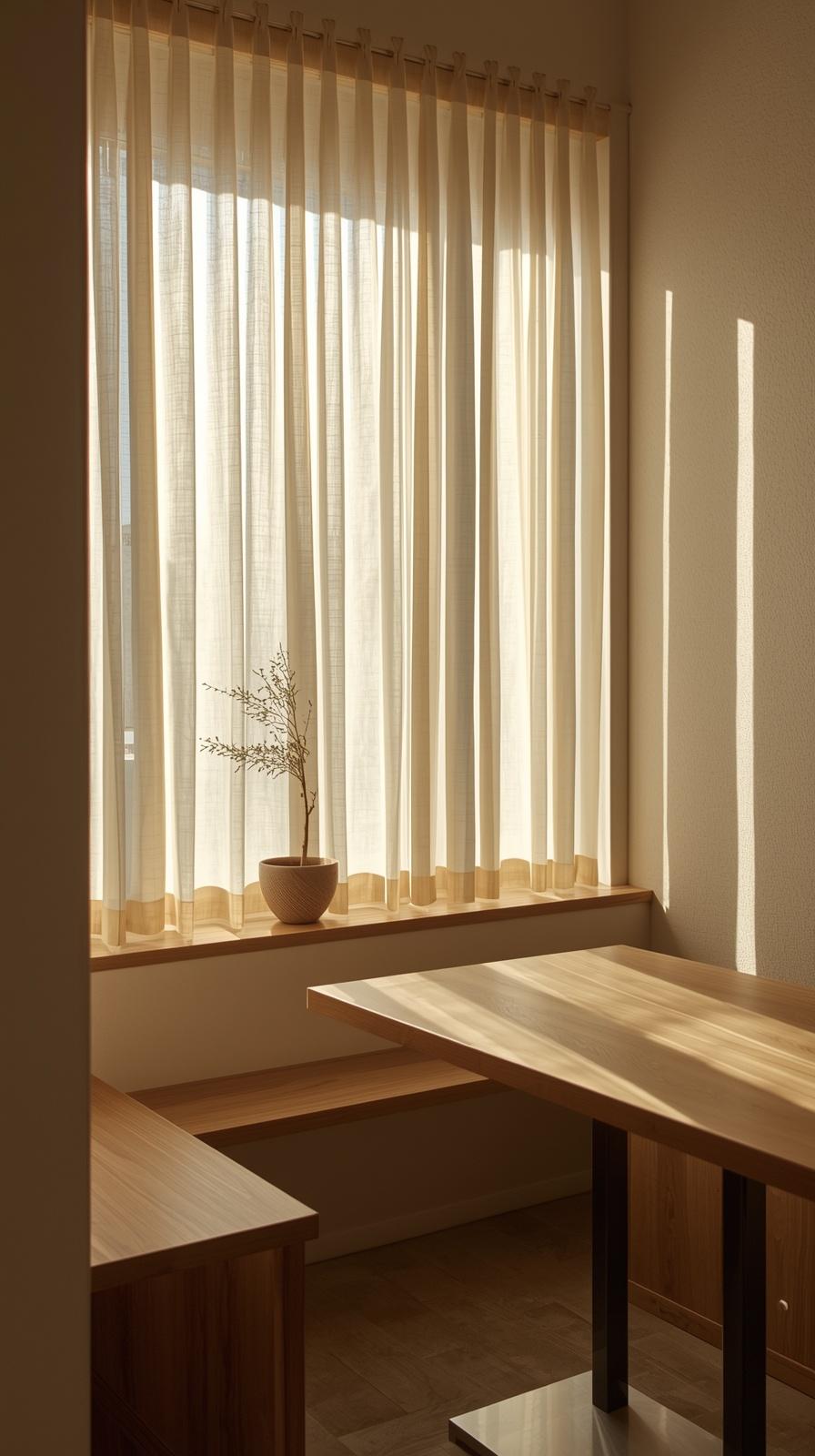
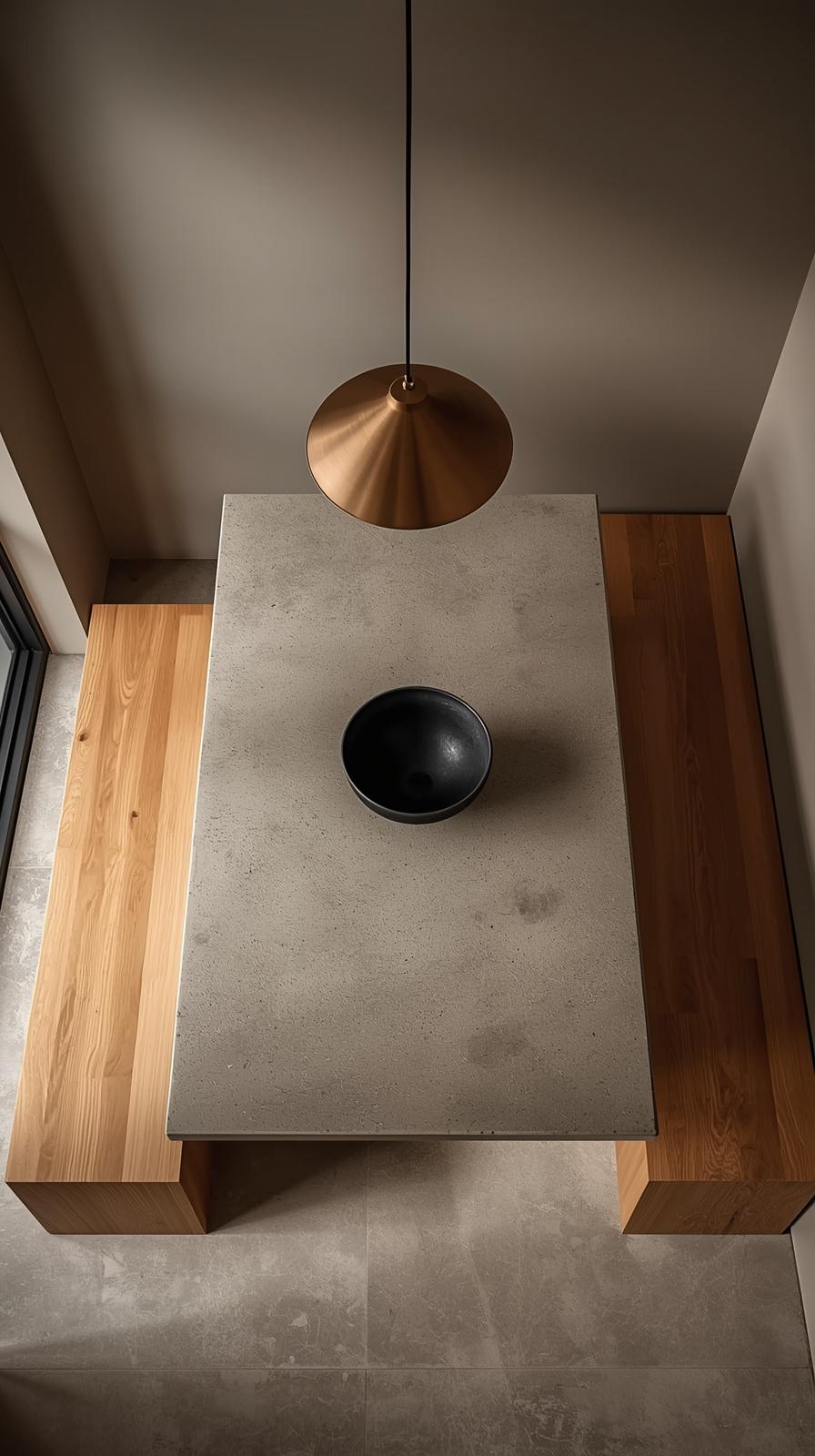
Mixing Matte Stone Surfaces With Warm Wood for a Grounded Aesthetic
If you want your Japandi nook to feel a little more elevated — like something out of a boutique Tokyo hotel — this combination is everything. A stone-effect table or countertop surface paired with a warm wood bench creates this incredible tension between cool and warm, heavy and light.
Go for matte finishes only. No glossy stone, no shiny wood lacquer. Keep the palette in warm whites, greige, charcoal, and taupe. This nook has serious design depth without needing a single accessory to prop it up.
Quick Styling Tips:
- Sintered stone or concrete-effect tables work brilliantly here
- Make sure your wood’s warm tones (honey or amber oak) contrast with the cool stone
- A single dark ceramic bowl on the table adds the right finishing note
- Keep lighting warm — a brass-toned pendant above completes the look
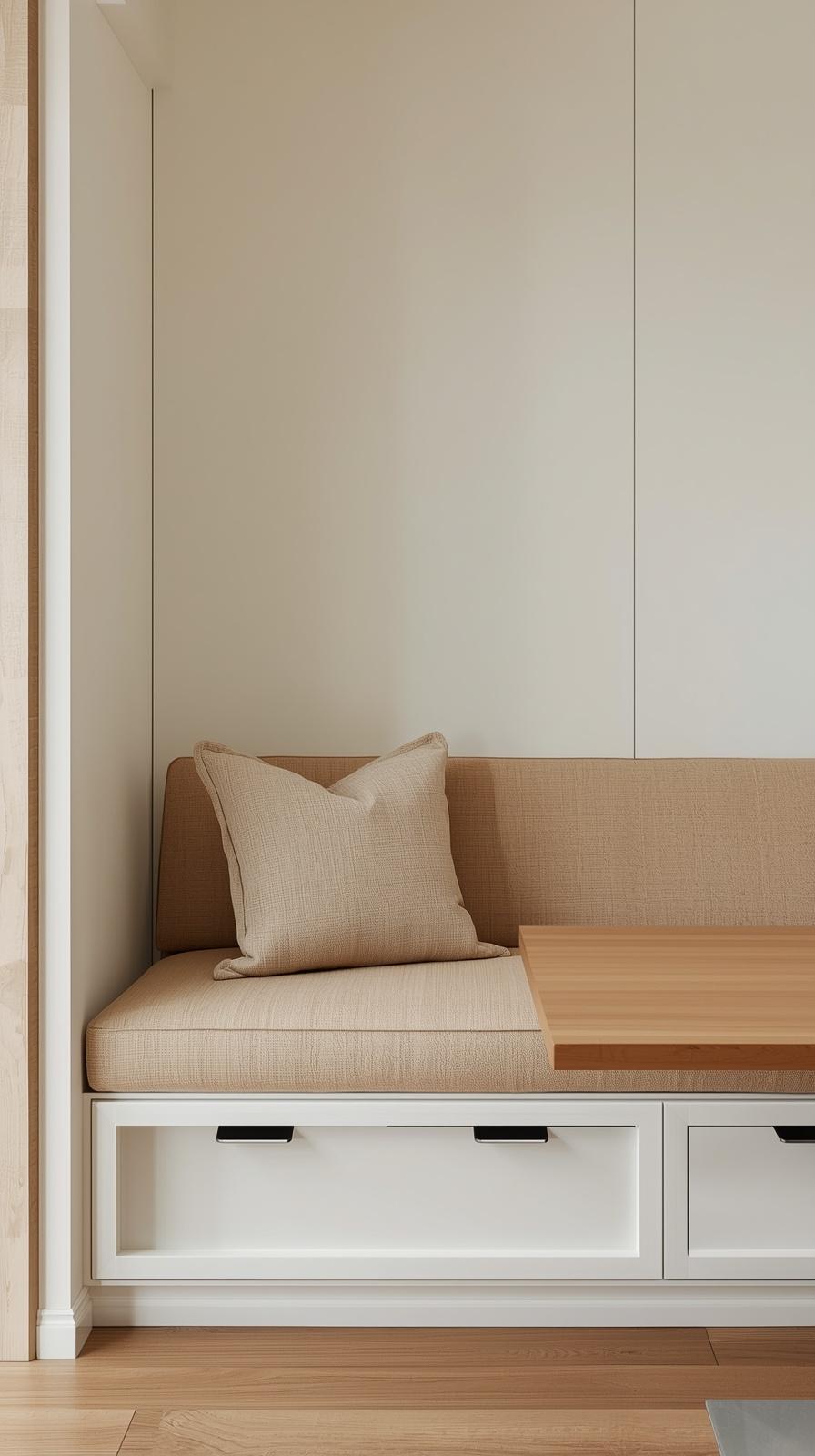
A Clean-Line Japandi Banquette That Hides All Your Clutter
This is the practical side of Japandi — and honestly, it’s genius. A built-in banquette with hidden storage underneath solves two problems at once: it gives you that beautiful minimal look and somewhere to stash all the stuff you don’t want to see.
Push-open drawers or lift-up seat panels with no visible hardware keep the exterior completely seamless. Paint it the same color as your walls for that expensive built-in look. From the outside, it’s just a gorgeous, clean bench. Inside? Storage gold.
Quick Styling Tips:
- Use push-to-open mechanisms — no handles break the visual noise
- Paint the banquette in the same tone as your walls for a seamless built-in effect
- Line the interior with a thin foam and canvas for a dual-purpose storage seat
- Keep only 1–2 throw cushions on top — resist the urge to over-accessorize
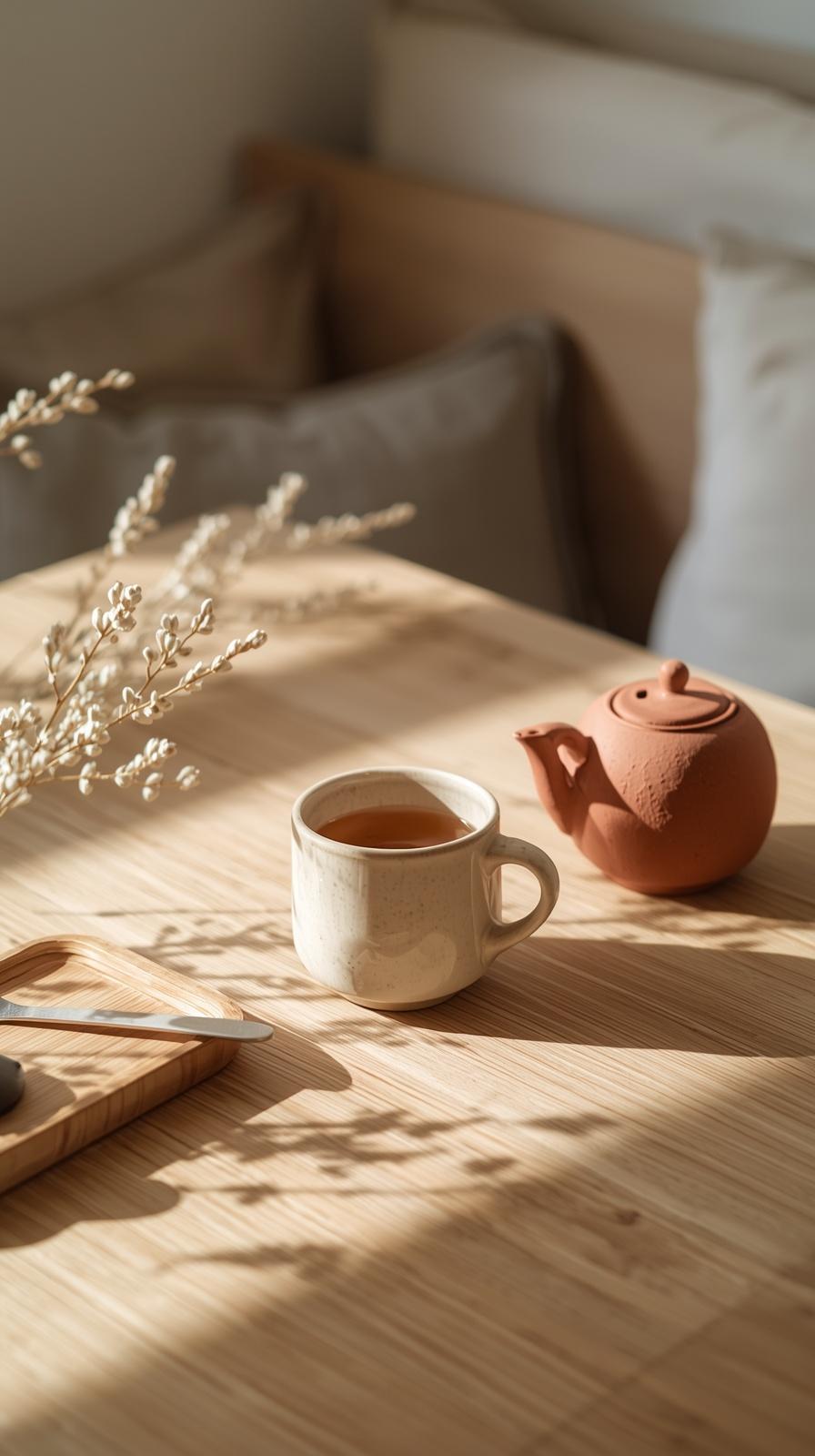
Handmade Ceramic Tableware as the Centerpiece of Your Morning Ritual
This idea takes a different approach — instead of starting with furniture, start with objects. A Japandi nook built around a beautiful collection of artisan ceramics is one of the most personal and Pinterest-worthy spaces you can create.
Imperfect mugs, hand-thrown bowls, a simple clay teapot — these become the centerpiece. Everything else (bench, table, wall) recedes into quiet neutrals to let the ceramics shine. This is wabi-sabi at its most liveable: function becomes decoration, and every morning feels like a quiet ceremony.
Quick Styling Tips:
- Source ceramics from small independent makers (Etsy has incredible options)
- Stick to a 3-piece set — don’t overcrowd the table
- Earth tones: terracotta, warm grey, dusty sage work beautifully together
- A small wooden tray corrals the pieces and keeps things looking intentional
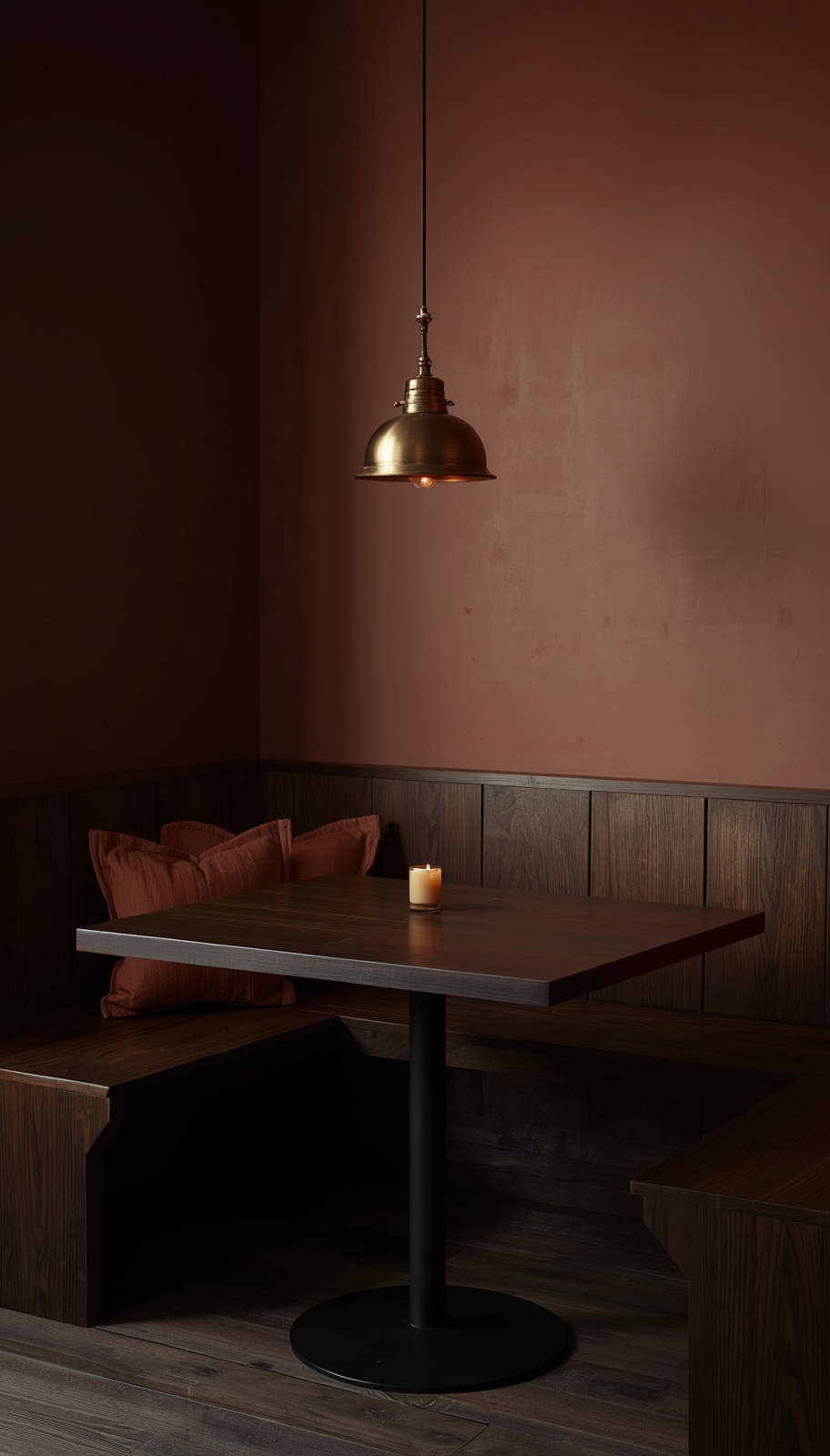
- Deep Toned Japandi Nook With Subtle Brass Details for Warmth
Most Japandi spaces lean light — but the dark, moody version is equally beautiful and far less common on Pinterest. A walnut or smoked oak bench paired with deep warm-toned walls and aged brass accents creates a nook that feels like a warm embrace on a cold morning.
One single brass pendant light above the table does most of the heavy lifting. Add dark wood, warm candlelight, and a single linen cushion in deep sand or rust. This is Japandi with depth — still completely calm, but with a richness that light versions can’t quite match.
Quick Styling Tips:
- Smoked oak or walnut bench and table for the deepest Japandi look
- Aged brass (NOT polished) — look for “antique brass” or “unlacquered brass” finishes
- Keep walls in deep warm putty or a muted olive-grey
- Add one small beeswax candle for the full moody morning atmosphere
Transforming a Bay Window Into a Japandi Sanctuary
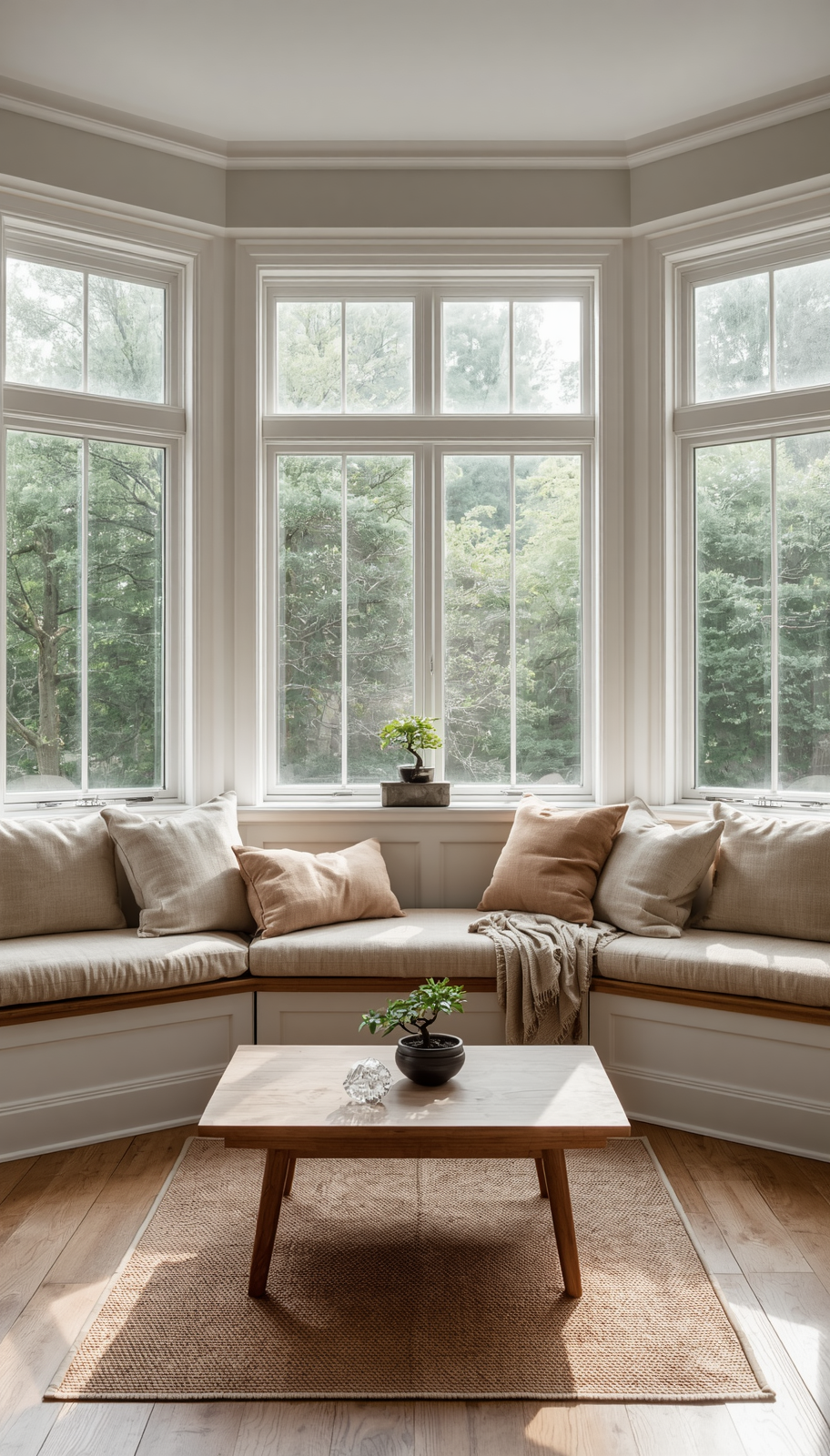
Bay windows were practically made for Japandi breakfast nooks. That curved or angled alcove of natural light is the perfect frame for a custom bench — and the result looks wildly more expensive than it actually is.
Fit a bench that hugs the bay window shape, layer it with linen cushions, and add a small bonsai or trailing pothos plant on the sill. A small low table in the center completes it. Morning tea here becomes something you genuinely look forward to — not just a caffeine habit.
Quick Styling Tips:
- Measure your bay window carefully — a tight-fitting bench makes it look custom-built
- Use the windowsill as a plant shelf (one small bonsai is perfect)
- Add a thin wool or jute rug under the table to define the nook space
- Scatter 3–4 linen cushions in slightly different tones for a collected, natural feel
Bringing Natural Texture In With Rattan Chairs and White Oak Tables
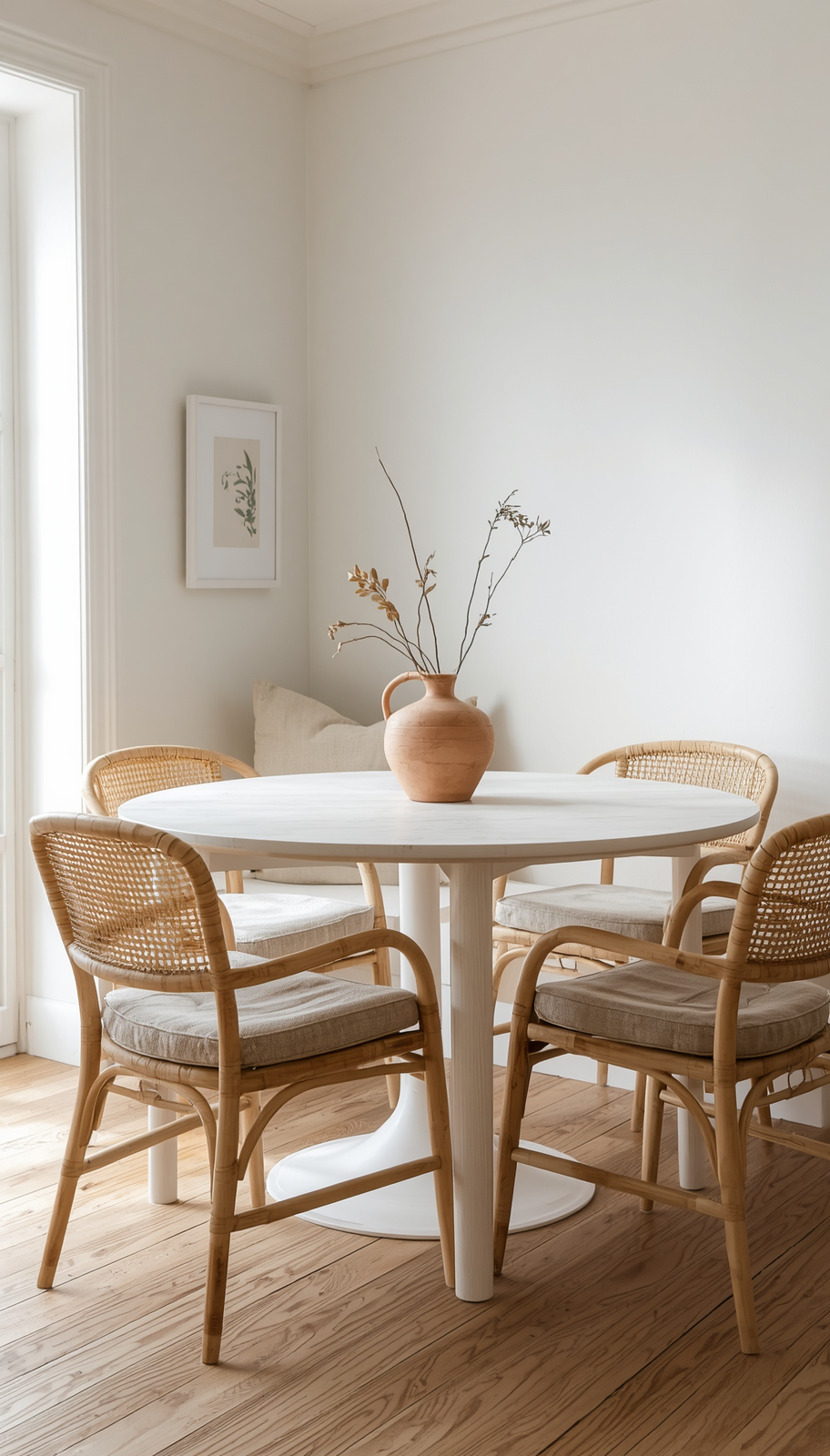
Rattan is one of those materials that perfectly straddles both sides of Japandi — it feels Japanese in its natural simplicity, and Scandinavian in its use of organic materials for everyday furniture. When paired with a white oak table and undyed linen cushions, it creates a nook that photographs beautifully from every angle.
Keep walls bare. Skip the artwork. Let the texture of the rattan and the grain of the oak do the visual work. This is the kind of nook that Instagram saves come from — effortlessly beautiful because it’s so honest.
Quick Styling Tips:
- Rattan chair back + simple wood legs = the ideal Japandi chair silhouette
- White oak tables (not yellow pine) give you the cleanest neutral tone
- No placemats needed — the table grain is the decoration
- One small bunch of dried pampas grass in the corner for the full look
Small Space Japandi Breakfast Nook Ideas That Feel Bigger Than They Are
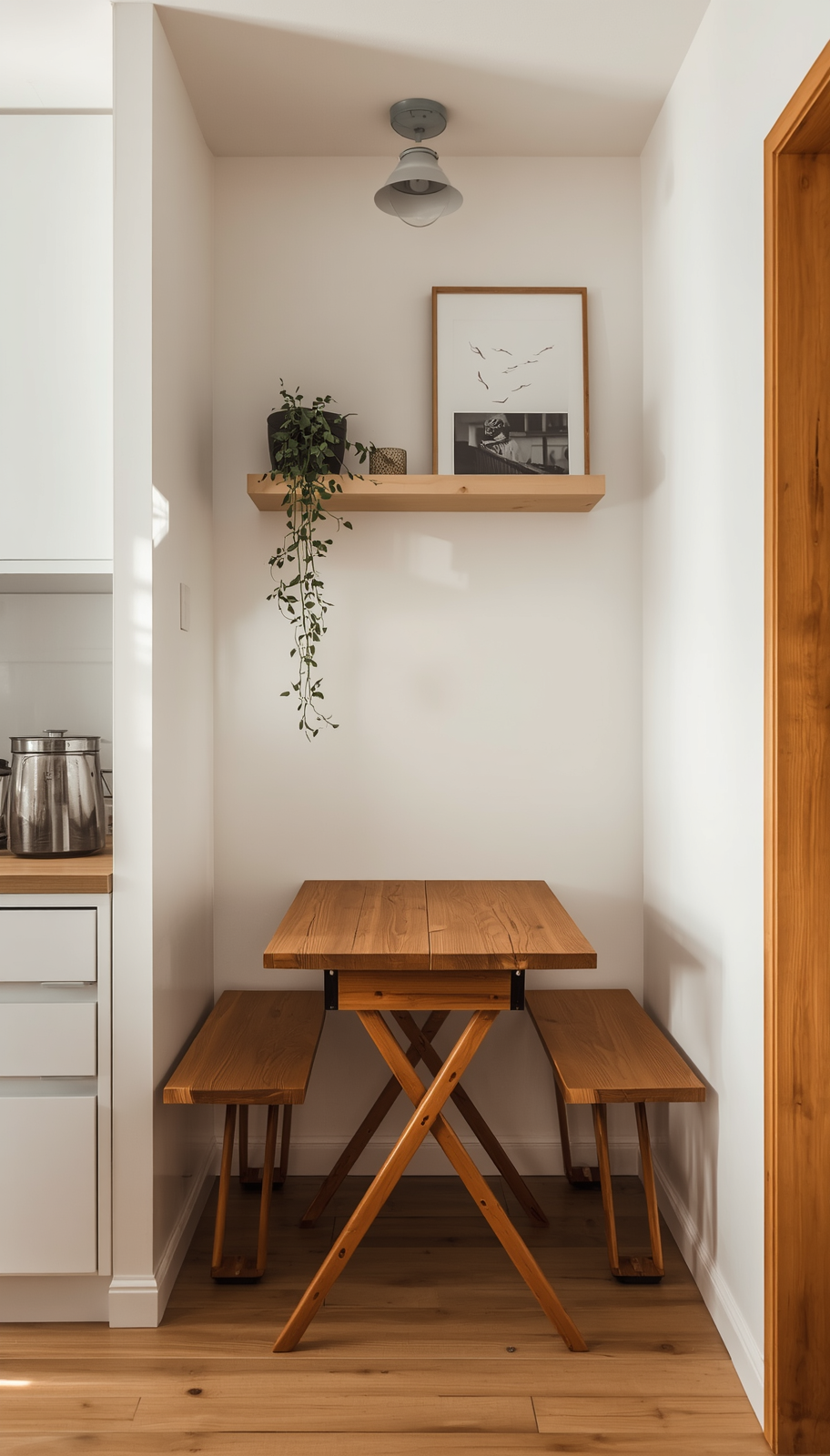
Small kitchen? No problem. Some of the best Japandi nooks I’ve come across are in tiny apartments — and they work precisely because of the constraints. Japandi design loves limitation; it forces you to edit down to only what matters.
A wall-mounted foldable table paired with a slim bench or one rattan stool is all you need. Use vertical space wisely: a floating shelf above with a single small plant and two ceramic pieces. Keep the floor clear. The result feels intentional, not cramped.
Quick Styling Tips:
- A fold-down wall table frees up floor space when not in use
- Choose a bench that slides fully under the table — saves 30cm of floor space
- Paint the wall behind the nook slightly warmer than the rest of the room — it makes the space feel defined without closing it in
- The mirror on the adjacent wall reflects light and makes the nook feel double the size
One Color, Total Calm — The Greige Japandi Breakfast Nook
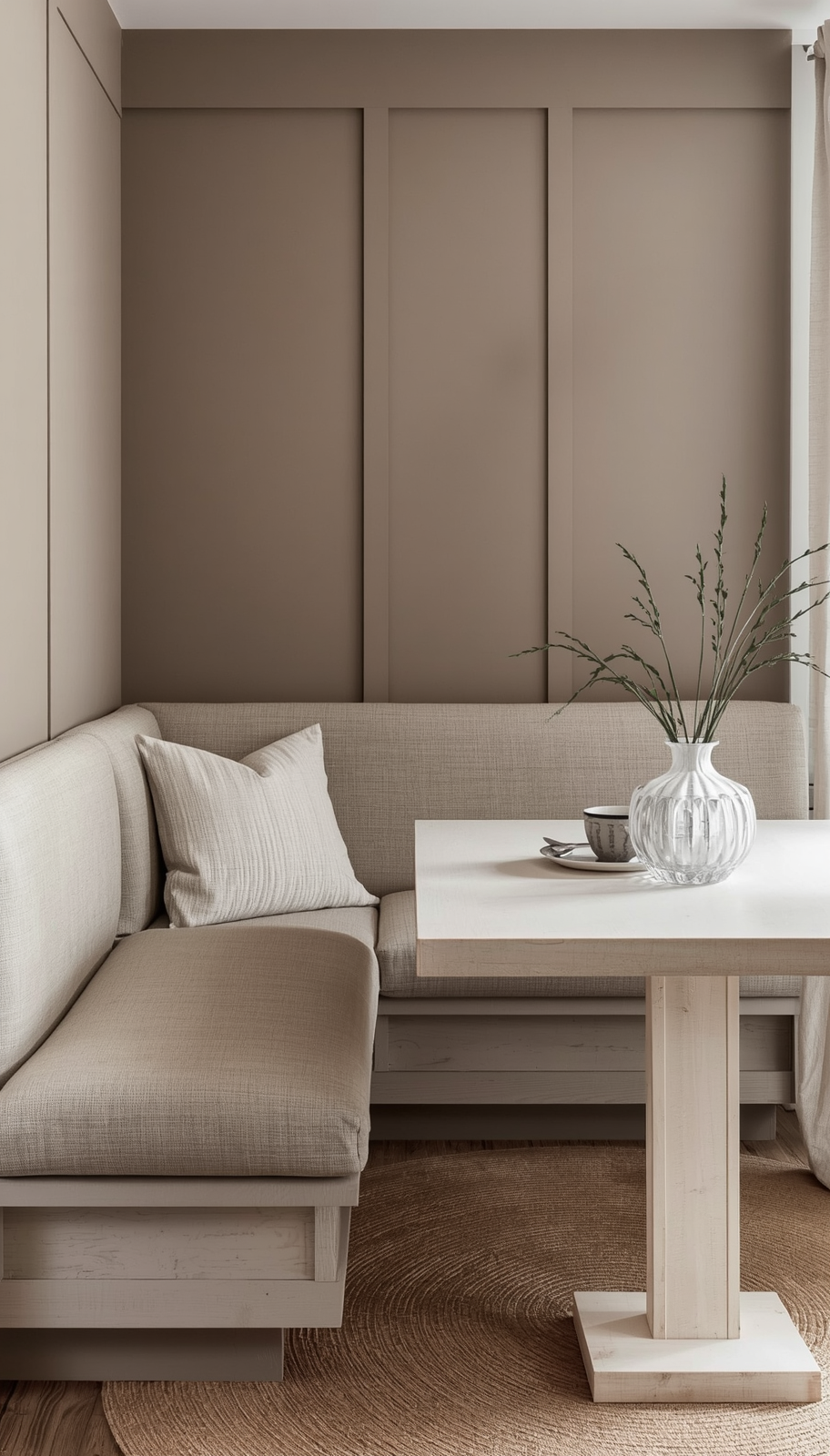
Tonal dressing — using different shades of one color throughout a space — is one of the most sophisticated design moves you can make. In Japandi terms, greige (that perfect grey-beige mix) is the holy grail color.
Walls in warm greige, bench cushions in slightly lighter greige, table in greige-washed wood, rug in natural sand. Different tones, same family. The result is incredibly layered and rich, even though there are technically “no colors” in the space. Add depth through texture only: bouclé, linen, raw wood grain.
Quick Styling Tips:
- Sample paint in your actual space before committing — greige reads differently in every light
- Layer textures aggressively: bouclé cushion + linen throw + wood grain = rich tonal space
- A single matte black candle holder is the only contrast element you need
- Avoid cool greys — everything should lean warm to stay within the Japandi palette
Adding Living Plants to Your Japandi Nook Without Overcrowding It
Plants in a Japandi nook have to be intentional — one wrong move and you’ve got a jungle instead of a sanctuary. The Japanese principle of ma (negative space) means that less is genuinely more.
One statement plant is better than five small ones. A single fiddle leaf fig in the corner, or a low bonsai on the table, or a trailing pothos on a small shelf — pick one and commit. The plant should feel like it belongs there, not like it was placed for a photo.
Quick Styling Tips:
- One large plant > five small ones — always in Japandi design
- Bonsai, snake plants, and fiddle leaf figs are the most Japandi-compatible species
- Use a ceramic or raw clay pot — never plastic, never terracotta with a saucer
- Place the plant in negative space (an empty corner, a windowsill), not on the table
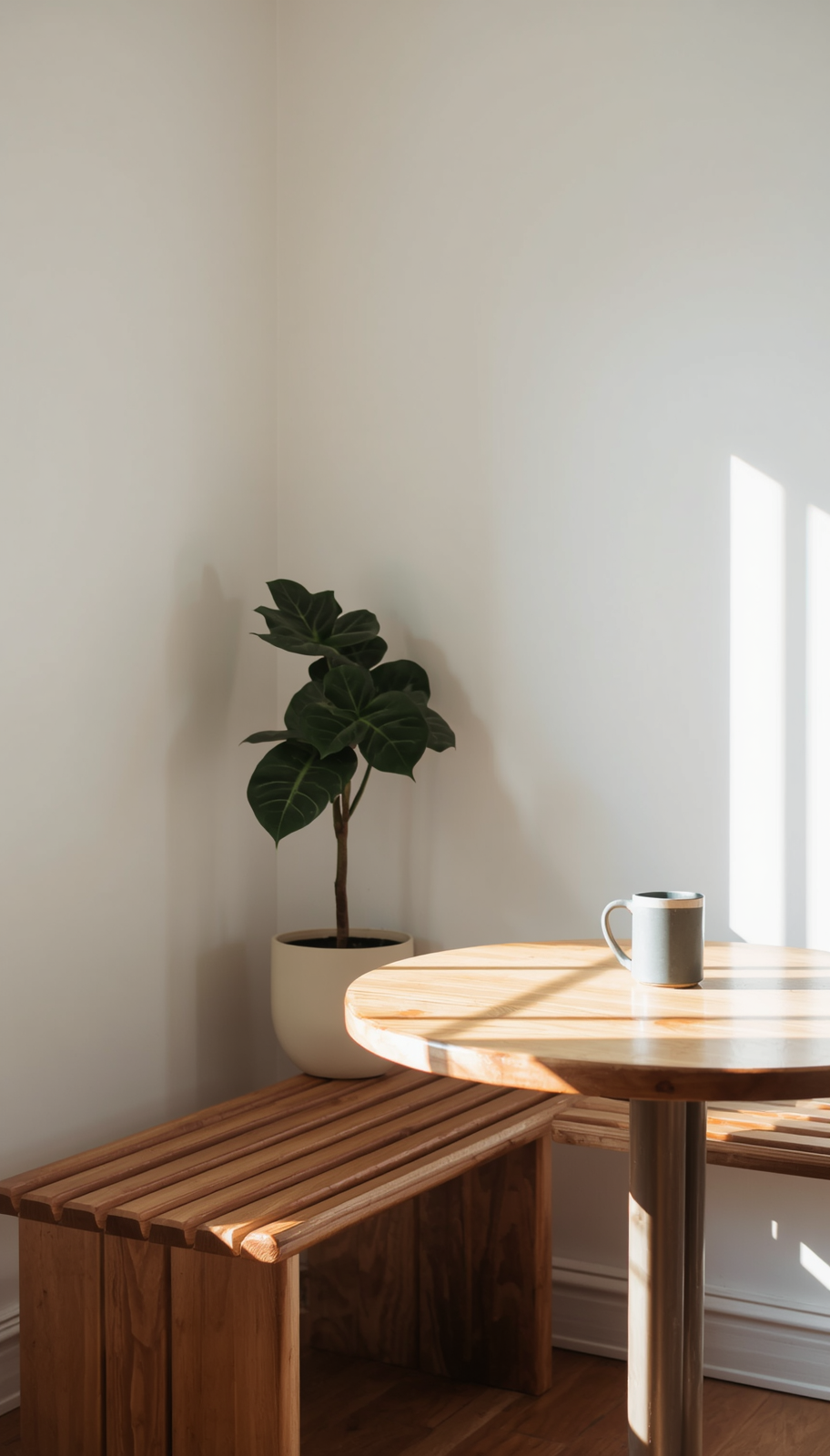
Using Tatami-Style Mats or Natural Jute Rugs to Ground Your Nook
One of the easiest ways to define a breakfast nook without walls or dividers is with a rug. In Japandi design, the rug isn’t decorative — it’s structural. It defines the space, grounds the furniture, and brings warmth to hard floor surfaces.
A natural jute, sisal, or tatami-inspired mat under your nook table does exactly this. Keep it simple — no pattern, no color. Just natural fiber, natural tone. It creates a visual boundary that makes the nook feel intentional and complete.
Quick Styling Tips:
- Size matters: the rug should extend at least 30cm beyond the table on each side
- Natural fibre rugs (jute, sisal, seagrass) stay true to the Japandi material ethos
- Layer a thin tatami mat on top of a jute rug for extra texture depth
- Avoid any rugs with pattern — in Japandi, texture is the only “print.”
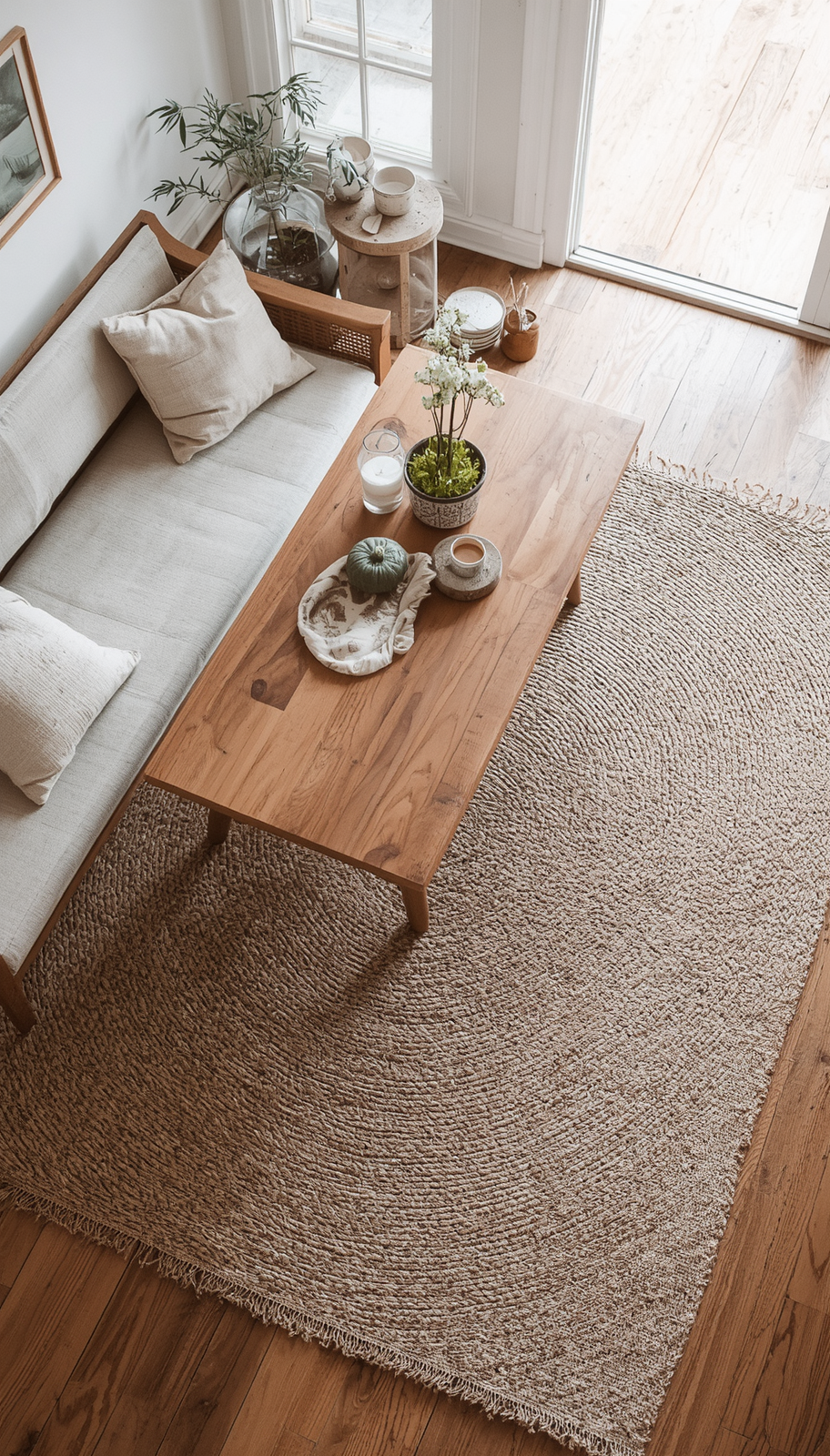
Using a Shoji-Inspired Screen to Create a Cozy, Separated Breakfast Space
This is one of my favourite ideas in this whole list — and it’s surprisingly achievable. A partial shoji-style screen (wood frame with rice paper panels or frosted glass) positioned at one edge of your nook creates privacy and definition without closing off the space entirely.
The light that filters through the paper panels is genuinely magical — diffused, warm, almost glowing. It transforms a corner into a room. And from a design standpoint, it’s the most distinctly Japanese-Scandinavian piece of furniture you can put in a home.
Quick Styling Tips:
- A 3-panel standing shoji screen can be found on Etsy or made by a local joiner
- Rice paper panels diffuse light beautifully — opt for this over frosted glass if possible
- Position it perpendicular to the wall so it “closes off” one side of the nook
- Keep everything else in the nook extra minimal — the screen is the statement
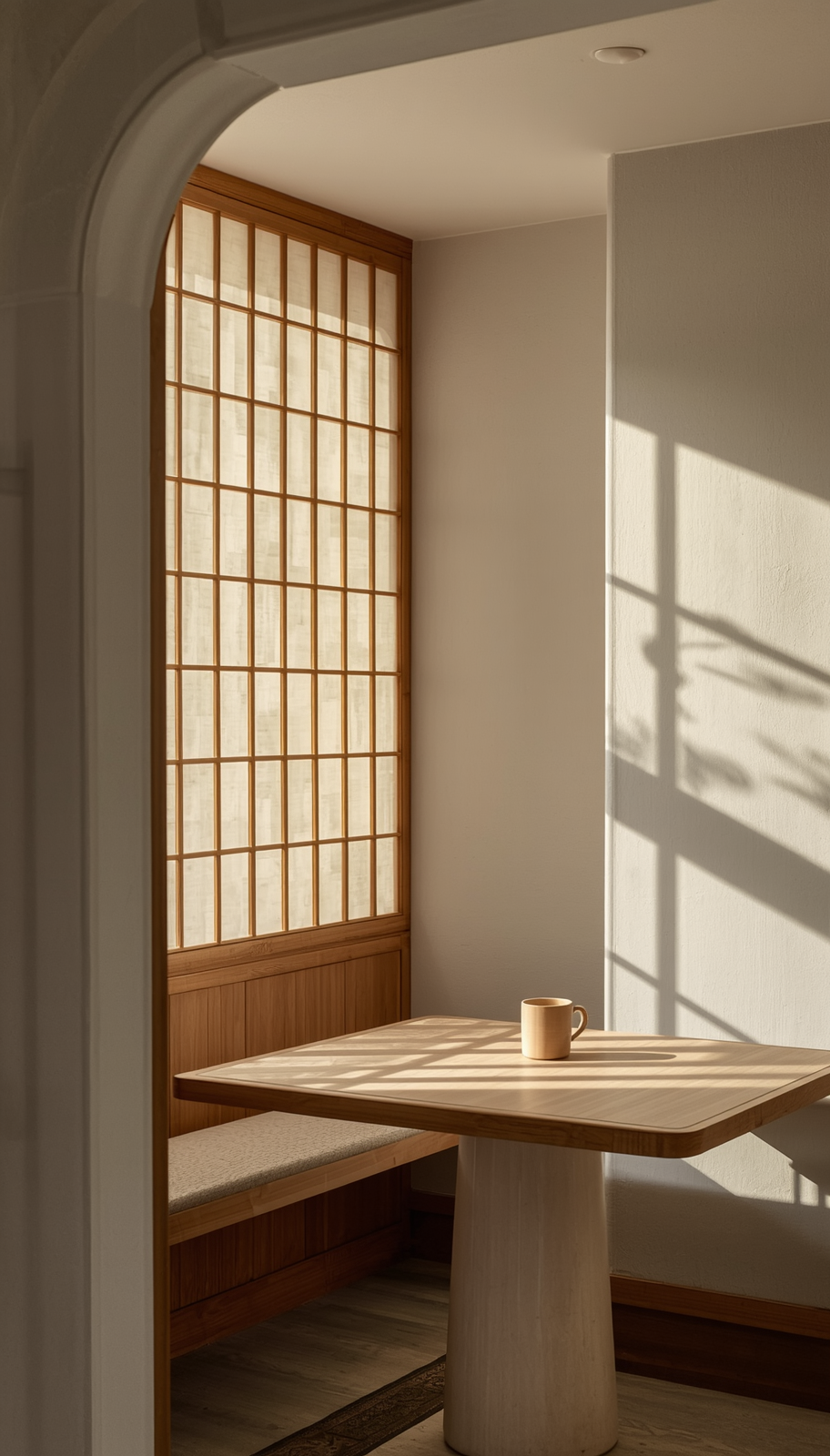
Designing Your Japandi Nook Around a Slow Morning Ritual
This idea is less about furniture and more about intention — and it might be the most important one on this list. The best Japandi nooks are designed around how you want to feel, not just how they look.
Build a small shelf into or beside the nook for three things: a book, a candle, and your favorite mug. That’s it. A space that says “sit here, slow down, be present.” No phone chargers. No mail pile. Just the things that belong to your morning ritual. The design follows from the intention.
Quick Styling Tips:
- A simple floating shelf at seated eye level holds books and a candle perfectly
- One beeswax taper in a minimal holder is more impactful than a candle collection
- Keep a cloth napkin folded neatly under your mug — it’s a tiny detail that elevates everything
- Remove anything that doesn’t belong to your morning ritual — ruthlessly
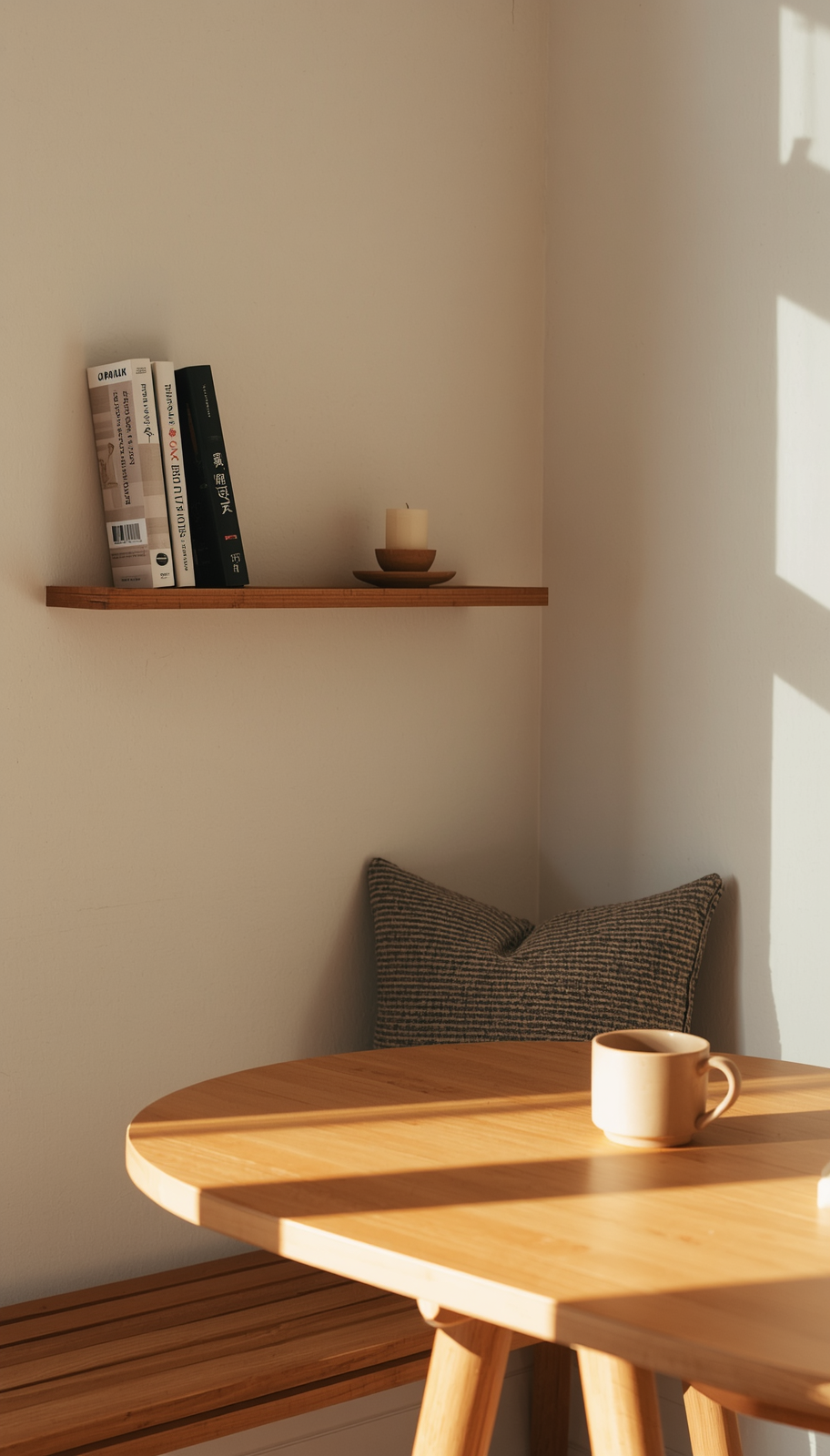
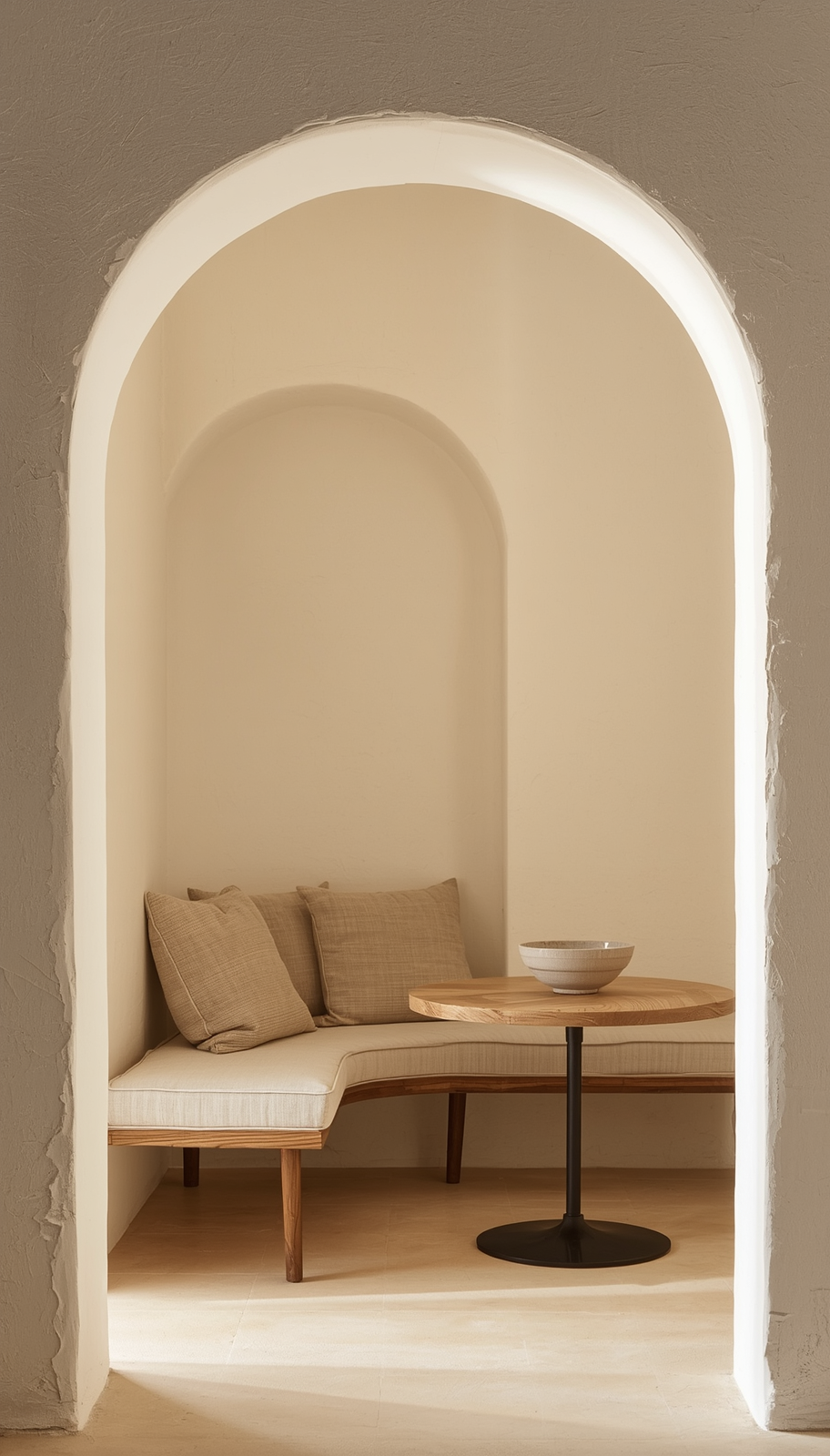
Adding an Arched Alcove for a Built-In, Boutique-Hotel Breakfast Nook Feel
If you want one architectural detail that completely transforms a breakfast nook, it’s an arch. A plastered or drywalled arched alcove framing your bench creates a space that looks expensive, intentional, and deeply considered — even if the furniture inside is simple and affordable.
The arch doesn’t need to be huge. A gentle curve over a window or built-in bench is enough. In warm white plaster or limewash, it adds depth and warmth to the wall while giving your nook a “this was designed” quality that flat walls just can’t achieve.
Quick Styling Tips:
- Arches can be created with drywall + corner bead — a weekend DIY project for the brave
- Limewash or Roman clay paint inside the arch creates gorgeous light variation
- Even renters can fake an arch with a freestanding arched headboard panel behind the bench
- Keep furniture inside the arch extremely simple — the arch is the star
How to Create a Japandi Breakfast Nook on a Budget — No Renovation Needed
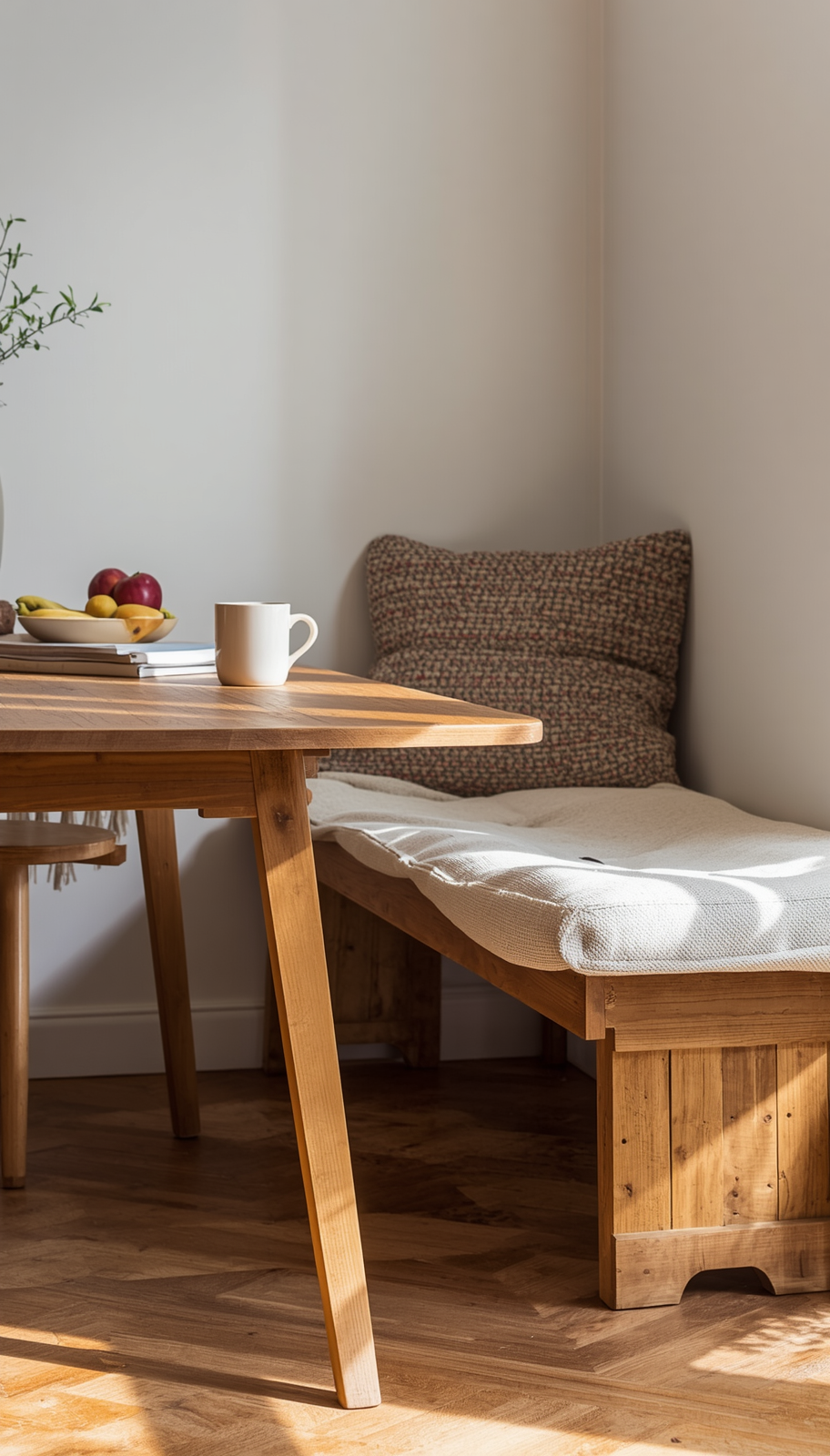
Here’s the truth: you don’t need to knock down walls or spend thousands to get a beautiful Japandi breakfast nook. The best budget version starts with editing what you already have, then adding a few key pieces strategically.
A simple IKEA table in natural birch, a second-hand wood bench from a Facebook Marketplace find, a linen cushion cover made from fabric you ordered online, and a single ceramic mug from a local pottery market — that’s a Japandi breakfast nook. The philosophy of the style supports restraint. Less buying, more editing, more intention.
Quick Styling Tips:
- IKEA GAMLEBY or MÖRBYLÅNGA table bases are perfect Japandi starting points
- Recover old cushions in undyed linen fabric (£8–15 per metre from fabric shops)
- Thrifted wood pieces with natural grain > new pine with yellow undertones
- Paint one wall in warm white or greige to frame the nook — a £15 tester pot is enough
Bringing Nature Completely Inside — The Biophilic Japandi Nook
For those who want to take it one step further, the biophilic Japandi nook is as close to eating outside in a Japanese garden as you can get indoors. Stone floor tiles, a pebble tray centerpiece, a preserved moss wall panel on one side — it sounds unusual, and it absolutely works.
The key is restraint. You’re not creating a greenhouse. You’re bringing in hints of nature — the cool weight of stone, the soft living green of moss, the organic shape of a pebble — and letting them anchor the space in something real and grounded.
Quick Styling Tips:
- Preserved moss panels are low maintenance and last for years — no watering needed
- A small pebble tray under a tea set acts as an organic centrepiece
- Pair stone floor tiles with a warm wood bench to balance the cool and warm
- Use only one natural element as the “hero” — stone floor OR moss panel, not both
Conclusion
The thing about Japandi design is that it doesn’t demand perfection — it demands intention. Every choice should have a reason. Every object should earn its place. And every corner of your home should make you feel a little more at peace.
You don’t need all 18 of these ideas. You just need one to start with. Pick the idea that felt most like you when you read it — and start there.
Save this post, pin your favourite idea, and come back when you’re ready for the next step. Your perfect morning corner is closer than you think.