
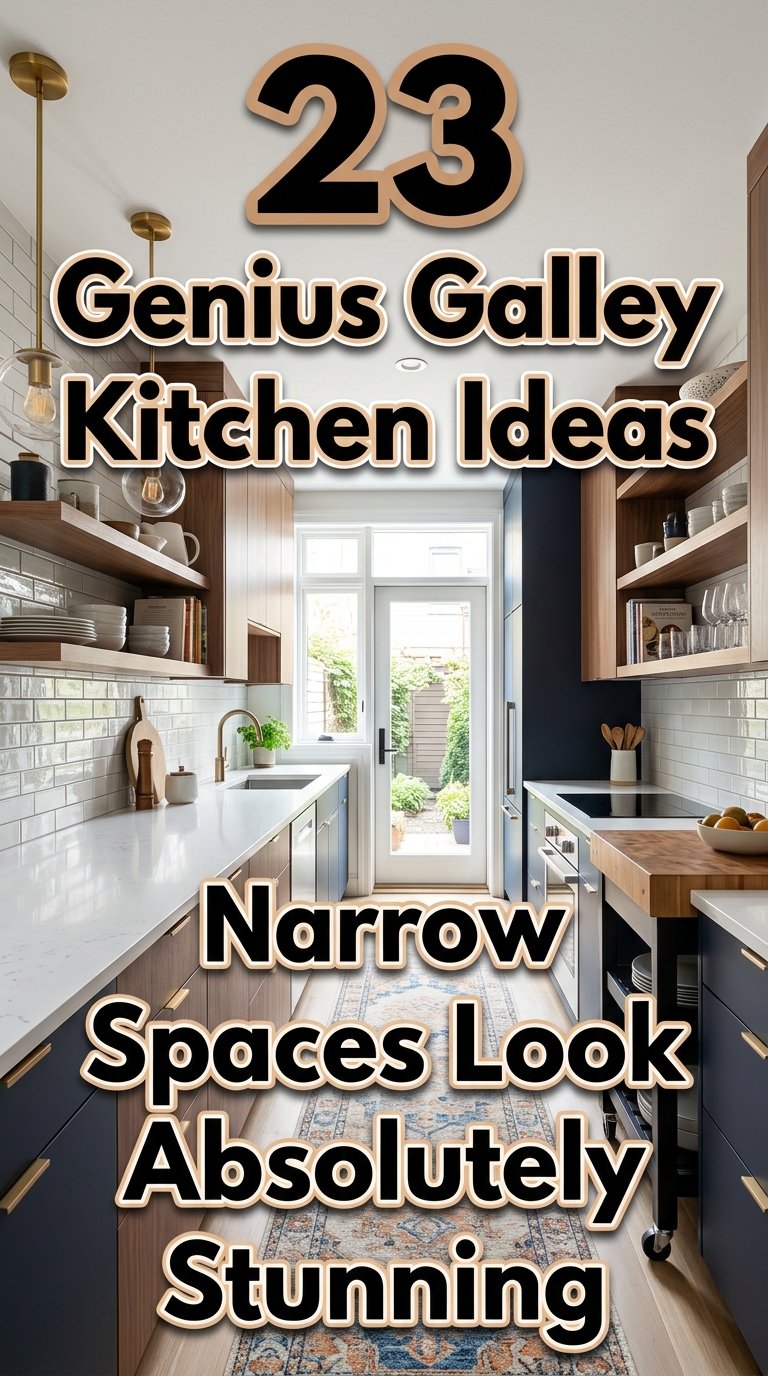
Galley kitchens have gotten a bad reputation over the years. People hear “galley” and immediately think cramped, dark, and impossible to work in — but that couldn’t be further from the truth. I’ve seen galley kitchens that stopped me mid-scroll on Pinterest: moody navy ones with brass fixtures glowing like a jewel box, bright white ones that felt like a French bakery, cozy farmhouse ones with herbs on the windowsill and open shelves full of beautiful ceramics.
The truth is, galley kitchens are actually one of the most efficient kitchen formats ever designed. Professional restaurant kitchens run on this exact layout because it keeps everything within arm’s reach. Whether your galley is short and tight or long and awkward, these 23 ideas will show you exactly how to transform it.
Bright White Cabinets with Warm Wood Open Shelving
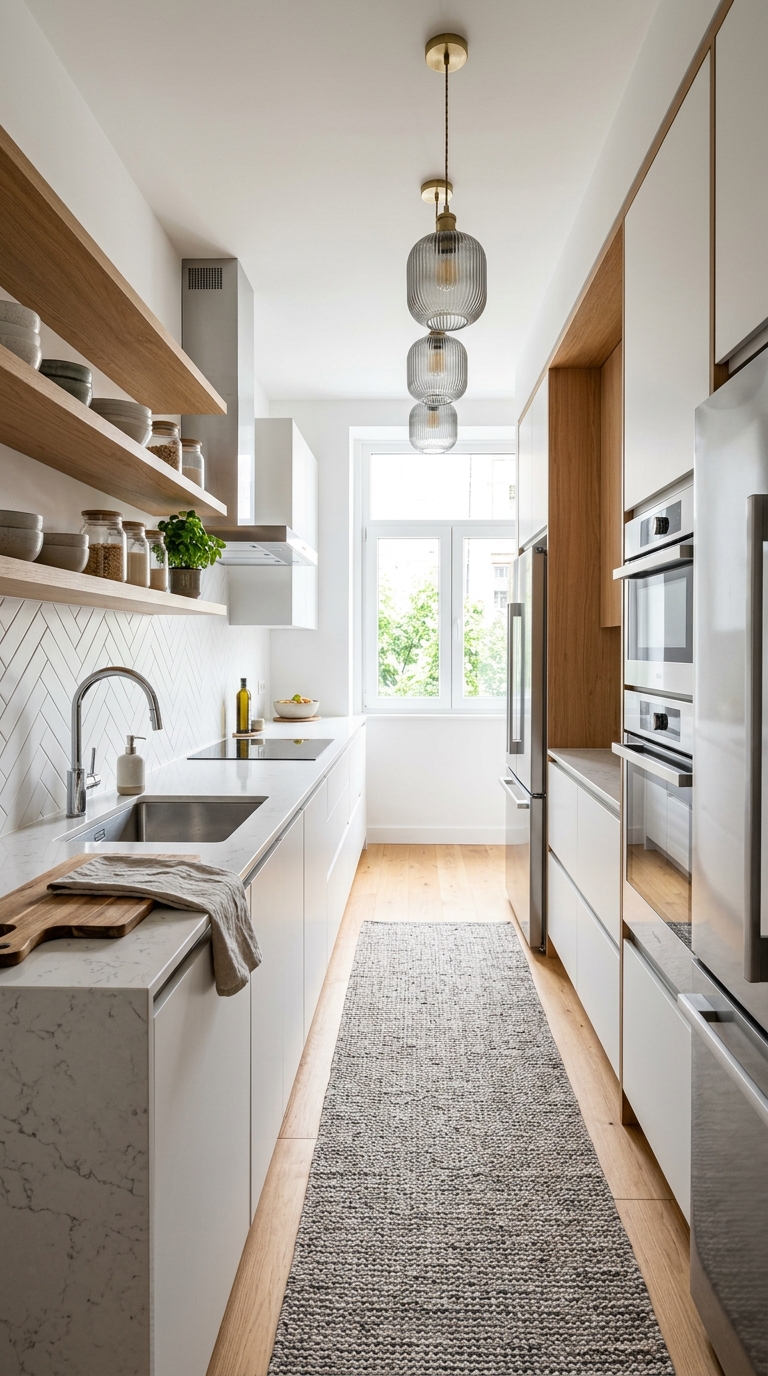
White cabinets instantly open up a narrow kitchen by reflecting light into the room — but all-white can feel cold. Swapping a few upper cabinets for floating oak or walnut shelves warms the whole space immediately and gives you a chance to display handmade mugs, glass jars, and small plants.
The key is to keep shelves styled, not stuffed. Think of them as a little gallery wall rather than pure storage, and pair everything with brass or unlacquered bronze hardware for a result that feels bright, warm, and completely intentional.
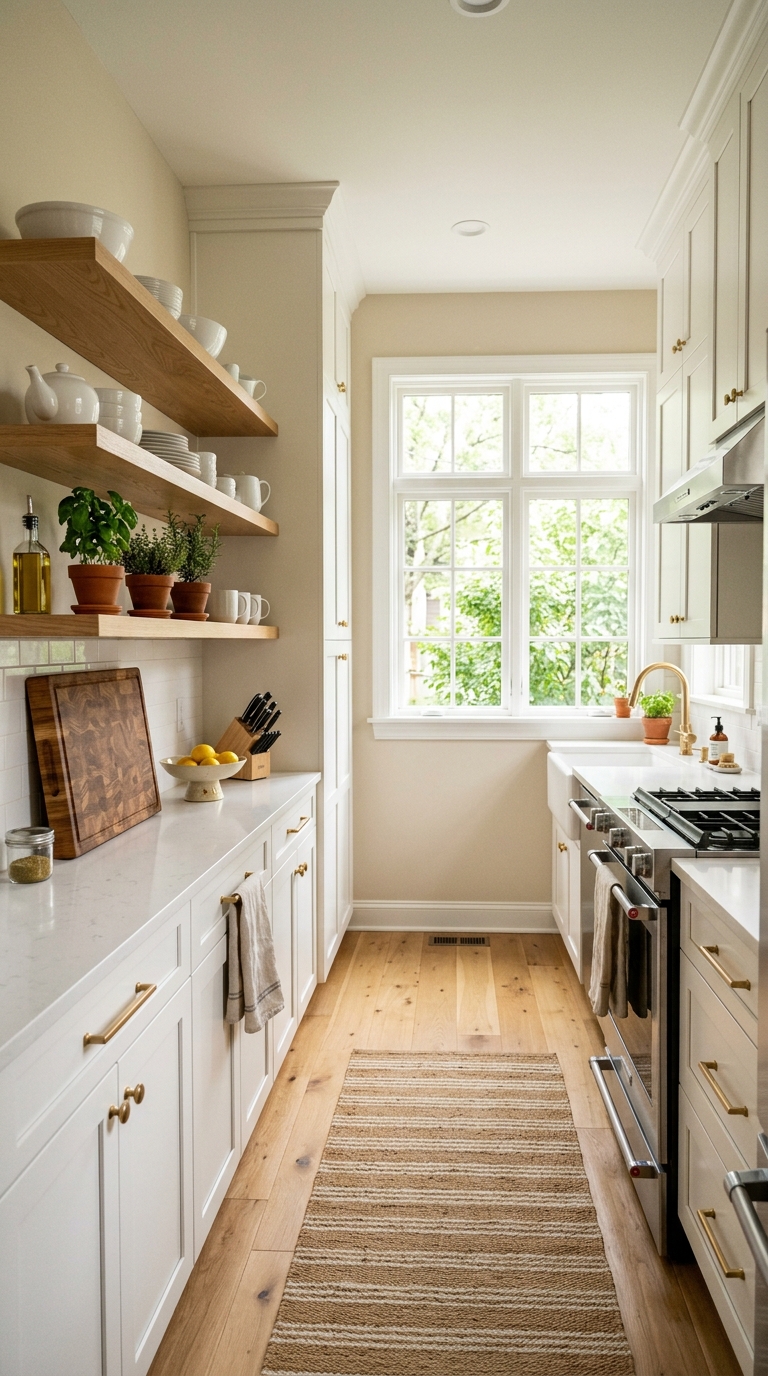
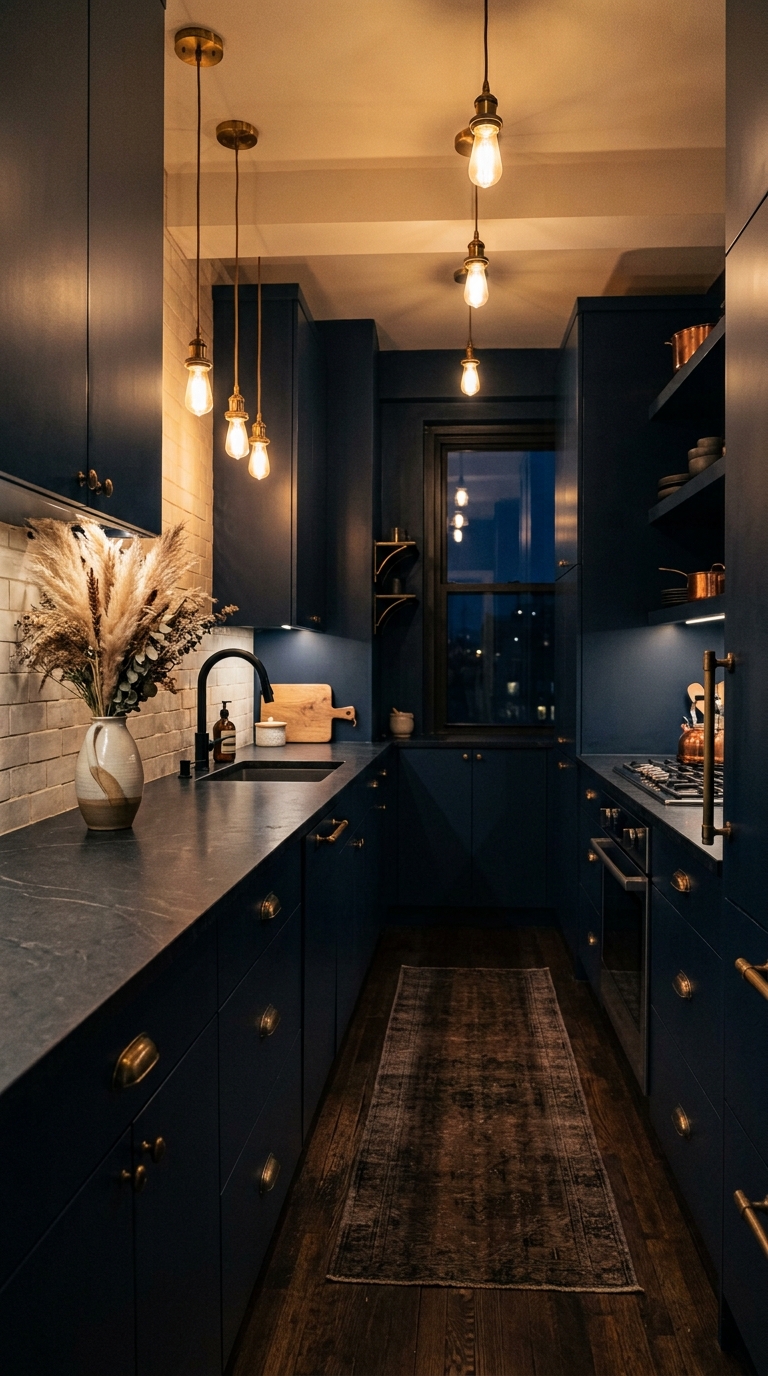
The Dark and Moody Galley — Midnight Navy with Brass Hardware
Midnight navy or deep charcoal cabinets paired with antique brass handles hit differently in a galley. Instead of fighting the enclosed feeling, you lean into it — and the narrow walls become a gorgeous tunnel of color that draws your eye straight through and photographs beautifully every time.
Add pendant lights with a warm amber glow rather than cool white, and your galley stops feeling small and starts feeling like a kitchen in a gorgeous boutique hotel. A matte black faucet and cream subway tile backsplash keep it from feeling overdone.
Add personality and depth to your space with these Blue Kitchen Cabinet Ideas that give galley kitchens a bold yet sophisticated style.
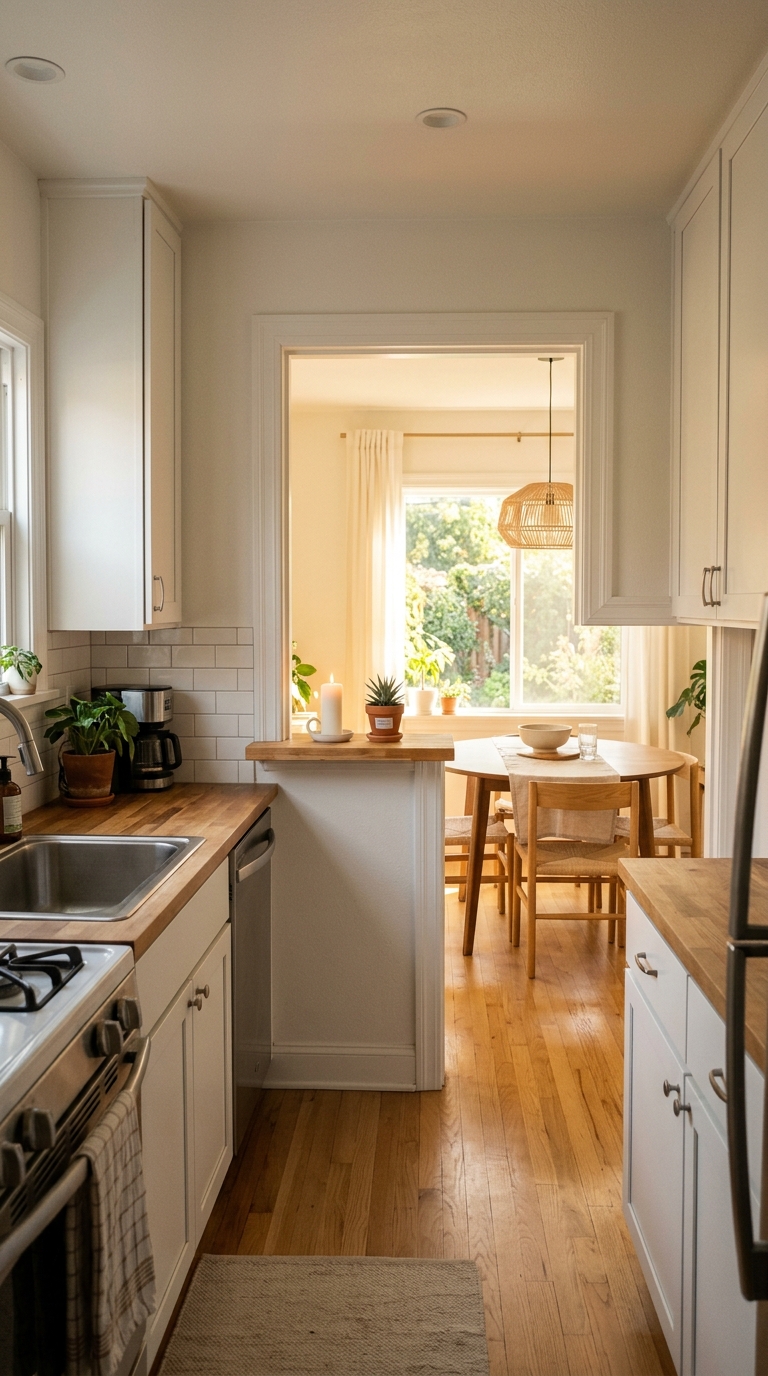
Pass-Through Serving Hatch Between Kitchen and Dining Room
A pass-through — a window-style opening cut between your kitchen wall and the dining room — lets light travel between both spaces and makes the whole area feel more connected. The best part is you don’t have to knock down a full wall; a smaller rectangular opening is enough to create the illusion of an open concept.
Frame it with simple trim, add a small shelf on the dining side for candles or a plant, and it instantly becomes an architectural feature rather than just a hole in the wall. For homeowners doing even a minor renovation, this can be genuinely transformative.
Image Prompt: Galley kitchen with a rectangular pass-through opening into a bright dining room, simple white trim framing the opening, a small wooden shelf on the dining side with a candle and small plant, light flowing through both rooms, warm afternoon light, clean white kitchen walls.
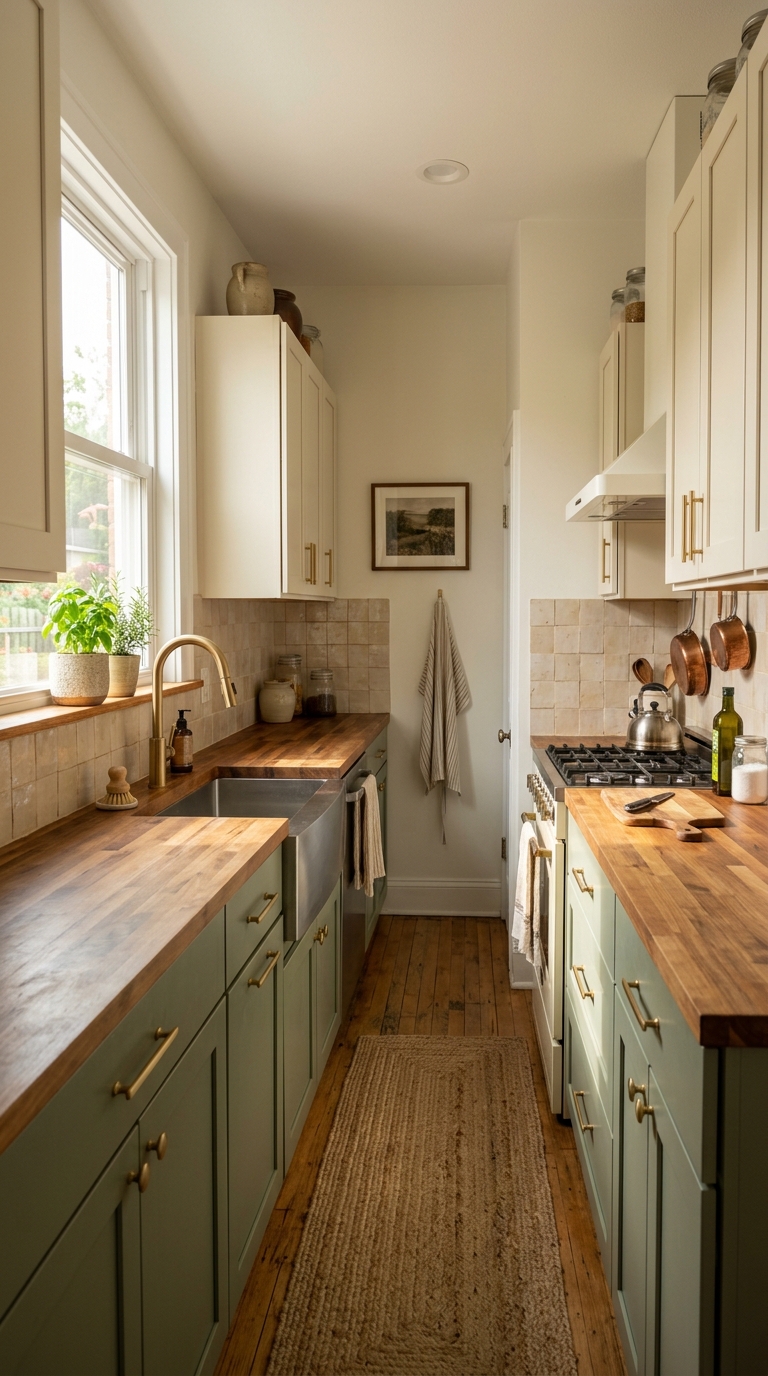
Sage Green Lower Cabinets with Cream Uppers
Two-tone cabinetry is one of the smartest things you can do in a galley kitchen. Lighter uppers keep the top half feeling airy and open, while the deeper color on the lower grounds the space and adds the kind of visual interest that makes a kitchen feel designed rather than default.
Sage green has a wonderful quality of reading differently throughout the day — almost neutral in morning light, warmer and richer in the evening. Pair it with brushed gold hardware and an earthy tile backsplash and you’ve got a kitchen that looks professionally styled, even if it was just paint and new hardware.
Choose White Oak Kitchen Cabinets to give your galley kitchen a warm, natural finish that enhances both style and everyday functionality.
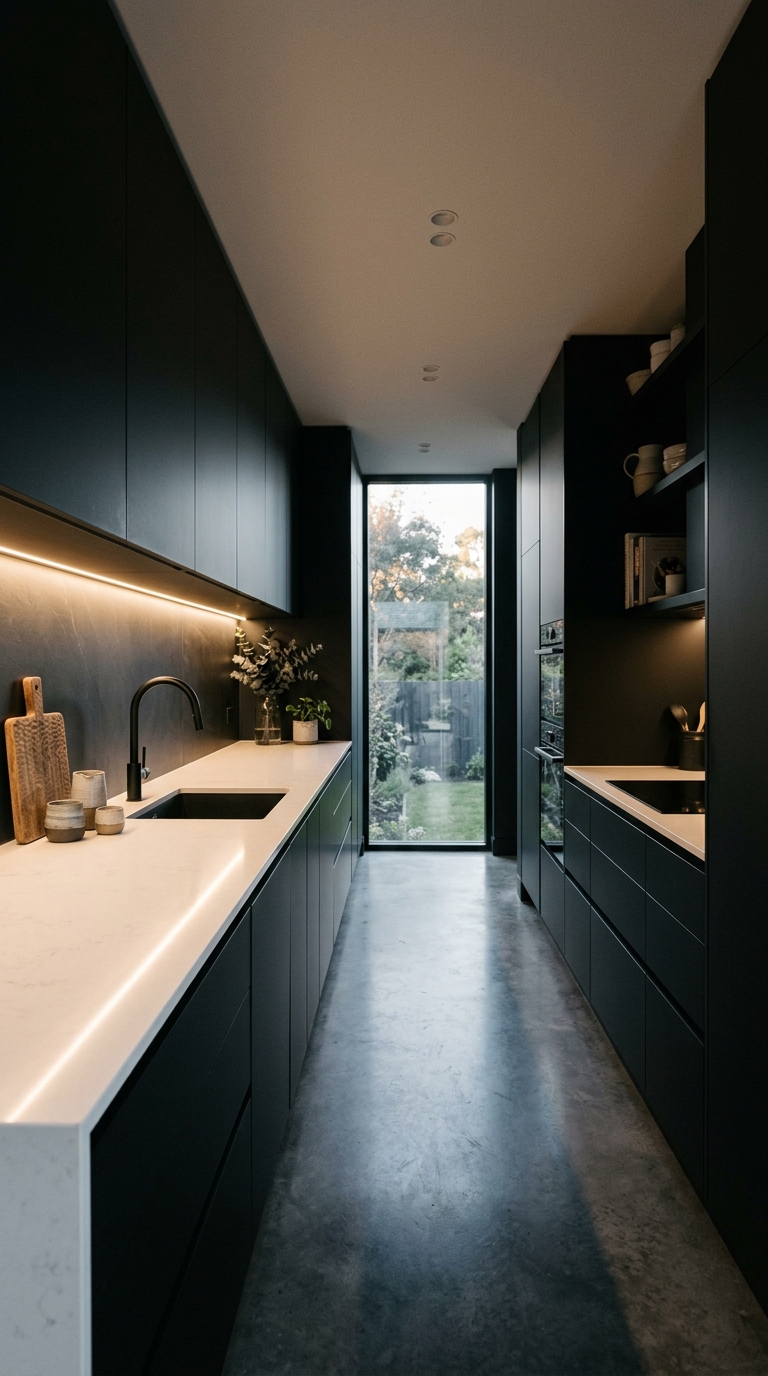
Handleless Matte Black Cabinetry with Under-Cabinet LED Lighting
There’s something incredibly satisfying about a kitchen with zero visual noise — no handles, no hardware, just clean flat-front cabinet doors in deep matte black with a strip of warm LED light glowing beneath each cabinet. It’s a look that feels very editorial and very deliberate.
Under-cabinet lighting is one of the most practical upgrades in a galley kitchen because your counter space is limited and you need to actually see what you’re doing. Keep everything else restrained — a white quartz countertop, a matte black faucet, almost nothing on the counters — and the result is stunning.
Upgrade your cooking space with these Modern Kitchen Remodel Ideas that combine sleek design, functionality, and efficient layouts.
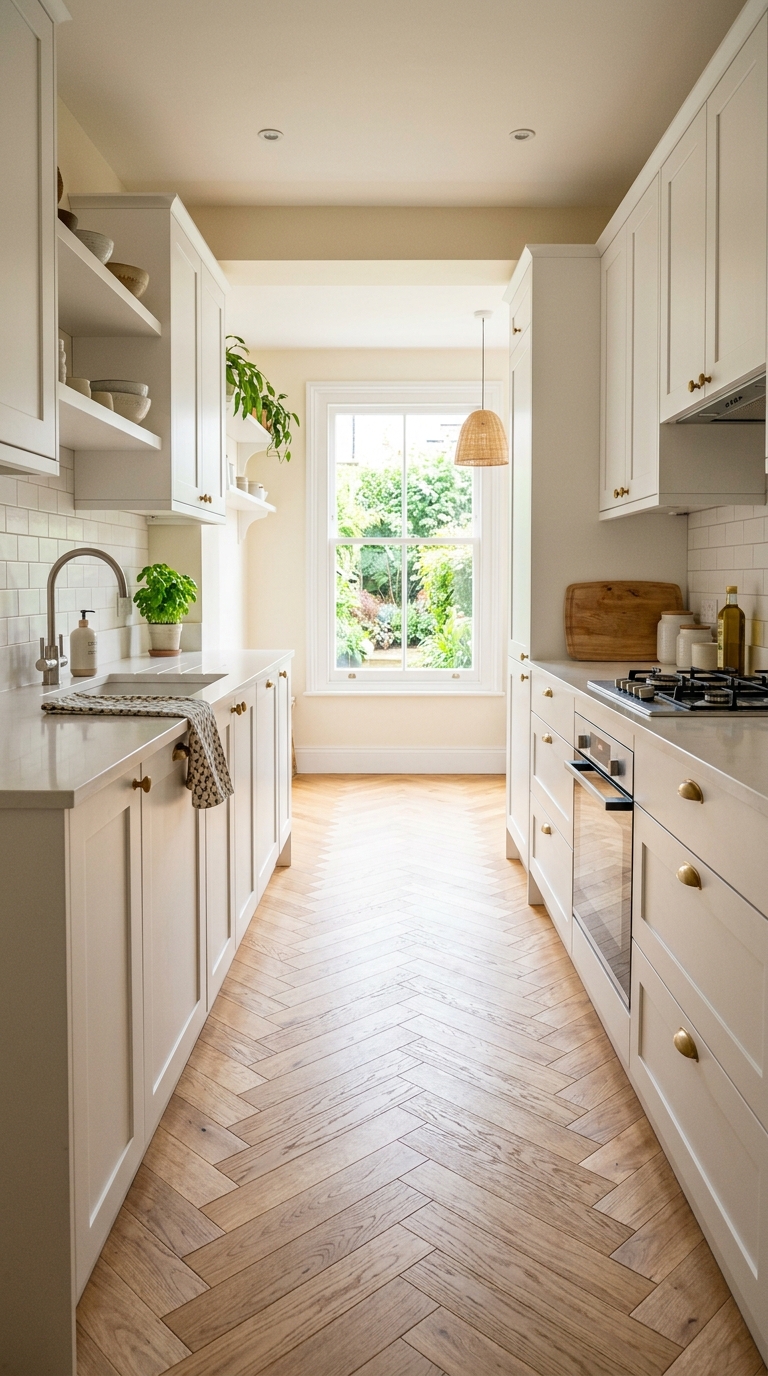
Herringbone Wood Floor to Visually Elongate the Space
The floor is one of the most underused design tools in a galley kitchen. A herringbone pattern in light oak can completely change the perceived length of the room — the diagonal lines pull your eye forward, making the kitchen look longer than it actually is.
Light oak is the sweet spot: dark floors can make a narrow galley feel cave-like, but a warm honey or natural blonde tone keeps the space feeling open. Even a wood-look LVP in herringbone has an elegance that elevates the entire kitchen, regardless of your cabinet color or style.
Subway Tile Backsplash — Classic Layout vs. Stacked Modern
Subway tile is a classic for a reason: it’s clean, affordable, reflects light beautifully, and works in almost any galley kitchen. But the way you lay it completely changes the mood — the traditional brick-lay pattern reads warm and familiar, while a vertical stack reads modern and graphic.
For galley kitchens specifically, a vertically stacked pattern helps the room feel taller, which is almost always a welcome trick. Both options are budget-friendly, and grout color gives you even more control — dark grout for an industrial feel, white or cream for something softer.
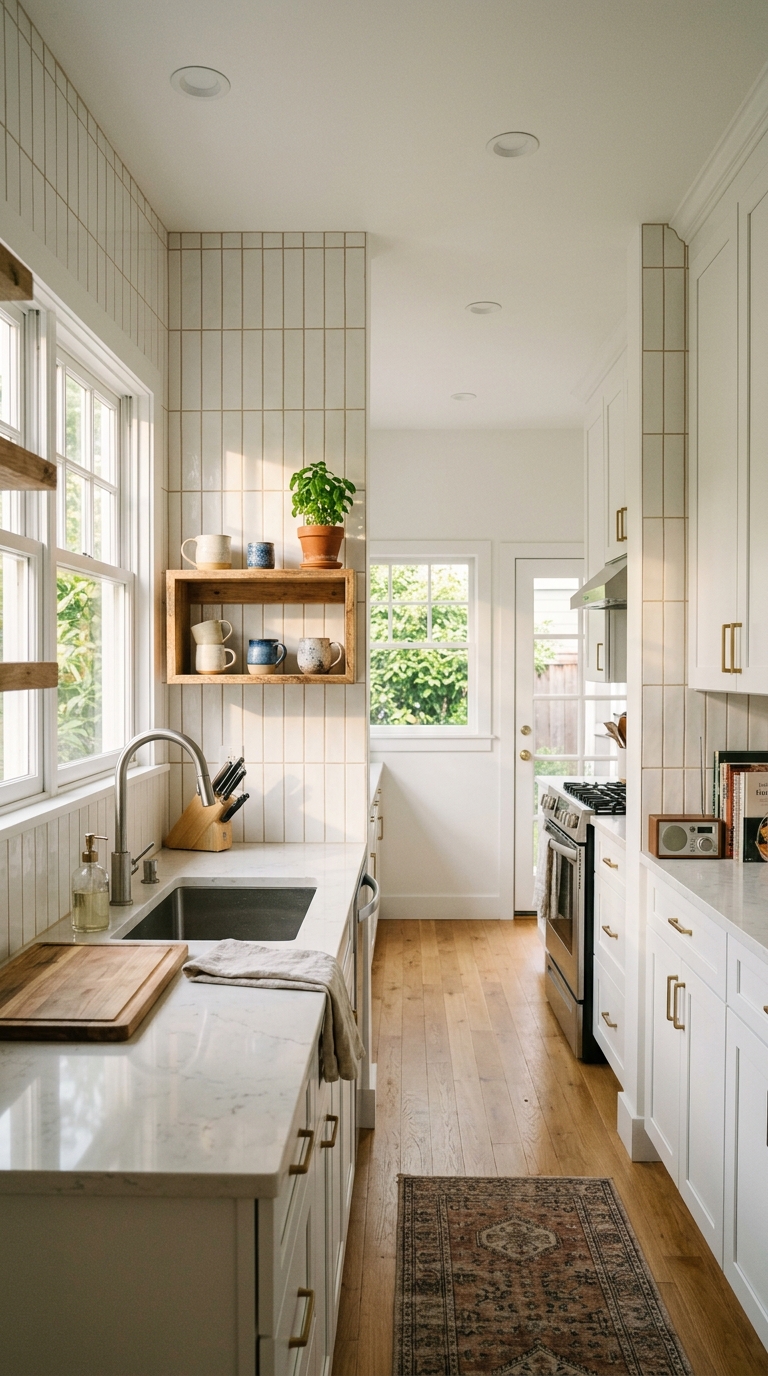
Tall Floor-to-Ceiling Pantry Cabinet at One End
Storage is the number-one struggle in a galley kitchen. Using that far end wall to install a full-height floor-to-ceiling pantry cabinet is a total game changer — a single tall pantry unit can hold more than three standard upper cabinets combined.
Add pull-out drawers on the lower half and adjustable shelves up top, and you suddenly have room for everything that usually ends up piling on your counters. Match the pantry to your surrounding cabinetry so it feels built-in rather than like a standalone piece of furniture.
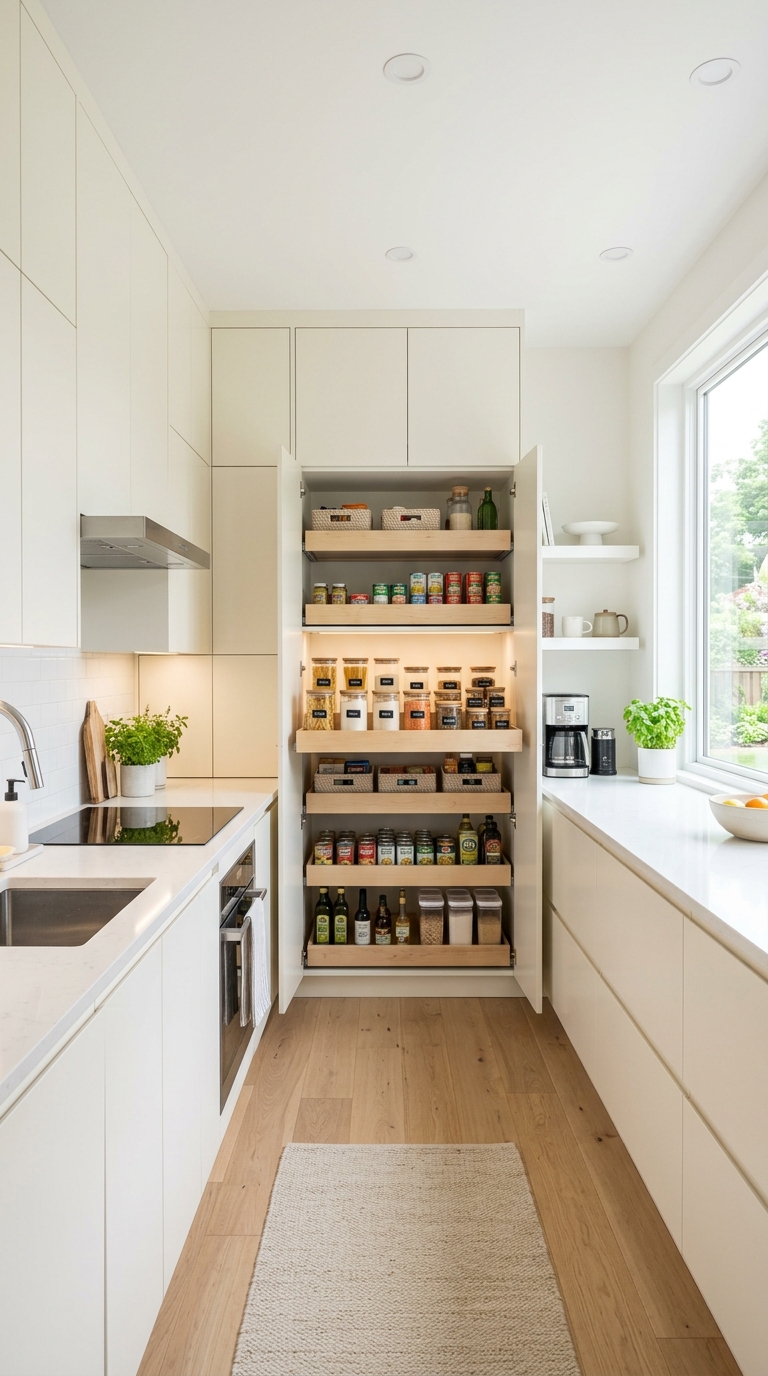
A Skinny Rolling Cart as a Pseudo-Island
Not every galley kitchen can fit an actual island — in fact, most can’t. But a slim rolling cart with a butcher block top gives you extra prep space exactly when you need it and tucks against the wall when you don’t, making it perfect for renters and small spaces alike.
Add hooks on the side for utensils and a lower shelf for pots or cookbooks, and if you paint it to match your cabinetry or choose a warm wood finish, it doesn’t look like an afterthought at all. Roll it out when you’re cooking, push it back when you’re done.
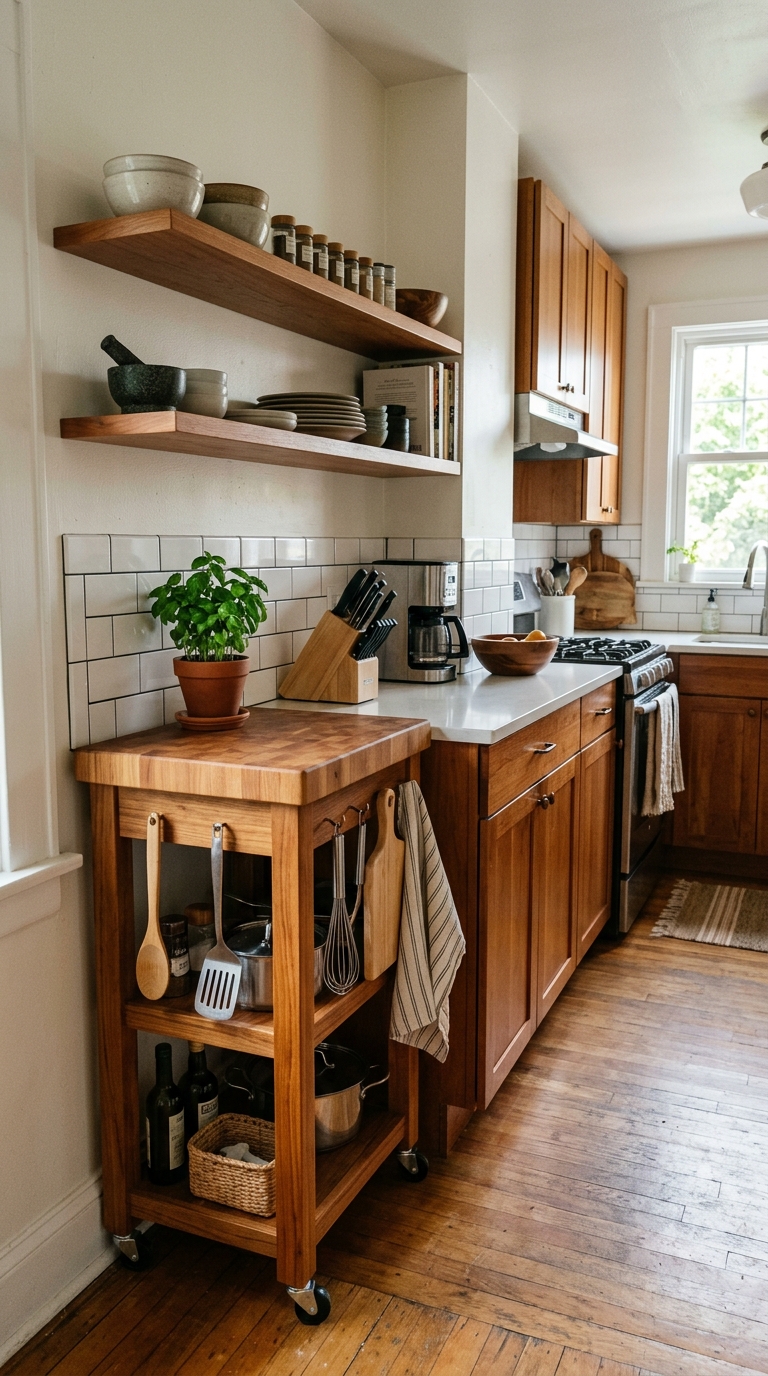
Moroccan or Zellige Tile Backsplash for Maximum Pinterest Appeal
Zellige tile — those handmade Moroccan tiles with their slightly uneven surface and subtle color variation — has a quality no other tile can replicate. Each tile catches light differently, and the result is a backsplash that looks alive rather than flat, especially across the long counter run of a galley.
You don’t even need a bold color; a creamy white or soft sage zellige does more work than a pattern tile in a brighter color because the texture is already doing all the talking. Pair it with flat-front cabinets and brass fixtures, and you have a kitchen that looks like it belongs in a design magazine.
Make your narrow kitchen feel larger with these White Backsplash Kitchen Ideas that reflect light and create a fresh, open look.
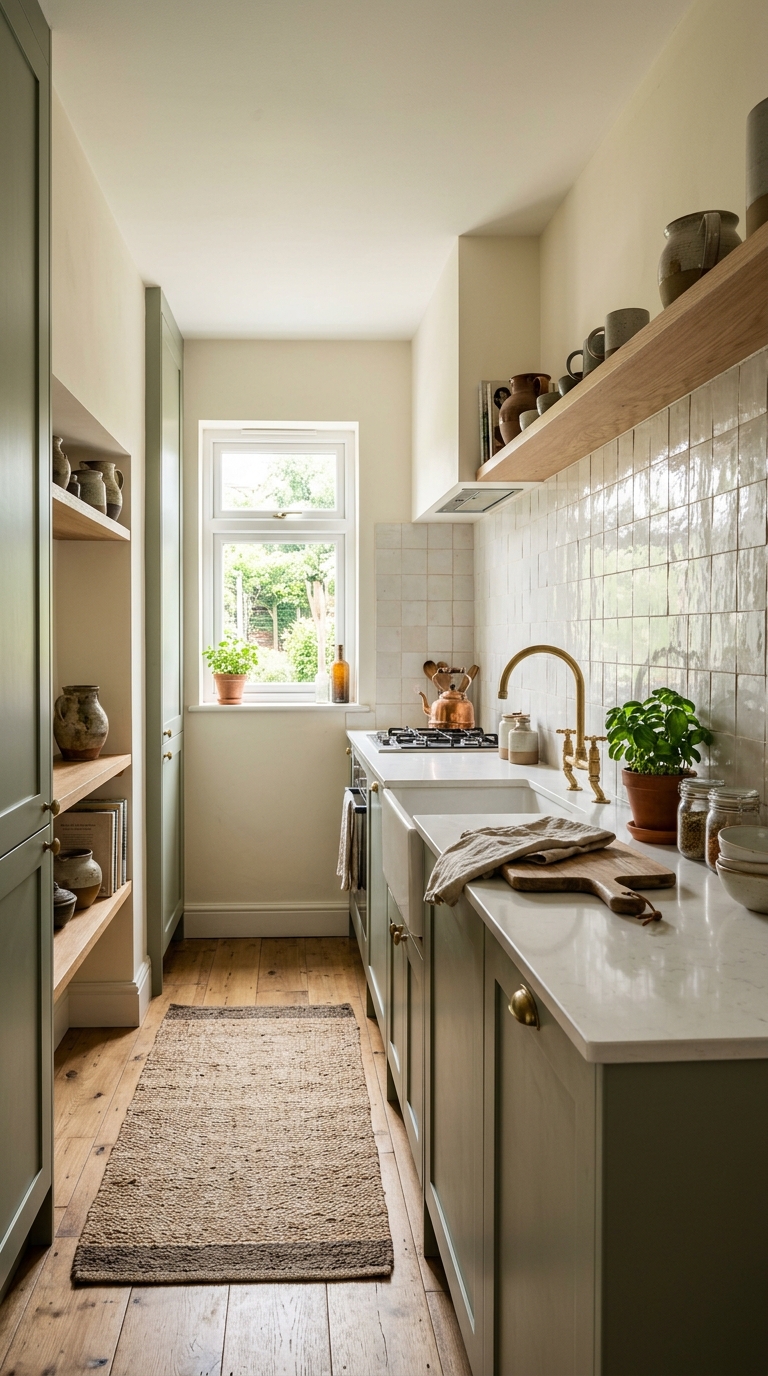
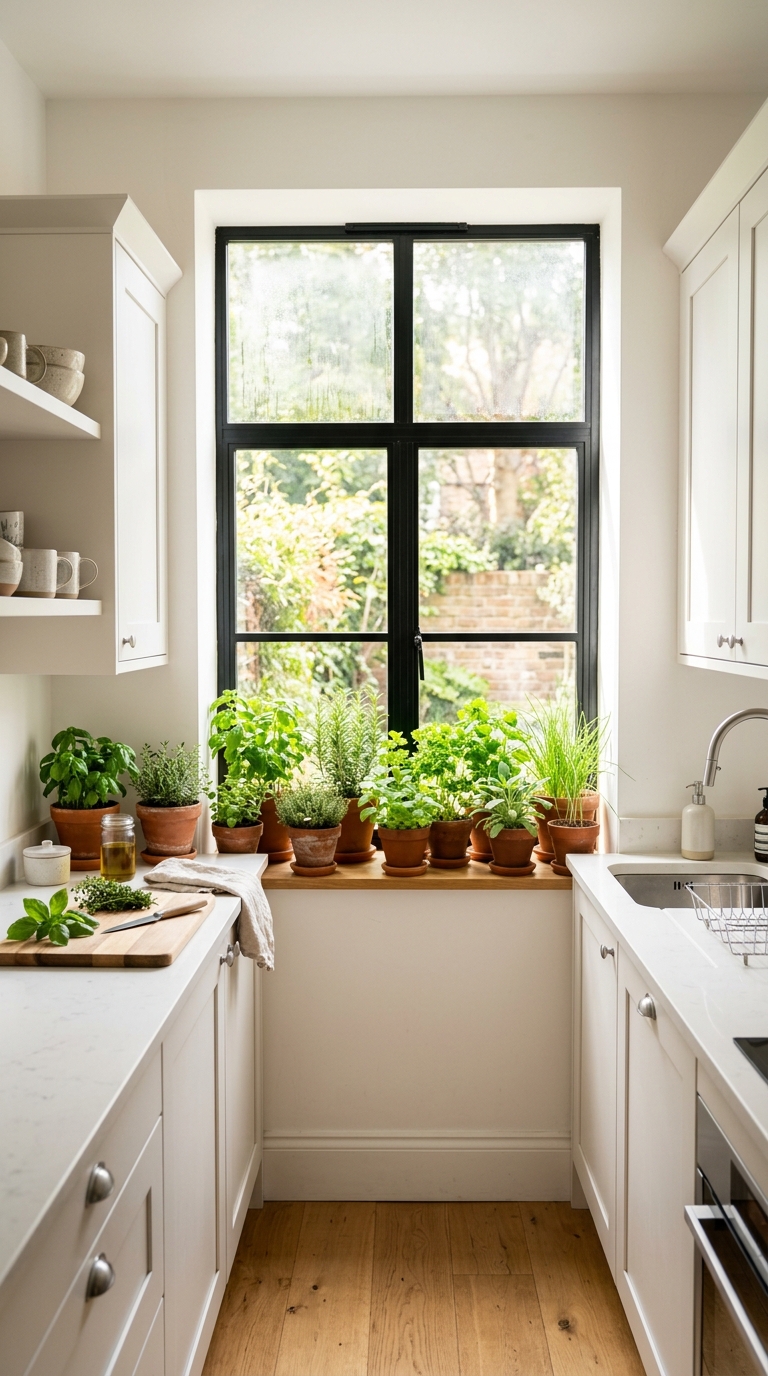
End-of-Galley Window Wall Turned into a Herb Garden Moment
A window at the far end of a galley is one of the best things that can happen to the layout — it creates a focal point, draws your eye through the room, and floods the kitchen with natural light. But what you put in and around that window matters a lot.
Turning the windowsill into a small herb garden works on every level: practically, you always have fresh herbs within reach, and visually, the green of living plants softens the hard lines of a kitchen. A slim black window frame makes the herbs pop even more dramatically against the soft morning light.
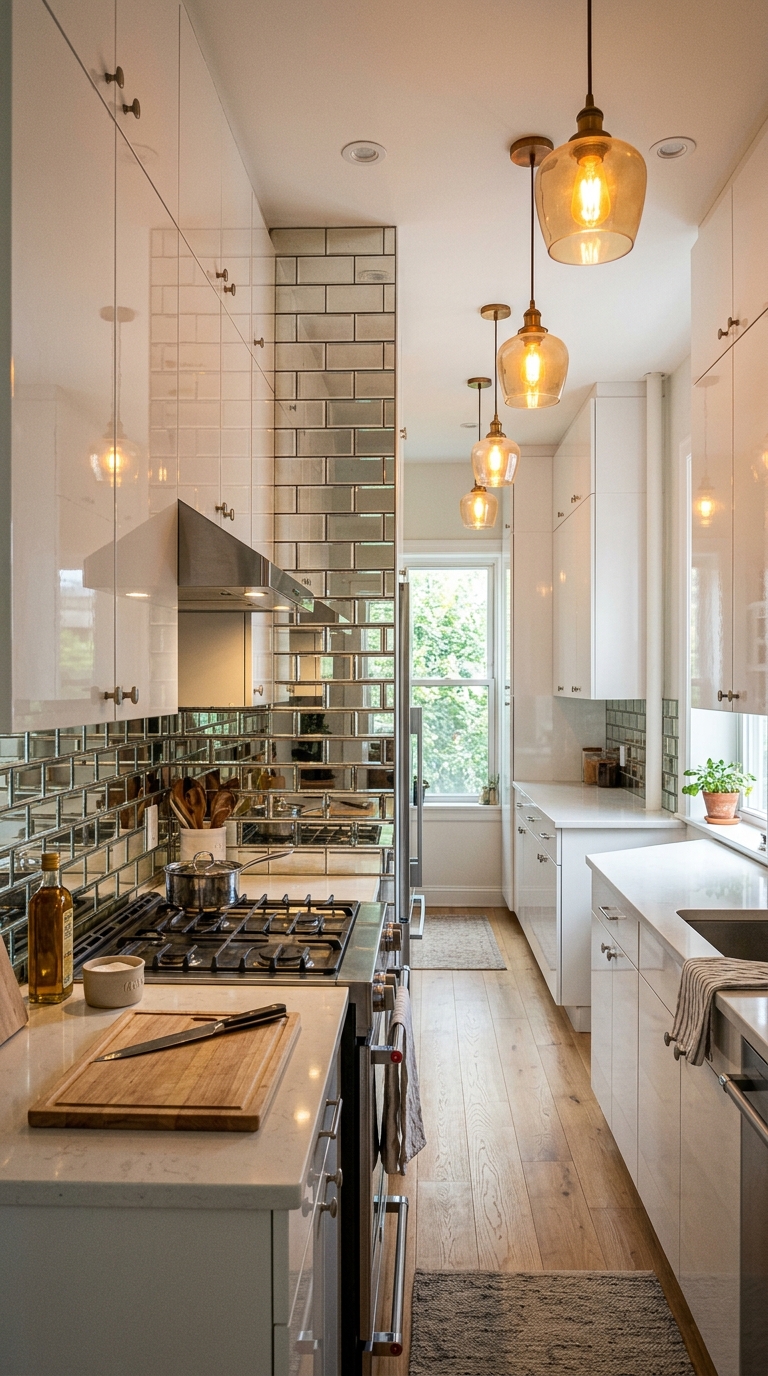
Mirrored or Glossy Backsplash to Bounce Light
A mirrored or high-gloss backsplash — particularly behind the stove or along the full counter run — bounces light back and forth across the kitchen and creates the illusion of more width. It’s the same trick interior designers use in small entryways, just applied to the kitchen.
A mirror-polished subway tile achieves this without looking like you’ve installed actual bathroom mirrors — the reflective quality is there, but it reads as a design choice. For a dark galley that doesn’t get much natural light, this is one of the most impactful changes you can make without touching a single cabinet.
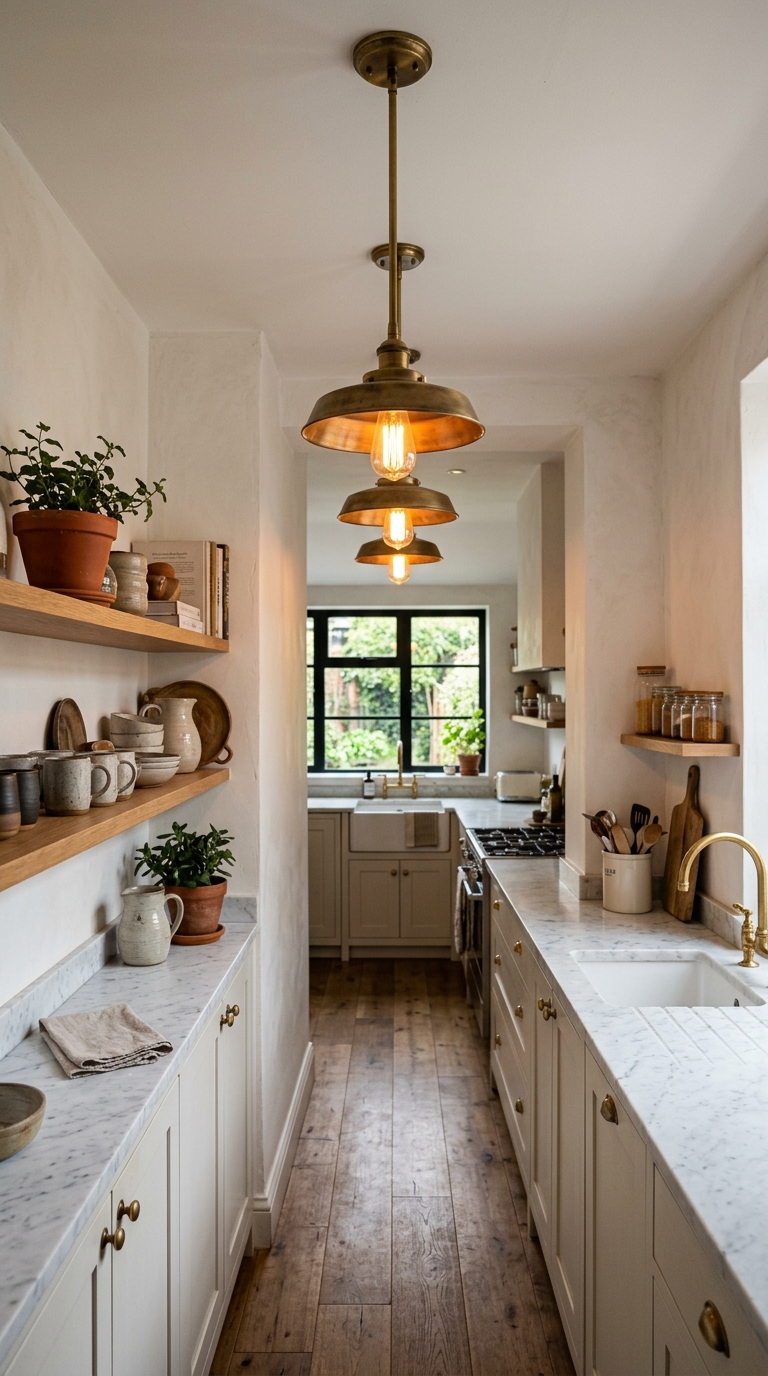
Statement Pendant Lights in a Row Down the Galley
Three pendant lights hung in a row down the length of the kitchen do something no other single change can: it creates a rhythm — a visual beat that your eye follows naturally from one end of the galley to the other. It’s one of the fastest ways to make a space feel intentional and designed.
Aged brass pendants with a simple glass or cage shade work across farmhouse, modern, and transitional styles. The key is to hang them all at the same height and space them evenly — when perfectly aligned, even a basic kitchen starts to feel thought-through and expensive.
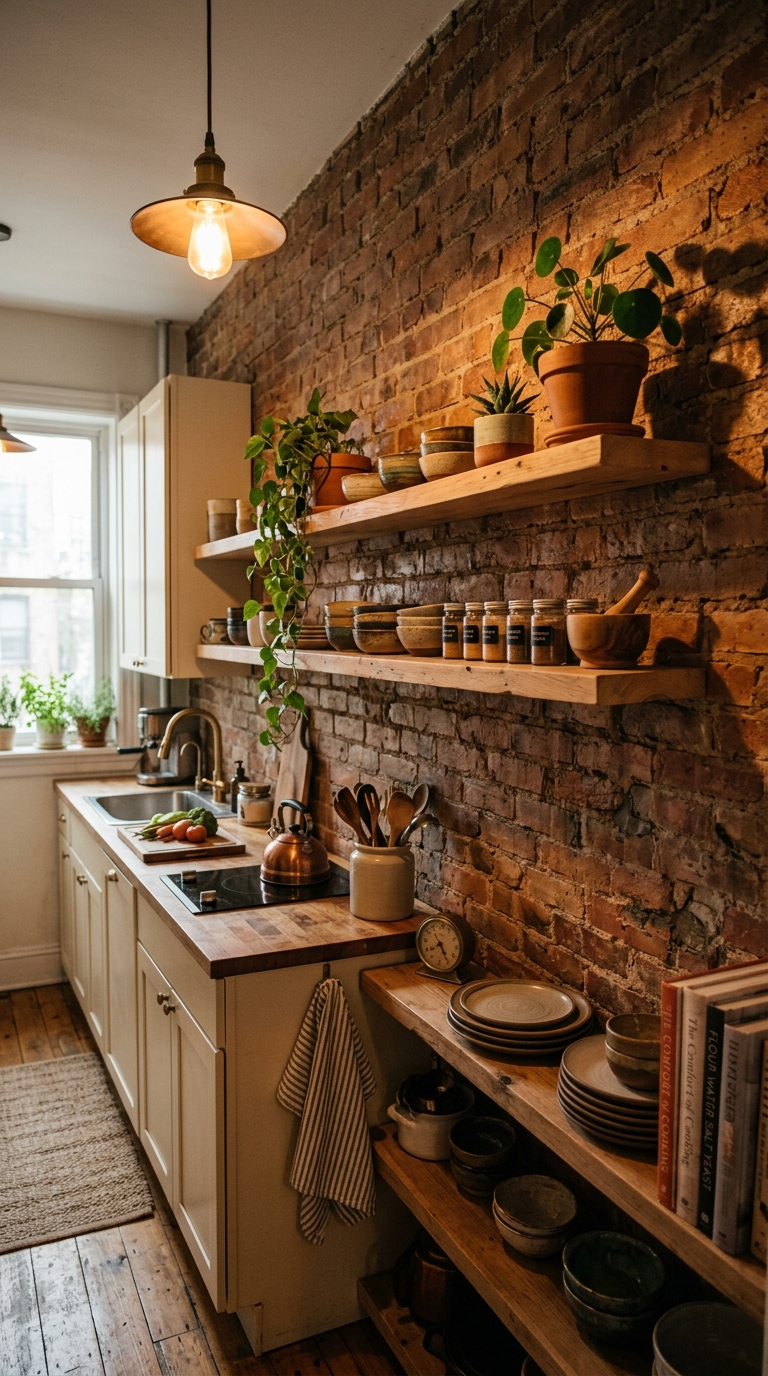
Exposed Brick Accent Wall Along One Side
Exposed brick in a galley kitchen does something few other design choices can — it tells a story. It brings texture, history, and warmth into a space that can feel purely functional, and in a narrow kitchen where you’re always close to the walls, that texture becomes something you actually feel as part of the experience.
Raw brick pairs beautifully with open wood shelving, hanging cast iron pans, and a few ceramic pieces for a kitchen that feels like it belongs in a Parisian apartment. If raw brick feels too rough, painted brick in white or off-white achieves a similar texture with a softer, more refined look.
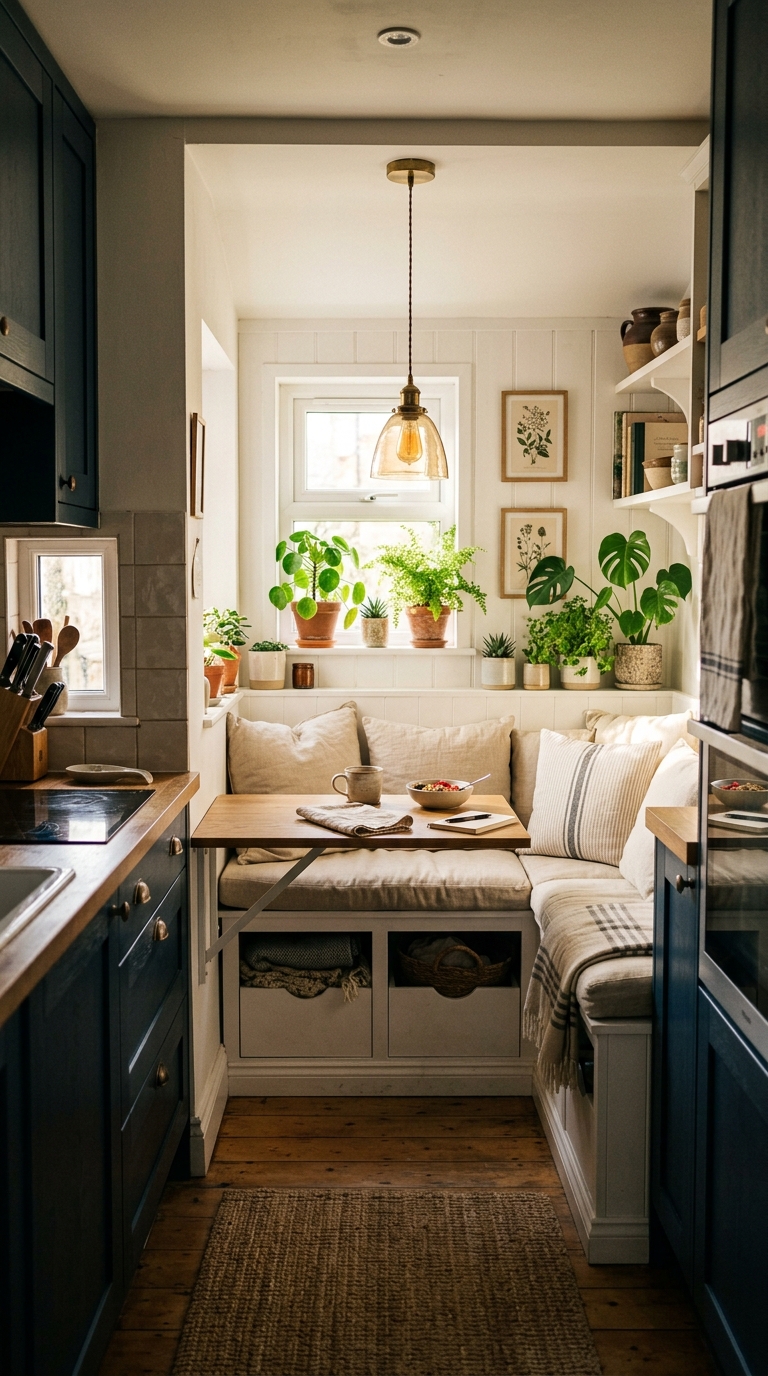
Cozy Breakfast Nook Built into the End of the Galley
Galley kitchens often end in a blank wall — and most people never think to use that terminal space for anything interesting. But if your galley has a few extra feet at one end, a small built-in breakfast nook turns that dead space into one of the most charming spots in your entire home.
A wall-mounted fold-down table takes up almost no space when not in use, and a built-in bench with a hinged seat for hidden storage solves two problems at once. Add cushions in linen or boucle fabric, a small pendant light above, and the nook instantly looks intentional and designed — not improvised.
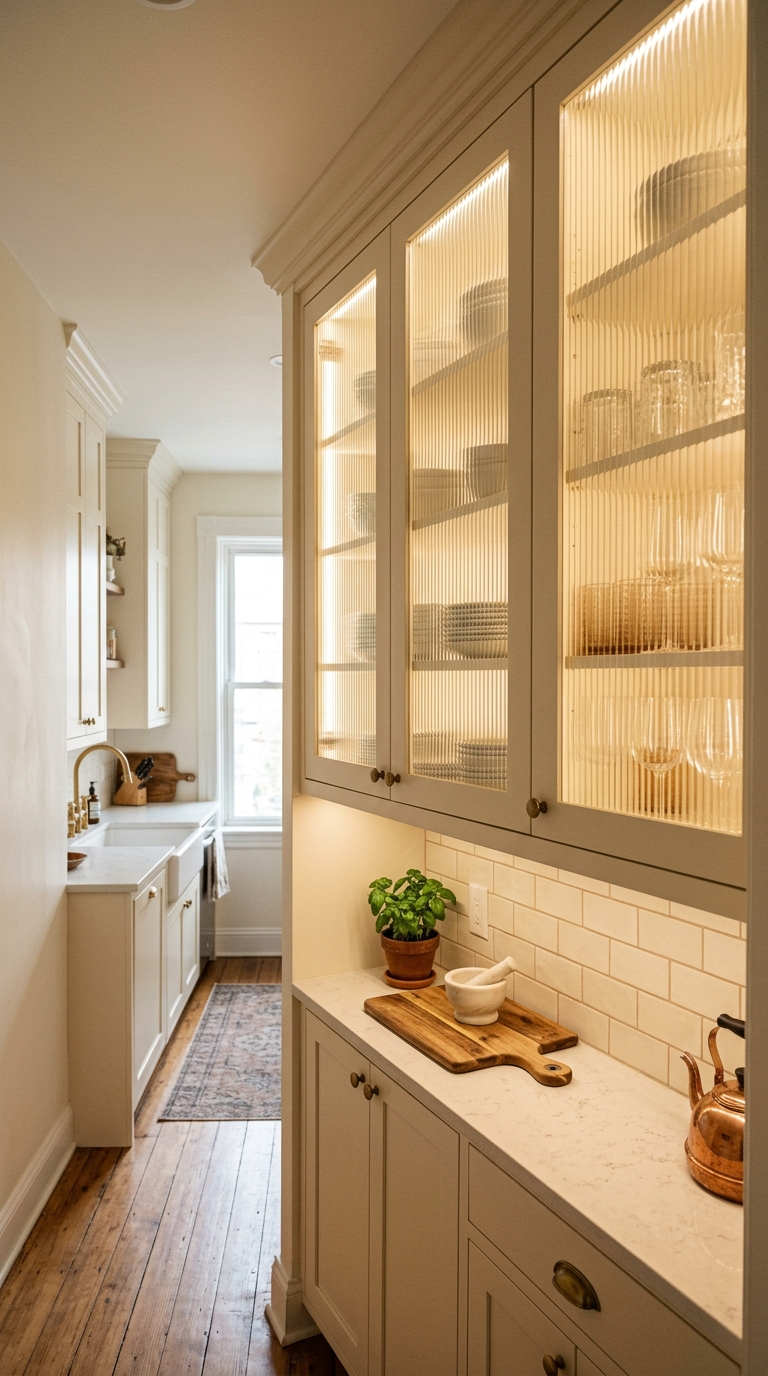
Glass-Front Upper Cabinets to Break Up Visual Heaviness
Solid cabinet doors on both walls of a galley can start to feel oppressive — they close the space visually and make it harder for light to move around. Swapping even just two or three upper cabinet doors for glass fronts makes an immediate and noticeable difference.
Reeded or fluted glass is a particularly beautiful option right now — it lets light filter through while keeping the contents slightly softened, so your cabinet doesn’t have to be perfectly Instagram-styled every single day. That’s a very practical consideration for real daily kitchen life.
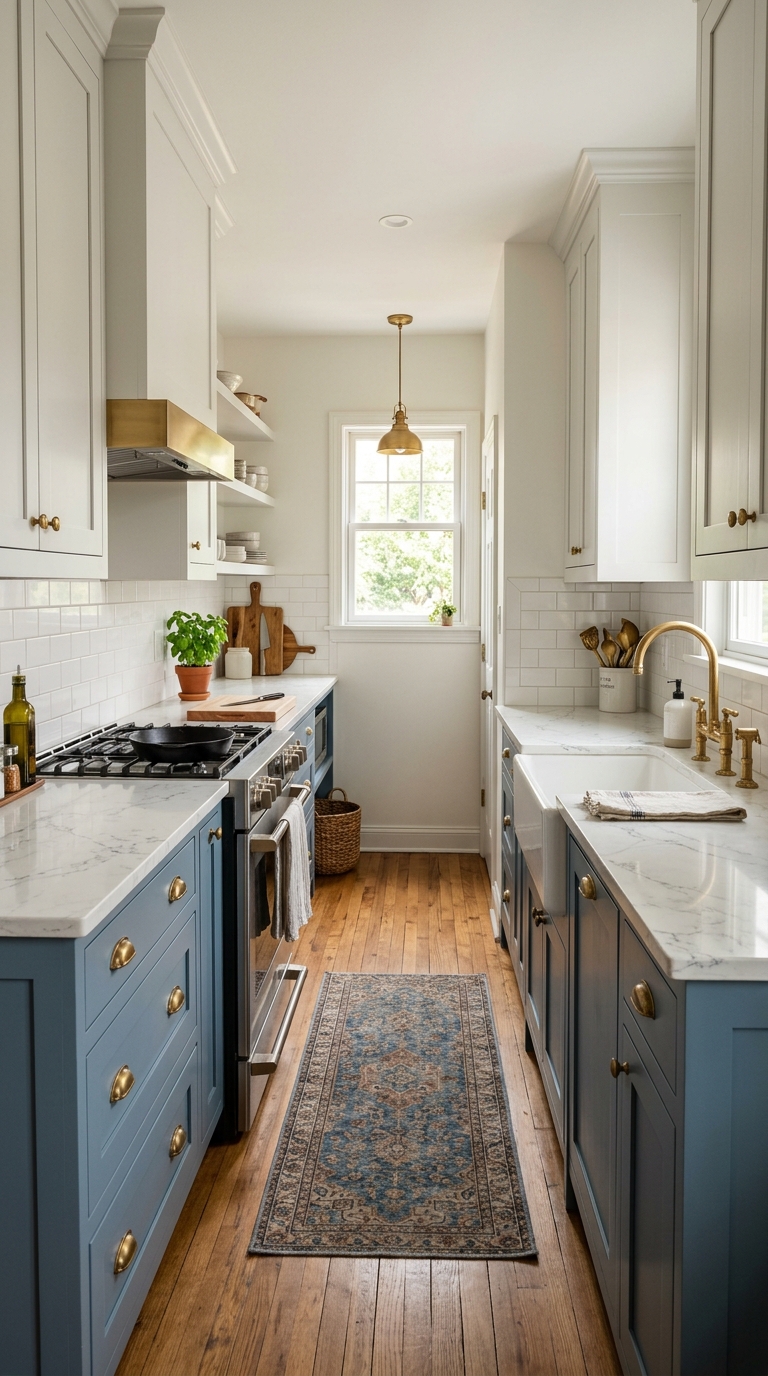
Two-Tone Cabinetry — Bold Lower, Soft Upper
Two-tone cabinetry makes a kitchen feel professionally designed without requiring a full renovation. A softer, lighter tone on top and something with more personality on the bottom creates visual depth that a single-color kitchen simply can’t achieve.
The rule of thumb: keep the darker color on the bottom to ground the space and prevent a top-heavy feeling. Go for something like dusty blue or forest green on the lowers with soft white uppers, add unlacquered brass hardware and a marble-look countertop, and the combination is genuinely stunning.
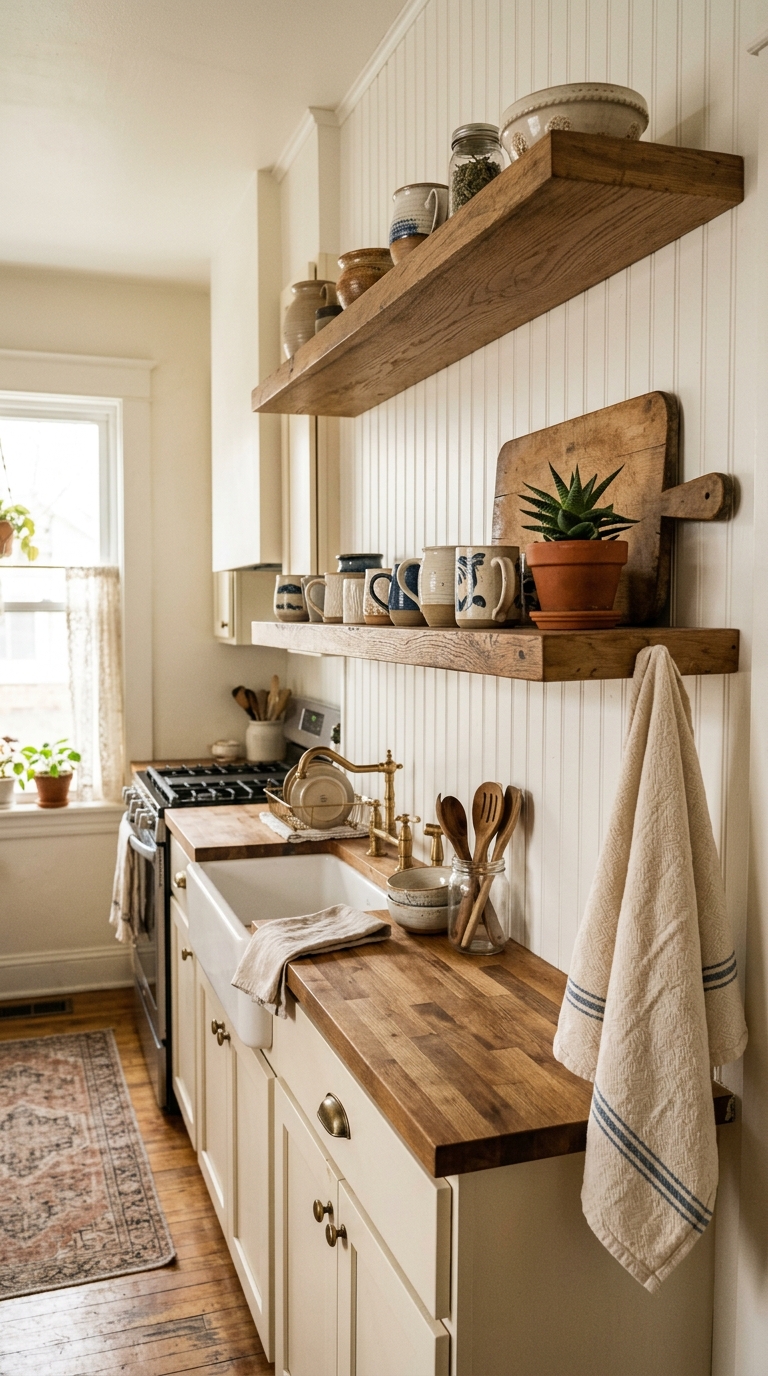
Beadboard or Shiplap Backsplash for Farmhouse Charm
Not every galley kitchen backsplash needs to be tile. Painted beadboard or shiplap paneling is one of the most budget-friendly alternatives, and it gives the kitchen an immediate cottage or farmhouse personality that feels genuinely warm and cozy.
This works particularly well behind open shelving, where the beadboard becomes a beautiful backdrop for displayed items. Just make sure to seal it with a semi-gloss or gloss paint to keep it wipeable — otherwise it’s a completely achievable DIY weekend project that looks like it cost far more than it did.
Integrated Panel-Ready Appliances for a Seamless Line
A stainless steel fridge, a dishwasher with its own face, a microwave in a different finish — in a narrow galley, all these different appliance fronts create visual fragmentation, and the eye has nowhere to rest. Panel-ready appliances solve this completely.
They’re designed to have custom cabinet panels fitted over the front, so your fridge, dishwasher, and microwave drawers can be matched exactly to your cabinetry. The result is a kitchen that looks like one long, seamless composition — and even in a modest galley with simple cabinets, it makes everything feel dramatically more high-end.
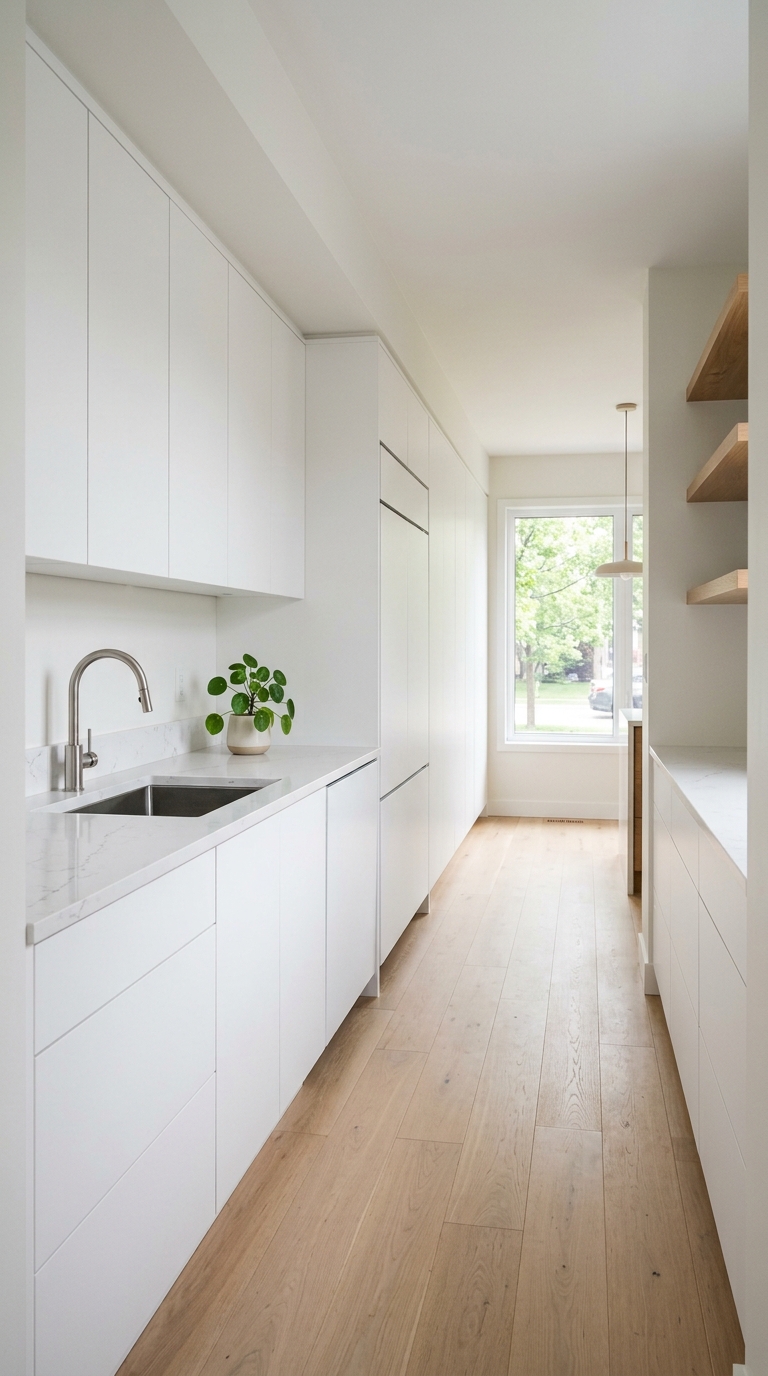
Bold Colored Ceiling to Add Drama and Draw the Eye Up
A colored ceiling in a galley sounds like it would make the space feel smaller — but it actually does the opposite. When the ceiling is a different color from the walls, your eye is drawn upward, and the kitchen suddenly feels taller than it actually is.
Terracotta, deep forest green, or navy on the ceiling paired with white walls and cabinets below creates a beautiful framing effect that makes pendant lights look more dramatic and intentional. And since a ceiling repaint is genuinely easy to reverse, it’s one of the boldest moves with the least commitment in interior design.
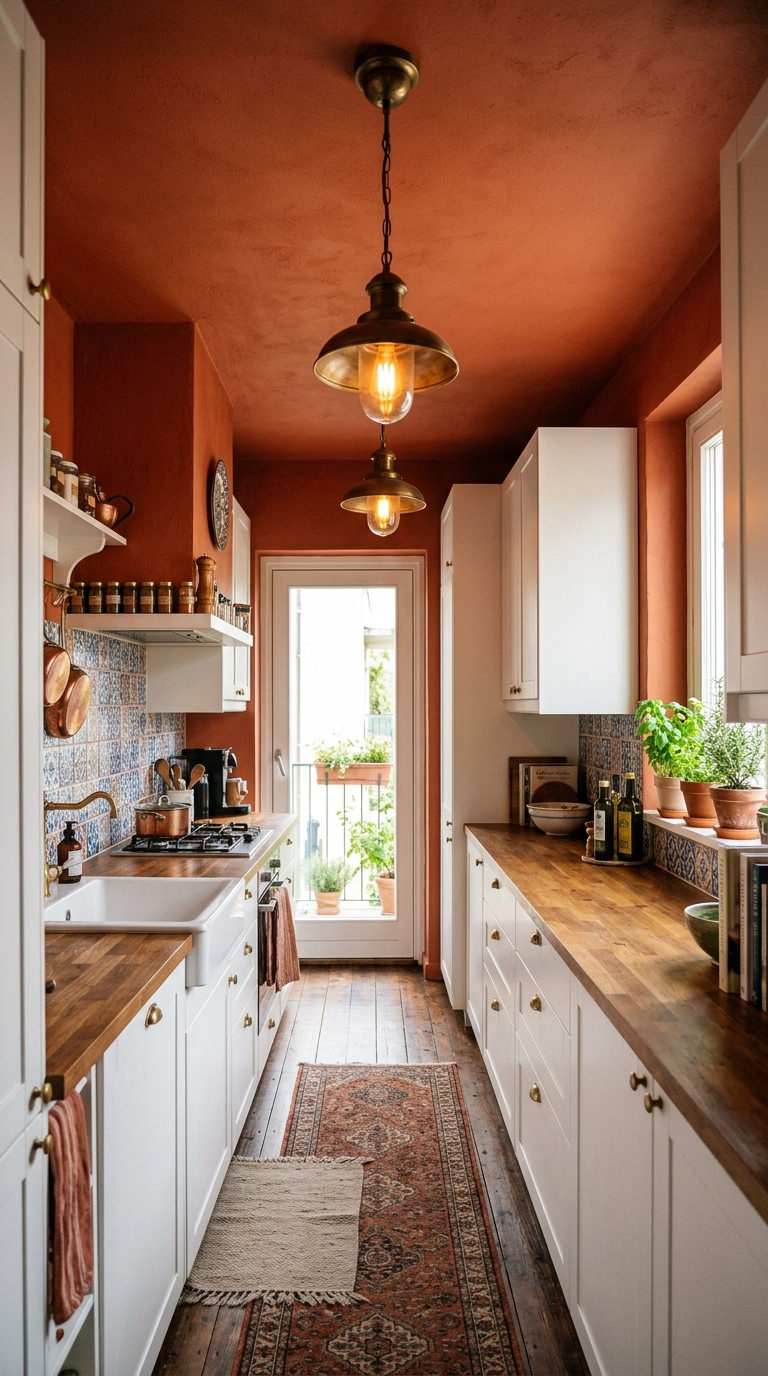
Open Concept Galley with Breakfast Bar on One Side
If your galley connects to a living or dining space, removing a partial wall and installing a breakfast bar on the kitchen-facing side is one of the most impactful renovations you can do. It transforms the galley from a solo cooking corridor into a social, connected kitchen where you can cook and still be part of the room.
The breakfast bar doesn’t need to be wide — even a 12-inch overhang is enough for bar stools and casual eating. Run pendant lights above the bar on the dining side, and it creates a beautiful visual separation between zones without needing a wall at all. This is the galley transformation that gets the most gasps.
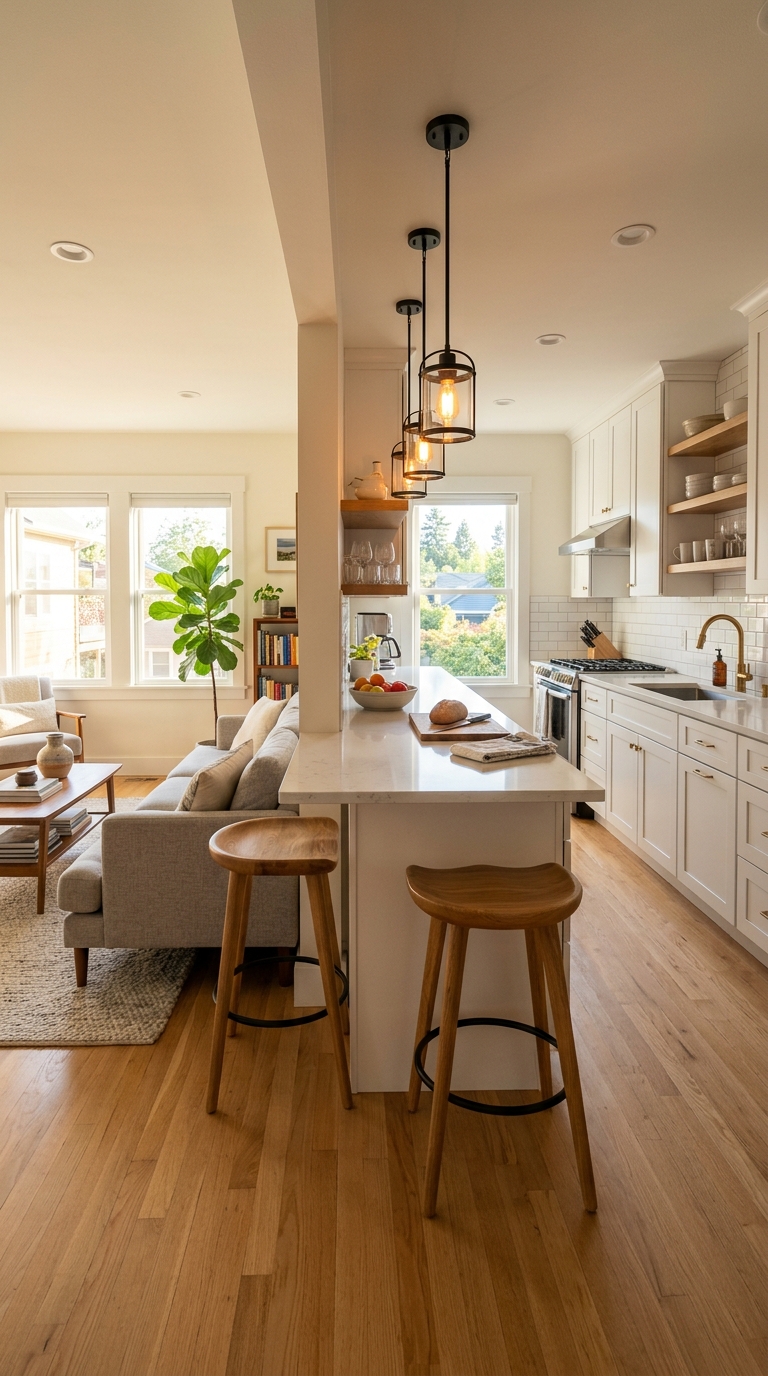
Vertical Tile Backsplash to Draw the Eye Up and Create Height
Layout direction matters more than most people realize when it comes to tile. Tiles laid horizontally make a room feel wider; tiles laid vertically make it feel taller. In a galley where you’re constrained on width, vertical tile is one of the most straightforward visual tricks you can use.
Long, narrow tiles like fluted ceramic stacked vertically and running floor to ceiling create a beautiful elongating effect in any color — white for a classic look, sage for something warmer. The floor-to-ceiling run is critical; half-height tile loses most of the effect, so go all the way up.
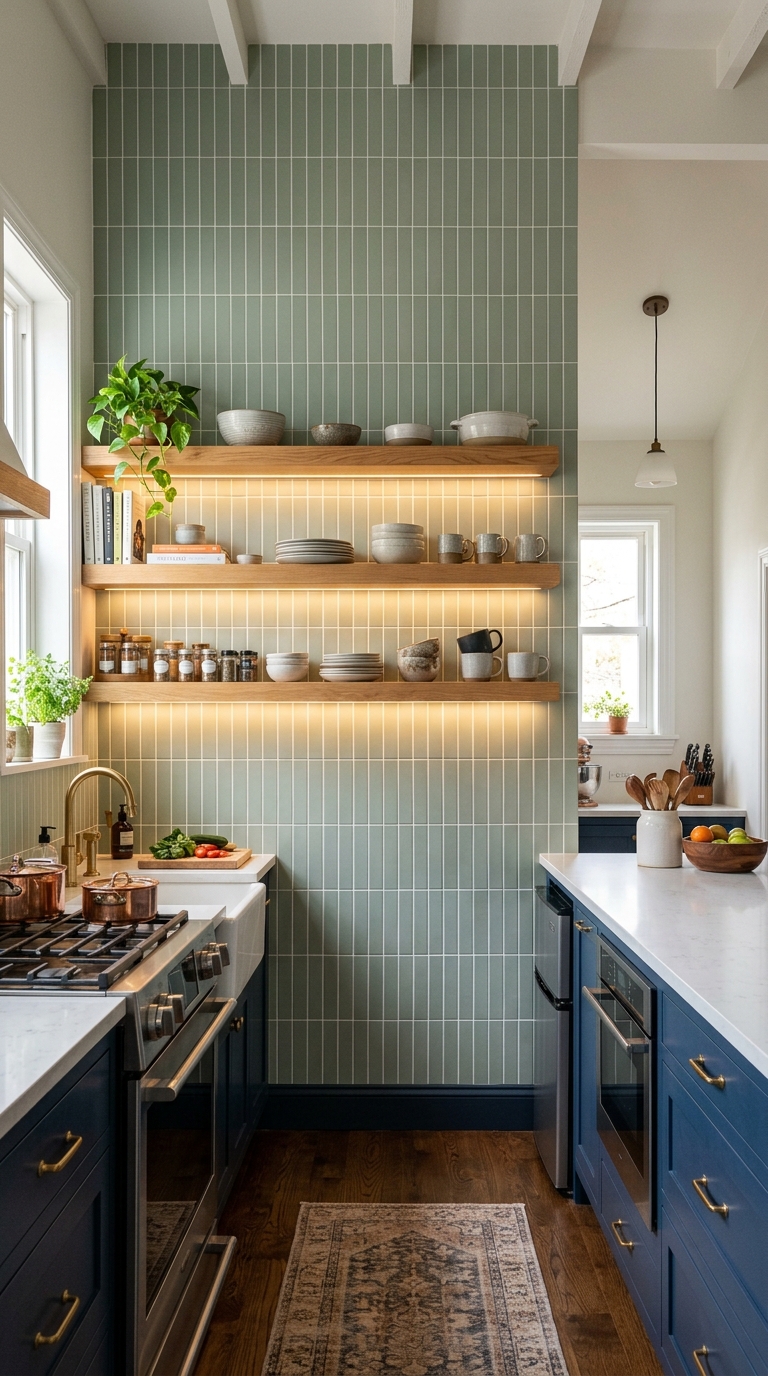
Warm Minimalist Galley — Natural Materials, Zero Clutter
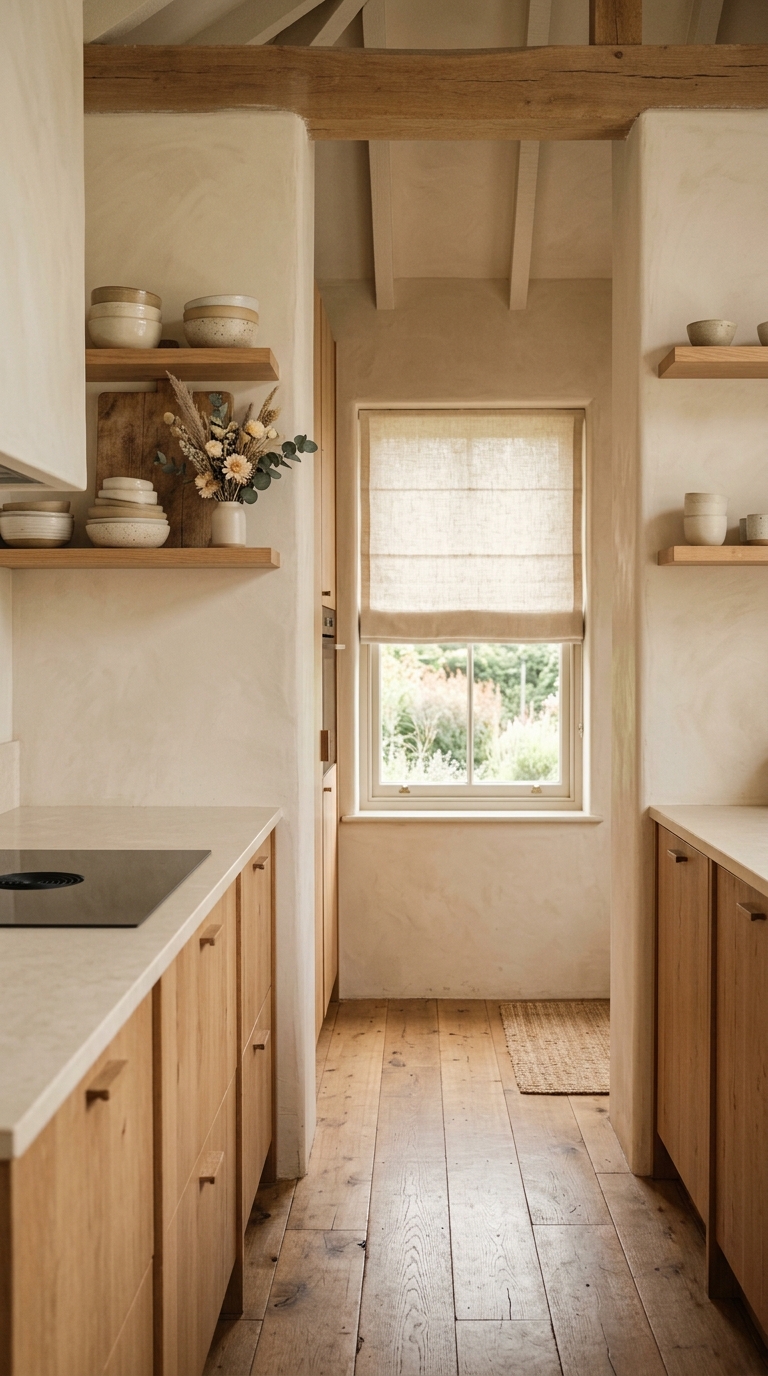
The warm minimalist look combines the calm of a Japandi interior with the warmth of organic materials — raw oak, limewash plaster, handmade ceramics, and linen. The result is a kitchen that feels deeply peaceful, the kind of space you actually want to spend time in rather than just pass through.
The key is zero clutter on the counters: one beautiful wooden cutting board, a small ceramic crock with wooden utensils, maybe a single vase with dried grasses. Limewash plaster walls are the secret ingredient — the subtle texture and color variation give the kitchen walls a soft, artisanal quality that paint simply can’t replicate.
5 Galley Kitchen Styling Tips That Make a Real Difference
Layer your lighting. One overhead light is never enough. You need overhead, under-cabinet task lighting, and at least one pendant working together — that’s what makes the kitchen feel warm and dimensional rather than flat and utilitarian.
Keep counters as clear as possible. In a narrow kitchen, visual clutter multiplies the feeling of tightness. Clear counters are the single fastest way to make your galley feel bigger and calmer — even a beautiful galley looks chaotic when counters are loaded with appliances and random items.
Run the same flooring into adjacent rooms. When the floor material continues without interruption from the galley into the living or dining area, the spaces read as one, and the galley immediately feels less like a separate, smaller room.
Add at least one natural element. A plant, a wooden shelf, a linen shade, a bundle of dried herbs. Natural materials soften the hard lines of a kitchen and make it feel lived-in rather than showroom-staged.
Pick one metal finish and commit to it. Mixed metals in a small kitchen fragment the eye. Choose brass, matte black, or brushed nickel — and use it consistently across faucets, hardware, light fixtures, and accessories. Consistency creates calm, and calm is exactly what a galley kitchen needs.
FAQS
What is a galley kitchen?
A galley kitchen is a narrow, corridor-style kitchen with two parallel counters facing each other, usually with a walkway in between. The layout is common in apartments, small homes, and older houses, and is named after the compact kitchens found on ships.
How do you make a galley kitchen look bigger?
Use light, reflective colors on cabinets and walls, install under-cabinet and overhead lighting to eliminate shadows, choose glossy or light-colored countertops, and add a mirrored or glass backsplash. Open shelving instead of upper cabinets also reduces visual bulk and makes the space feel taller and wider.
What is the ideal width for a galley kitchen?
Most designers recommend at least 42 inches between counters for one cook, and 48 to 60 inches if two people will be working in the kitchen at once. Anything under 36 inches starts to feel cramped and limits cabinet and appliance options.
Should galley kitchen cabinets be light or dark?
Light cabinets generally work better in galley kitchens because they reflect more light and make the narrow space feel open. Dark cabinets can still work if paired with strong lighting, a light-colored countertop, and a contrasting light wall or backsplash to avoid a closed-in feel.
Can a galley kitchen have an island?
Most galley kitchens are too narrow for a full island, but a slim rolling cart, a fold-down counter extension, or a narrow peninsula at one end can add workspace without blocking the walkway. A true island typically needs at least 42 inches of clearance on all sides, which most galley layouts don’t have.
Where should appliances go in a galley kitchen?
The most efficient setup follows the kitchen work triangle: place the refrigerator near the entrance, the sink in the middle, and the stove closer to the far end, splitting these points across both counters. This keeps foot traffic logical and reduces the number of steps between key tasks.
Conclusion
Galley kitchens are not a compromise — they never were. They’re one of the most efficient, most workable kitchen layouts ever designed, and with the right ideas, they can be some of the most beautiful spaces in any home.
The ideas in this list prove that narrow doesn’t mean limited. It just means intentional. Every choice matters a little more in a small space, and that’s actually the gift — because when you get it right, the result feels completely personal and completely yours. Save your favorites, try one thing at a time, and trust the process. Your galley kitchen is closer to stunning than you think.