
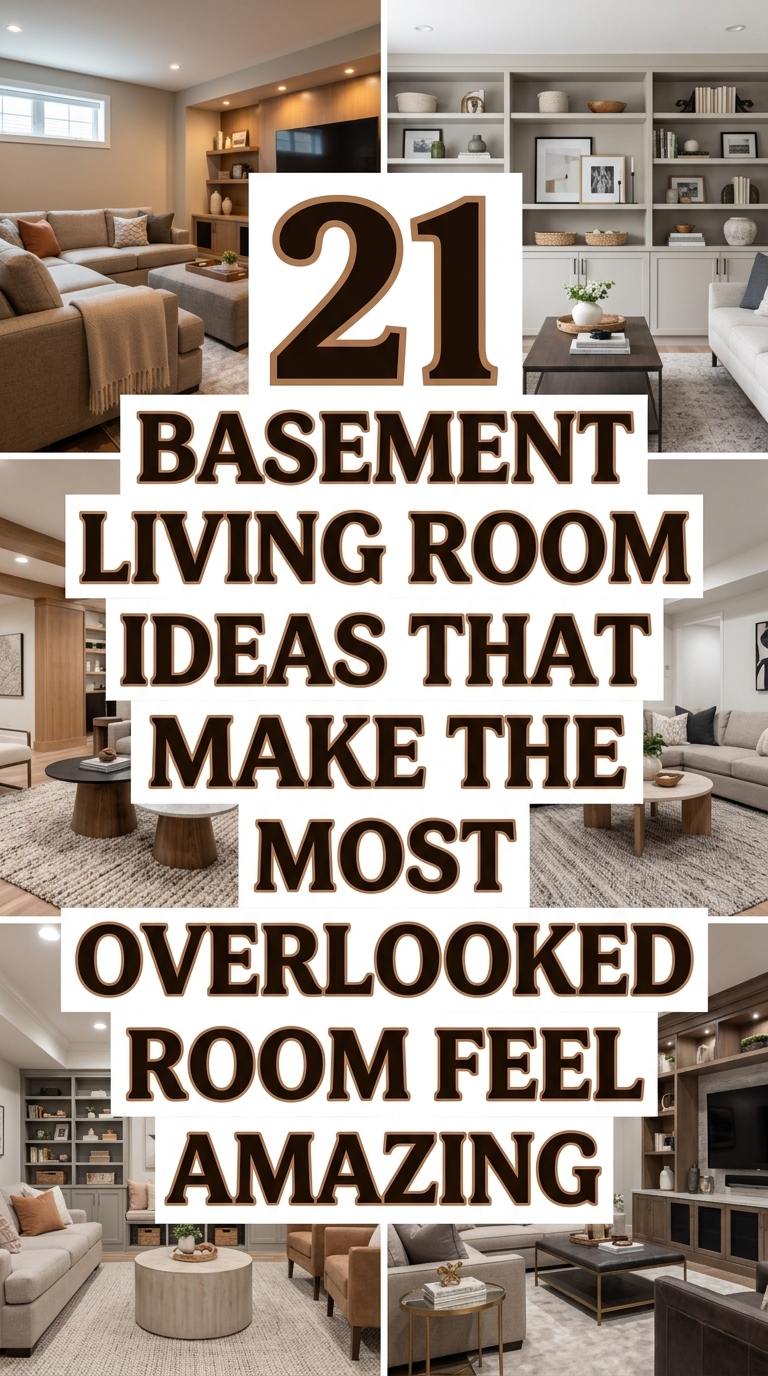
Basements get a bad deal. Most of the time they end up as dumping grounds — boxes stacked in corners, old furniture shoved against walls, and a single bare bulb doing its best. But honestly? A basement might be the most exciting space in your entire home. It’s a blank slate.
No awkward existing layout, no previous owner’s questionable taste to work around — just pure, untouched potential waiting to become your favorite room in the house. These 21 basement living room ideas cover everything from low-ceiling tricks and lighting solutions to cozy sectional setups and moody lounge aesthetics. Whether you’re starting from scratch or need a serious refresh, something on this list will make you genuinely excited to go downstairs.
The Cozy Sectional Setup — Anchor Your Basement Living Room Around the Perfect Sofa
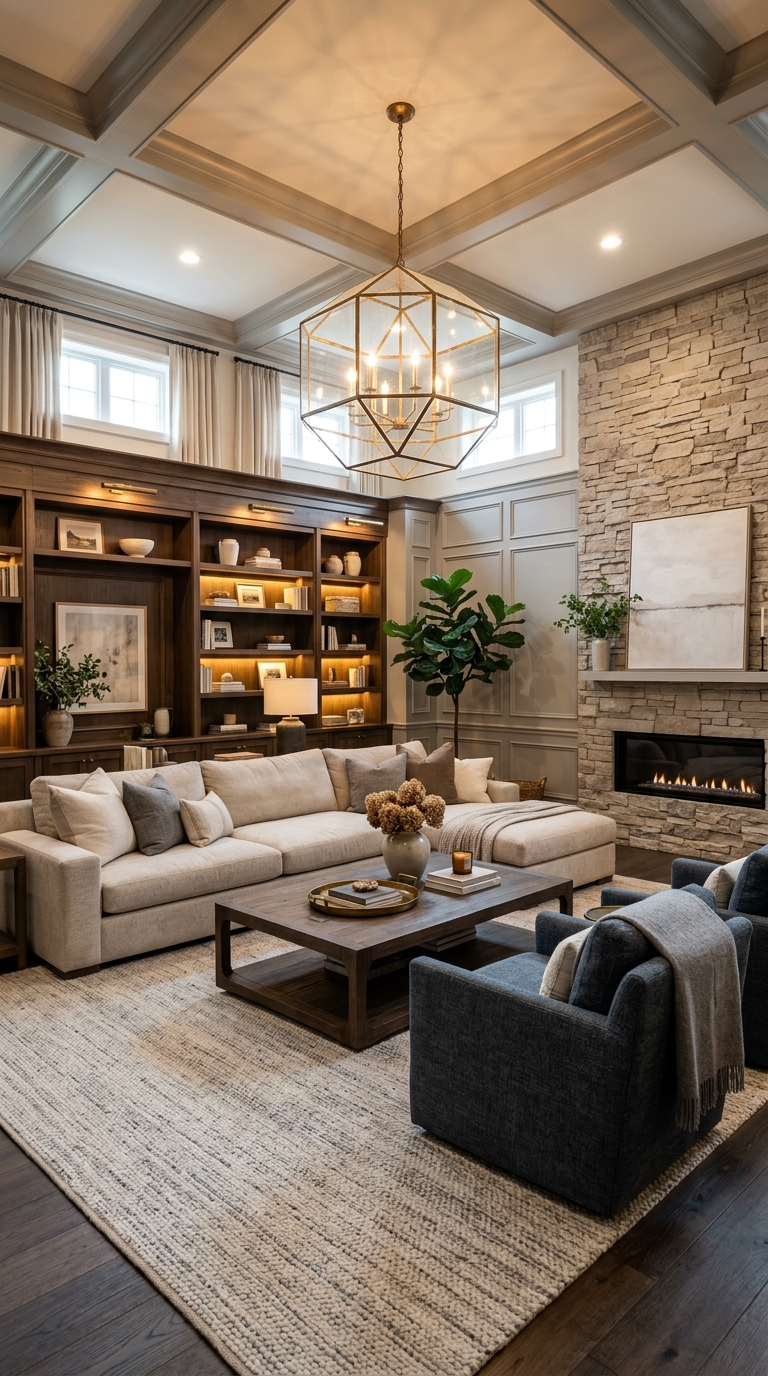
The sofa is everything in a basement living room. It’s the piece that defines the space, sets the tone, and — let’s be real — determines how much time people actually want to spend down there.
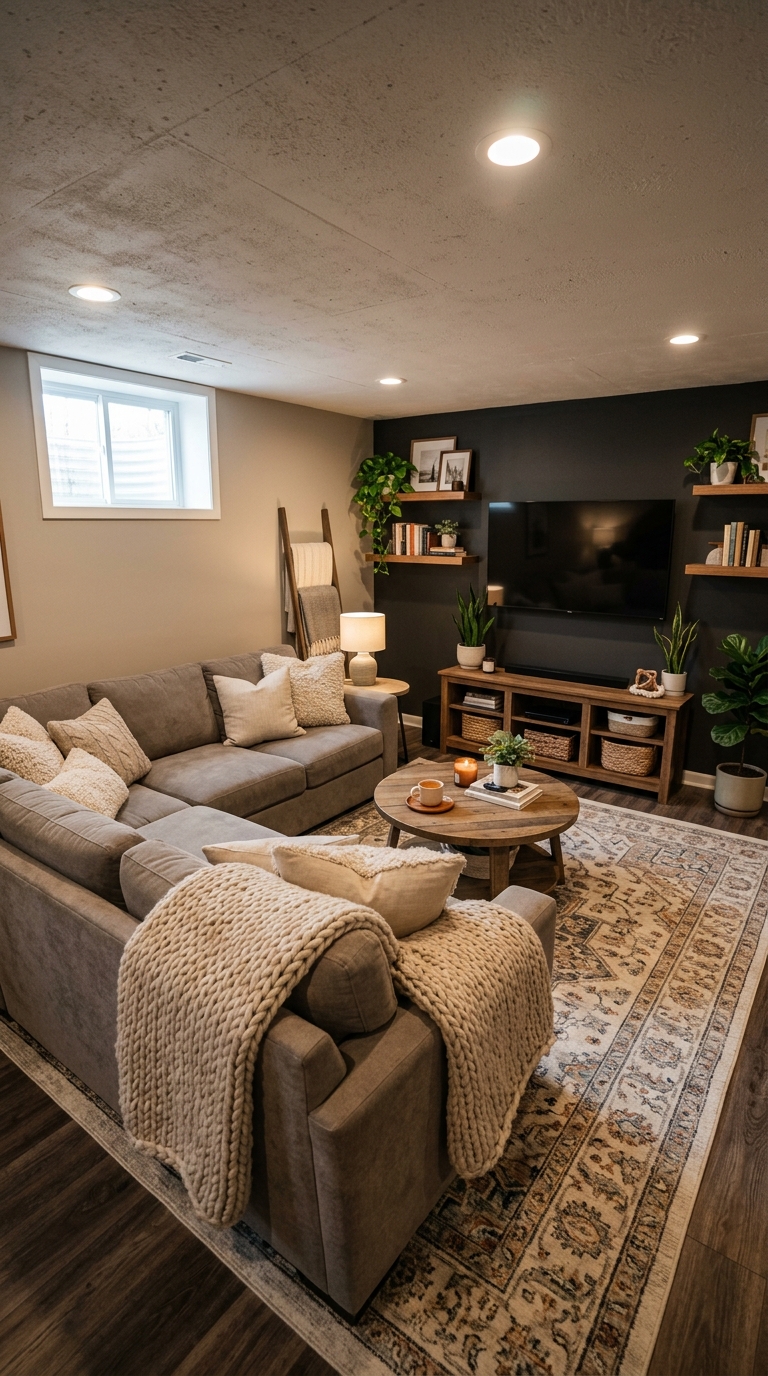
A large L-shaped or U-shaped sectional in a soft neutral like warm grey, oatmeal, or camel immediately makes a basement feel like a proper living room rather than a leftover space. Position it facing a TV wall or centered on a large area rug to create a clear, intentional seating zone.
What makes a basement sectional work differently from an upstairs sofa is the scale. Basements can actually handle oversized furniture that might feel too bulky in a main-floor room. Go bigger than you think.
A deep-seated, wide sectional with plush cushions and throw pillows in warm, earthy tones creates exactly the kind of sink-in comfort that makes a basement feel truly irresistible.
Pull the whole setup together with a large area rug that extends beyond the sectional on all sides. This one move visually grounds the seating area and makes the space feel designed rather than assembled.
Styling Tips:
- Choose a sectional with a chaise on one end for maximum lounging comfort
- Warm grey, oatmeal, camel, or deep navy are the best basement sofa colors
- Size up — a sectional that feels large upstairs will feel perfectly proportioned in a basement
- A large 8×10 or 9×12 rug anchors the seating zone and makes the room feel finished
- Layer throw blankets and pillows in warm, cozy tones to make the sofa look inviting
Dark Accent Wall in the Basement — Why Going Bold Down Here Actually Works
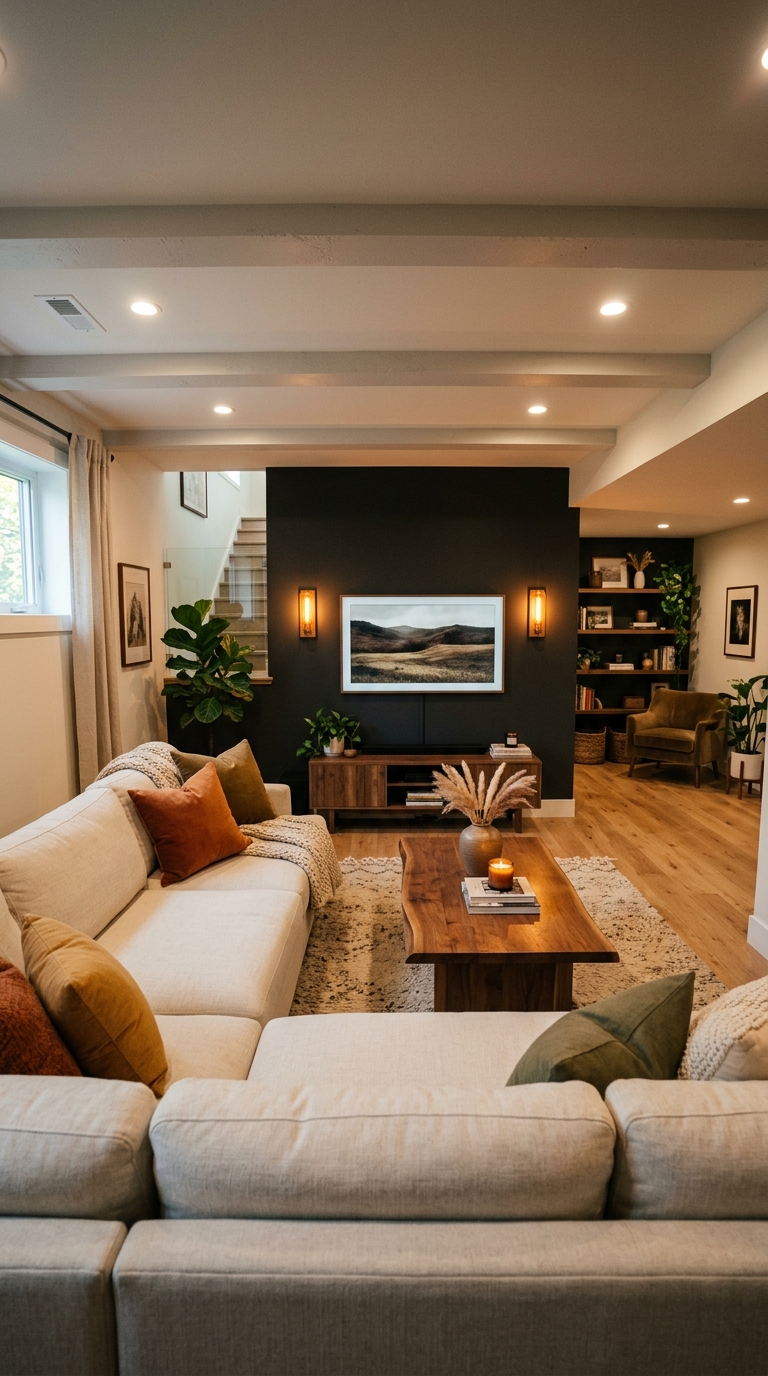
Here’s something counterintuitive: going dark in a basement often works better than trying to lighten everything up. A deep charcoal, navy, forest green, or even matte black accent wall behind the TV or sofa creates a moody, intentional atmosphere that feels designed rather than dimly lit by accident. It gives the room a focal point and immediately makes the space look more finished.
The key is pairing the dark wall with warm lighting and lighter furnishings. Cream or light grey sofas, warm wood accents, and amber-toned lamps balance the drama of the dark wall and prevent the room from feeling cave-like. The contrast is what makes it work — dark backdrop, warm and inviting everything else.
An accent wall also solves a common basement problem: uneven or imperfect walls. A coat of bold paint draws the eye intentionally and distracts from any surface imperfections that might show up under bright overhead light.
Styling Tips:
- Deep charcoal, forest green, navy, or slate blue are the best basement accent wall colors
- Use matte paint finish — it hides wall imperfections and looks more sophisticated than satin
- Mount the TV directly on the dark accent wall to make it a true focal point
- Balance the dark wall with lighter furniture — cream, oatmeal, or warm white sofas work best
- Add warm amber sconces on either side of the TV wall for a layered, architectural lighting effect
Recessed Lighting Done Right — The Strategy That Makes Every Basement Feel Bigger
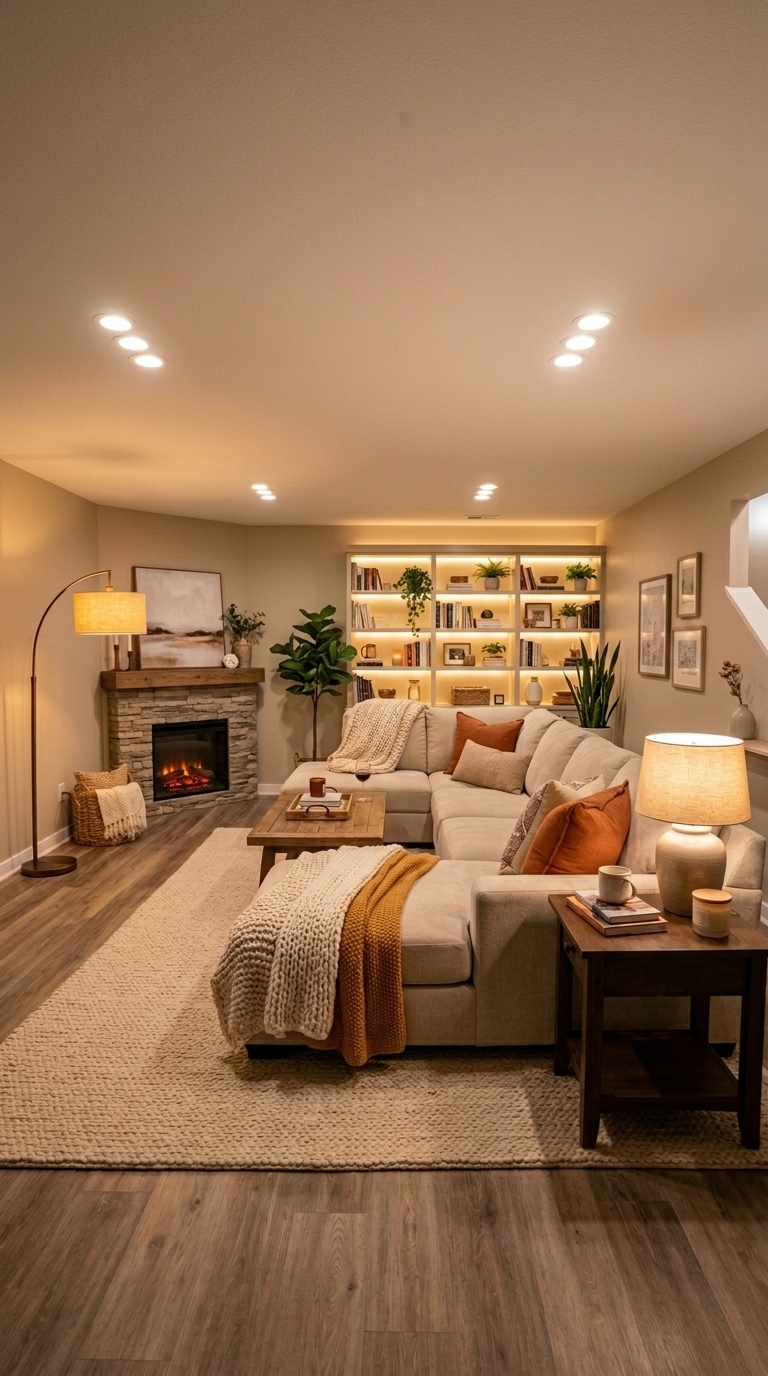
Lighting is the single most important design decision in a basement living room — and recessed lighting done properly can completely transform how the space feels. The mistake most people make is installing recessed lights in a rigid grid pattern that creates flat, even light with no depth or warmth. Instead, think in zones: cluster lights over the seating area, add a few over any shelving or artwork, and use dimmers throughout.
Warm bulbs are non-negotiable. Cool white or daylight bulbs in a basement make the space feel clinical and harsh. Use 2700K to 3000K bulbs throughout — they cast a warm, golden glow that makes the room feel inviting even without a single window. Combined with floor lamps and table lamps, layered recessed lighting gives a basement the kind of warm, dimensional atmosphere that feels genuinely livable.
For basements with drop ceilings, recessed lighting is one of the best investments you can make. It cleans up the ceiling visually, removes the need for surface-mounted fixtures, and instantly makes the space look more like a real room and less like a utility space.
For a timeless and intellectual aesthetic, take a look at these dark academia living room ideas filled with vintage charm, deep tones, and elegant character.
Styling Tips:
- Install recessed lights in clusters over functional zones rather than in a uniform grid
- Always use warm bulbs at 2700K–3000K — never cool white in a basement
- Put every recessed light on a dimmer switch for full atmosphere control
- Layer recessed lighting with floor lamps and table lamps for warmth and depth
- Aim lights toward walls and artwork to create a wash of light that makes ceilings feel higher
Basement Living Room with a Built-In Bar Corner — Entertain and Relax in One Space
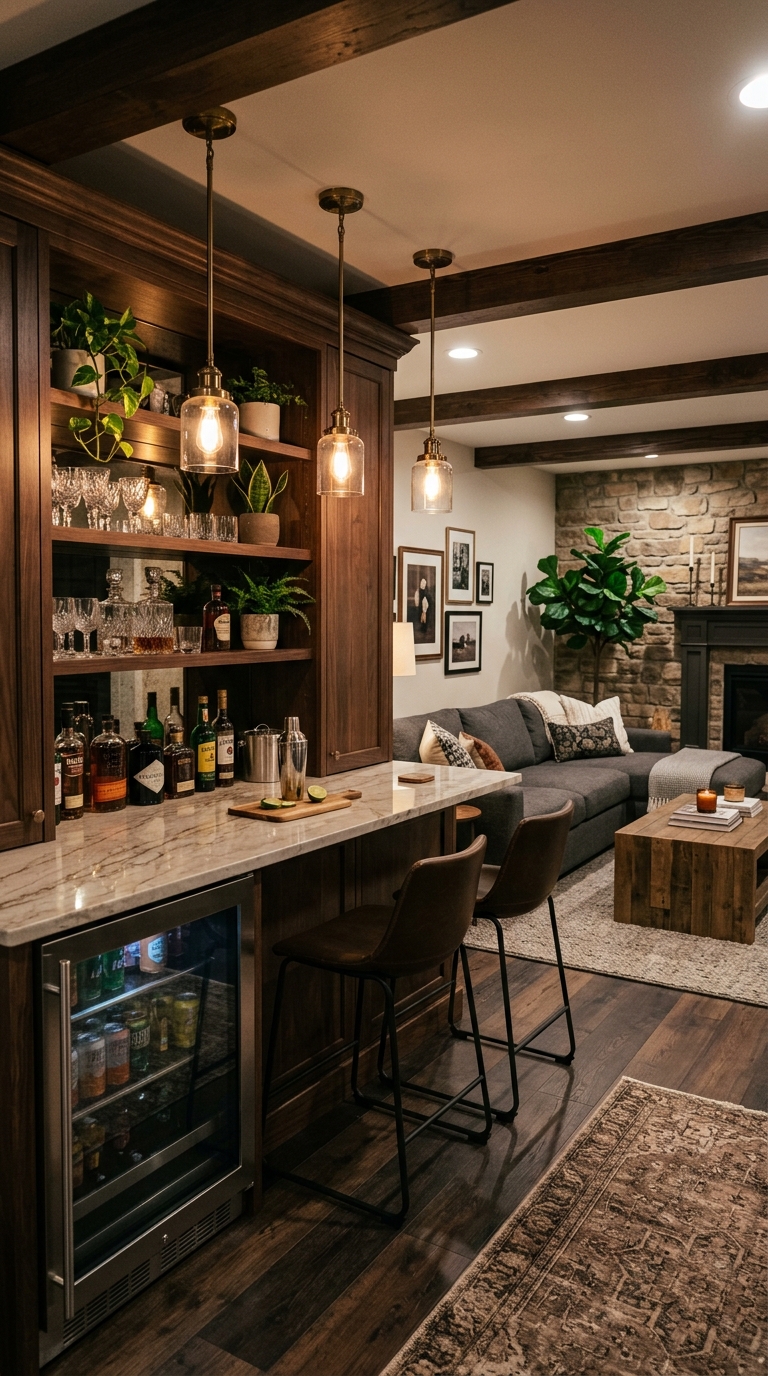
A bar corner in the basement living room is one of those additions that seems like a luxury but is actually incredibly practical. It gives the space a defined entertaining zone, keeps drinks and glasses organized, and makes the basement feel like a destination rather than just another room. Even a small bar cart in the corner works — but a built-in bar with open shelving, a small counter, and a mini fridge takes things to a genuinely impressive level.
Design-wise, the bar should feel like a natural extension of the living room rather than a separate element. Use the same wood tones, the same hardware finish, and the same color palette as the rest of the space. Add pendant lighting above the bar counter and a couple of bar stools for a finished, polished look that ties everything together.
Open shelving above the bar is a great opportunity to add personality — a mix of glassware, small plants, framed prints, and decorative objects creates a display that’s both functional and visually interesting.
Styling Tips:
- Use the same wood tone for bar shelving as the rest of your furniture for cohesion
- A mini fridge built into the base of the bar keeps the counter surface clean and functional
- Pendant lights above the bar counter add atmosphere and define the zone visually
- Bar stools in leather or velvet add texture and make the bar feel like a proper destination
- Style open shelves with a mix of glassware, small plants, and decorative objects
Low Ceiling Basement Living Room — Design Tricks That Make It Feel Taller
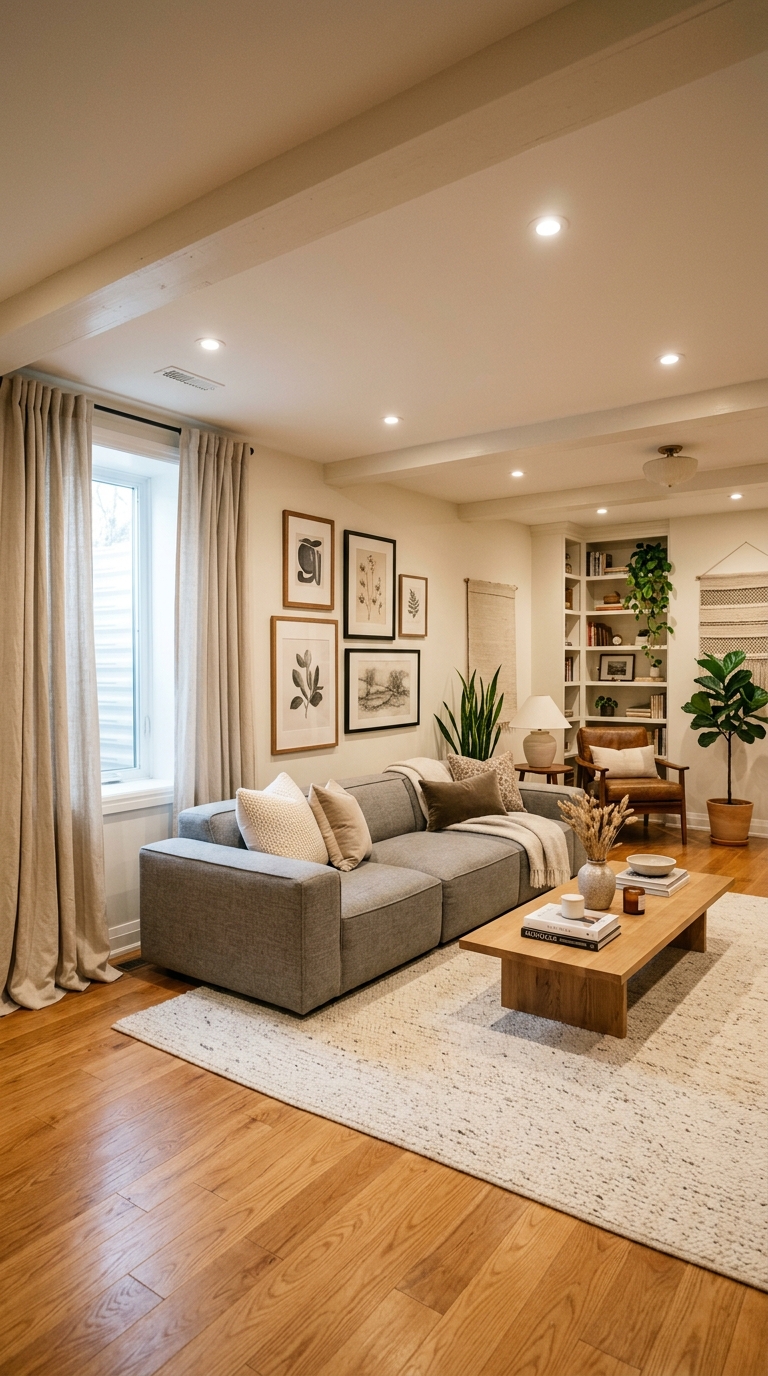
Low ceilings are the most common basement challenge — and the good news is that smart design can make them feel significantly less noticeable. The most effective trick is keeping everything visual low and horizontal. Choose low-profile furniture — a sofa with short legs, a flat coffee table, a low media console — and the ceiling suddenly feels less close because there’s more visual space between the furniture and the ceiling.
Paint the ceiling the same color as the walls — or even slightly lighter. When the wall-to-ceiling transition disappears, the eye doesn’t register where the wall ends, which creates a sense of continuous height. Avoid ceiling-mounted light fixtures that hang down and eat into your headroom — recessed lighting is your best friend in a low-ceiling basement.
Vertical elements also help. Floor-to-ceiling curtains, tall narrow shelving, and vertical artwork all draw the eye upward and trick the brain into perceiving more height than actually exists.
Styling Tips:
- Choose furniture with very short or no legs — low-profile pieces make ceilings feel higher
- Paint the ceiling the same color as the walls or one shade lighter to blur the boundary
- Avoid pendant lights or chandeliers — recessed lighting preserves every inch of headroom
- Hang floor-to-ceiling curtains even over small windows to draw the eye upward
- Use vertical stripes or tall, narrow art to reinforce the illusion of height
Rustic Basement Living Room with Exposed Beams and Stone Wall Accents
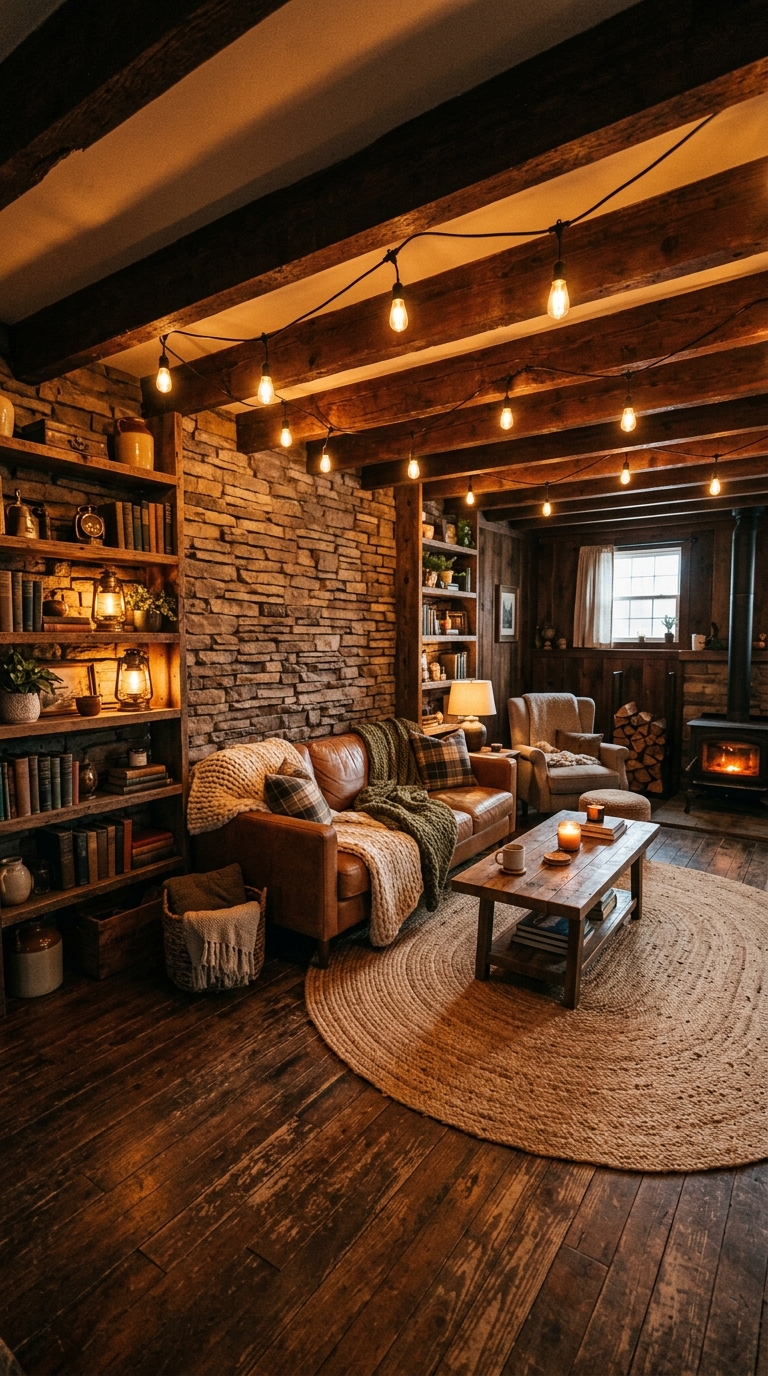
Some basements come with built-in character — exposed wooden beams overhead, original stone foundation walls, rough concrete features. And instead of hiding all of that, the best thing you can do is lean into it. A rustic basement living room that celebrates these architectural details feels infinitely more interesting than one that tries to cover them up with drywall.
Keep the palette warm and earthy — cream, caramel, warm brown, and deep green all feel right at home in a rustic basement. Add a plaid or buffalo check throw blanket, a chunky jute rug, and a leather sofa, and the whole space feels like a cozy hunting lodge or a mountain cabin retreat.
Exposed Edison bulb lighting strung between beams, a faux or real stone fireplace surround, and open wooden shelving stacked with books and lanterns complete the rustic look
Love rich colors and dramatic interiors? These moody maximalist living room ideas show how layered textures and bold decor can create a cozy yet sophisticated atmosphere.
Styling Tips:
- Leave exposed wooden beams natural or stain them in a warm walnut tone — never paint them
- A stone or faux stone accent wall behind the TV reinforces the rustic character beautifully
- A leather sofa in caramel or cognac tones feels perfectly at home in a rustic basement
- Edison bulb string lights between beams add warmth and reinforce the rustic aesthetic
- Chunky jute or sisal rugs, plaid throws, and wood lanterns complete the look naturally
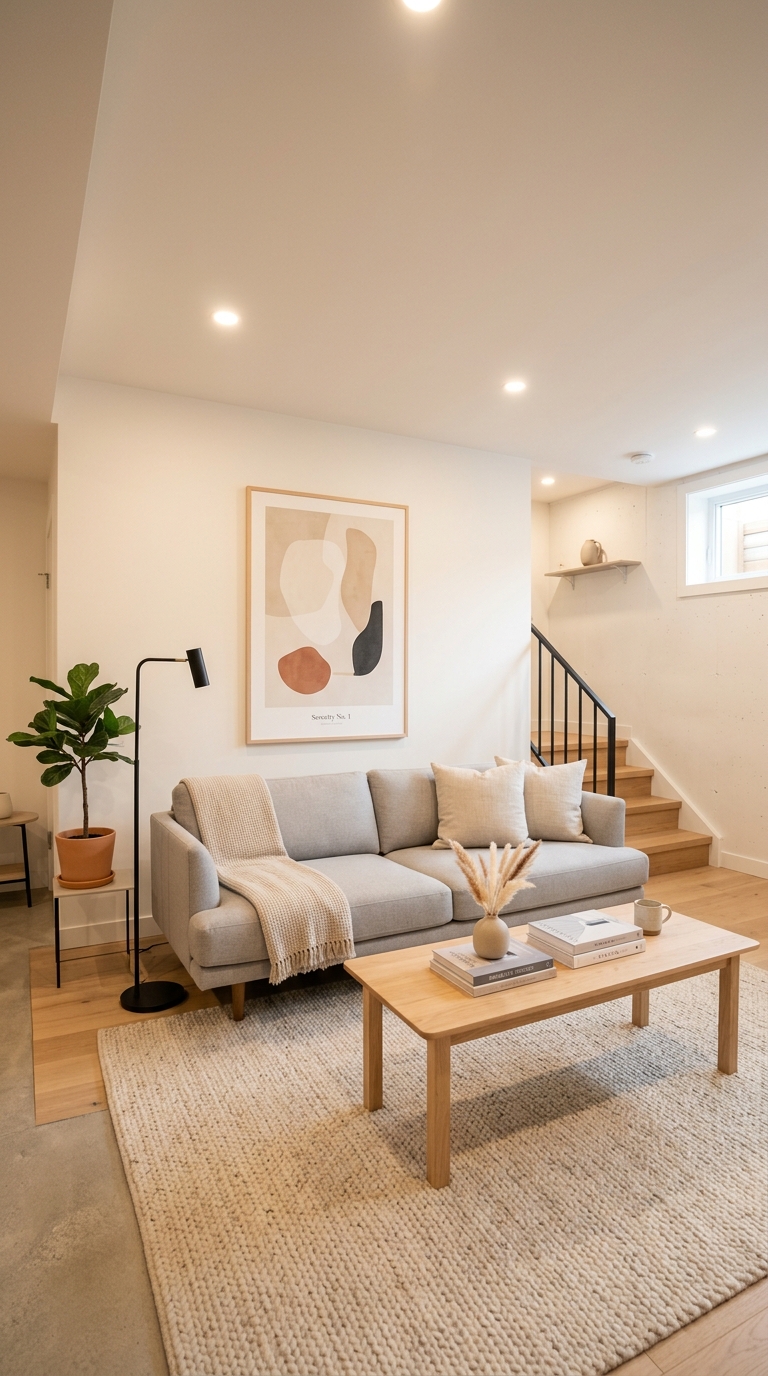
Modern Minimalist Basement — Clean Lines, Neutral Tones, and a Surprisingly Airy Feel
Minimalism in a basement might sound counterintuitive — but a clean, uncluttered basement living room can feel genuinely spacious and serene. The key is editing ruthlessly. Choose a few well-made, intentional pieces — a sleek sofa, a simple coffee table, one piece of statement art — and resist the urge to fill every surface and corner.
Stick to a tight palette of two or three neutrals: warm white, light grey, and natural wood tones are a perfect minimalist combination for a basement. The simplicity of the palette makes the space feel open and deliberate, and it allows the quality of each piece to shine rather than getting lost in visual noise.
Minimalist basements work especially well as home office-living room combos, yoga spaces, or adult retreats. The absence of clutter creates a mental clarity that makes the space feel genuinely restful.
Styling Tips:
- Limit the color palette to two or three neutrals — warm white, light grey, and natural wood work beautifully
- Choose one statement sofa and resist adding too many additional seating pieces
- A single large piece of abstract art does more for a minimalist basement than a gallery wall
- Keep surfaces clear — one tray, one plant, one lamp per surface maximum
- Hidden storage ottomans and built-in shelving keep clutter invisible without sacrificing function
Basement Home Theater Living Room Combo — Movie Nights Just Got a Major Upgrade
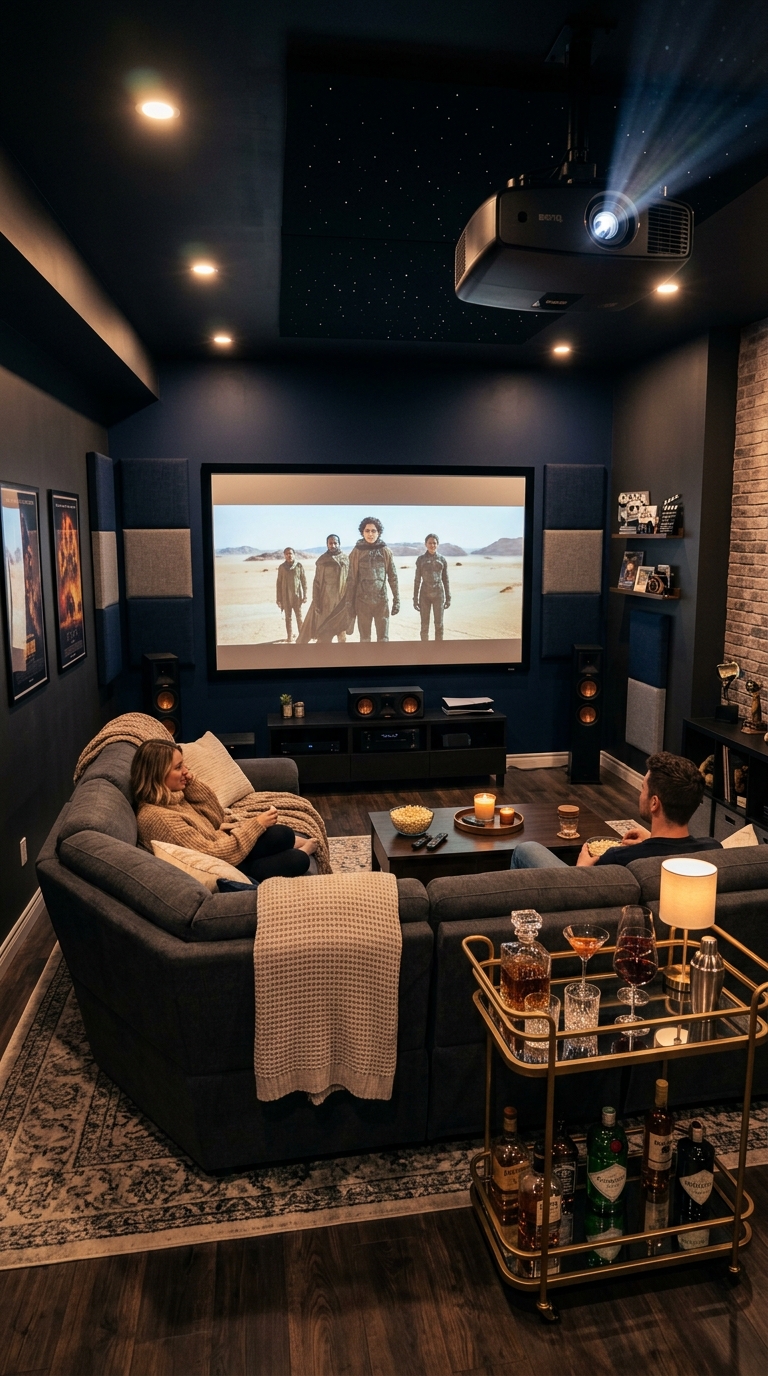
The basement is the natural home for a home theater setup — it’s away from the main household noise, it’s easy to control light, and there’s usually enough wall space for a genuinely impressive screen. But the key to a basement home theater that also works as a living room is making sure the space doesn’t feel like a commercial cinema. It should feel warm, personal, and comfortable enough to hang out in on a regular Tuesday evening, not just for movie nights.
A large projector screen or an oversized TV mounted on a dark wall, a deep sectional angled perfectly toward the screen, and dimmable lighting that can go from bright to atmospheric in one switch — that’s the formula. Add soundproofing panels disguised as acoustic art on the walls, and the audio experience becomes surprisingly cinematic without any visible technical equipment cluttering the space.
Tiered seating — even just two rows of comfortable furniture at slightly different heights — creates a genuine theater experience. Pair it with a small popcorn station or bar cart in the corner, and movie nights become actual events.
Styling Tips:
- Use a dark accent wall behind the screen to minimize light reflection and improve picture quality
- A projector and pull-down screen are more flexible than a fixed TV for a dual-purpose space
- Dimmable recessed lighting lets you shift from a bright living room to a cinematic atmosphere in seconds
- Deep reclining seats or a large sectional with a chaise ensure maximum comfort during long movies
- Acoustic panels in fabric-wrapped frames on side walls improve sound without looking technical
Basement Living Room with Faux Fireplace All the Warmth, None of the Renovation
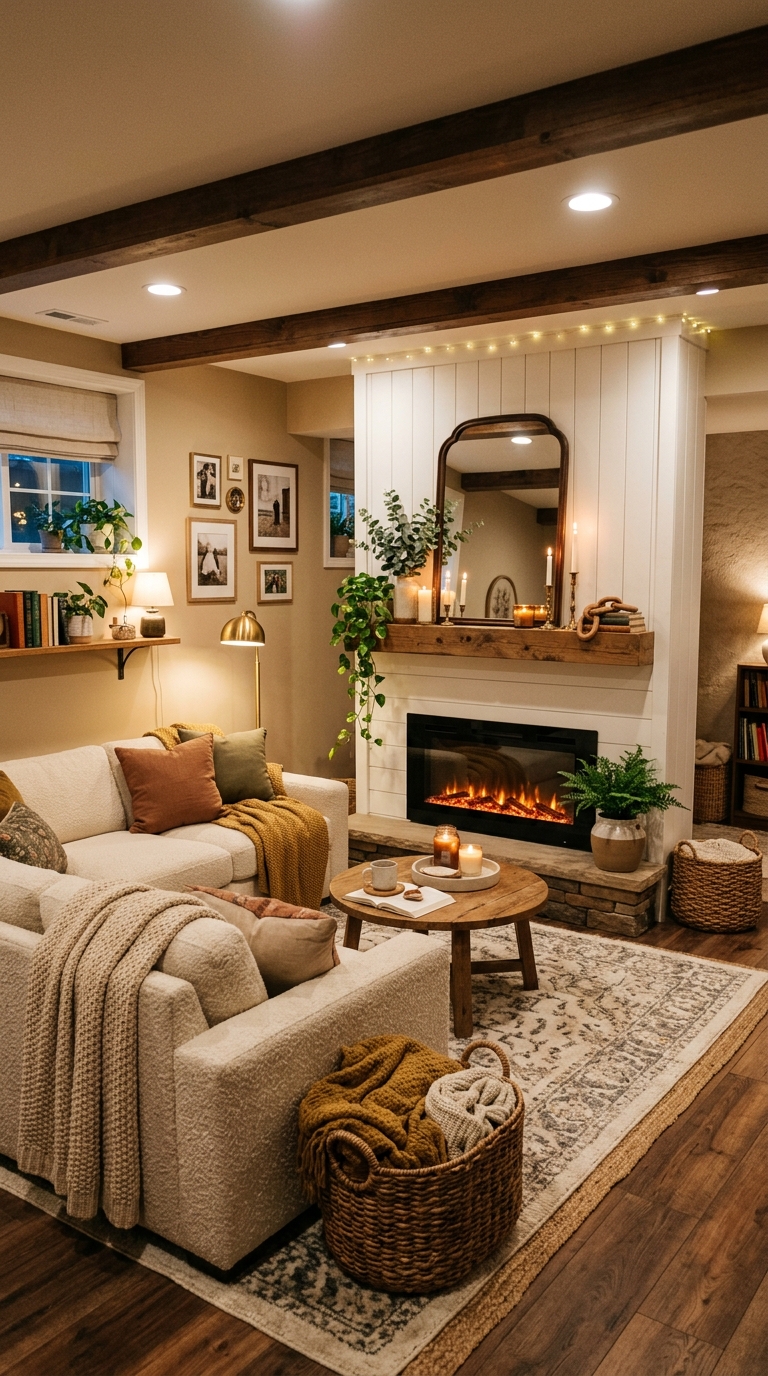
A fireplace in the basement living room changes everything about how the space feels. It creates an instant focal point, adds warmth, and gives the room a sense of permanence and intention. And the good news is you don’t need a real wood-burning fireplace or expensive renovation to get that effect — electric fireplaces have become genuinely beautiful, and a well-styled surround makes them look completely authentic.
Build or buy a simple fireplace surround in white painted MDF or shiplap, add an electric fireplace insert, and suddenly you have a mantelpiece to style, a glowing focal point for the room, and a warm feature that people are immediately drawn to. Style the mantel with a large mirror, a few candles, some greenery, and a couple of meaningful objects — it should look like it’s always been there.
Position the sectional or main sofa angled toward the fireplace rather than purely toward the TV. When both the fireplace and TV are on the same wall, the room immediately feels like it was professionally designed.
Styling Tips:
- A white shiplap or painted MDF fireplace surround looks authentic and is surprisingly affordable
- Choose an electric fireplace insert with a realistic flame effect and adjustable heat settings
- Style the mantel with a large leaning mirror, candles, greenery, and a few layered objects
- Position the main sofa angled toward the fireplace for a cozy, conversation-first layout
- Place the TV above or beside the fireplace so both anchor the same feature wall
Small Basement Living Room Layout Ideas That Make Every Square Foot Count
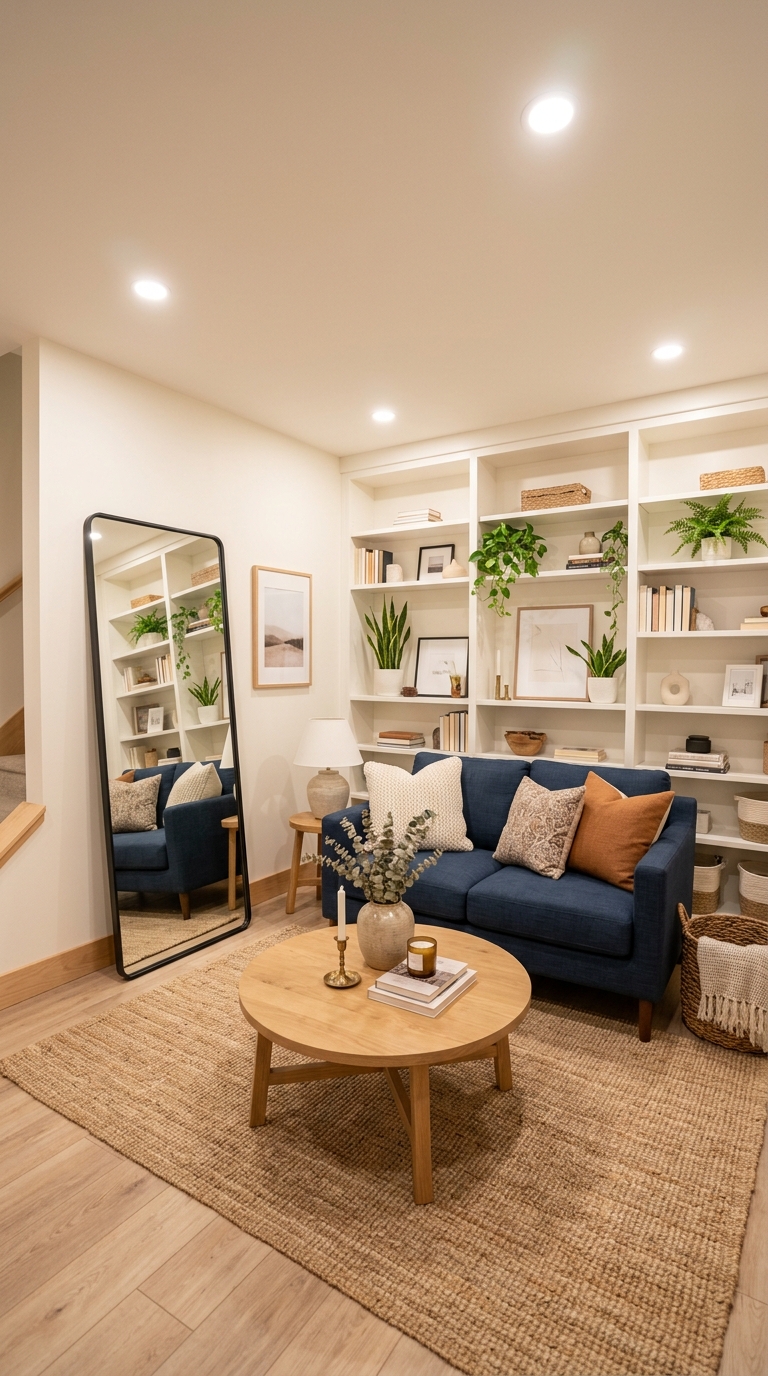
Small basements require intentional layouts — every furniture decision has to serve a purpose, and every inch has to earn its place. The most effective approach is choosing one primary seating arrangement and resisting the urge to add extra chairs, side tables, or decorative pieces that eat into circulation space. A small basement with one well-chosen sofa and a clear, open floor plan feels far more spacious than the same room stuffed with furniture.
Float furniture away from walls — it sounds counterintuitive in a small space, but pulling a sofa even six inches from the wall creates breathing room that makes the space feel larger. Use a round or oval coffee table rather than a rectangular one to improve flow and reduce the feeling of being hemmed in.
Multifunctional pieces are essential in a small basement living room. An ottoman that doubles as a coffee table and hidden storage, a console table that works as a desk, and built-in shelving instead of freestanding bookcases all maximize function without multiplying the visual clutter.
Styling Tips:
- Float furniture slightly away from walls — even 6 inches creates a more spacious feeling
- Choose a round or oval coffee table to improve traffic flow in a small space
- A storage ottoman replaces both a coffee table and a storage unit in one piece
- Built-in shelving uses wall space efficiently without taking up floor area
- Use mirrors strategically — a large mirror on one wall visually doubles the perceived size of the room
Basement Living Room with No Windows — How to Fake Natural Light Beautifully
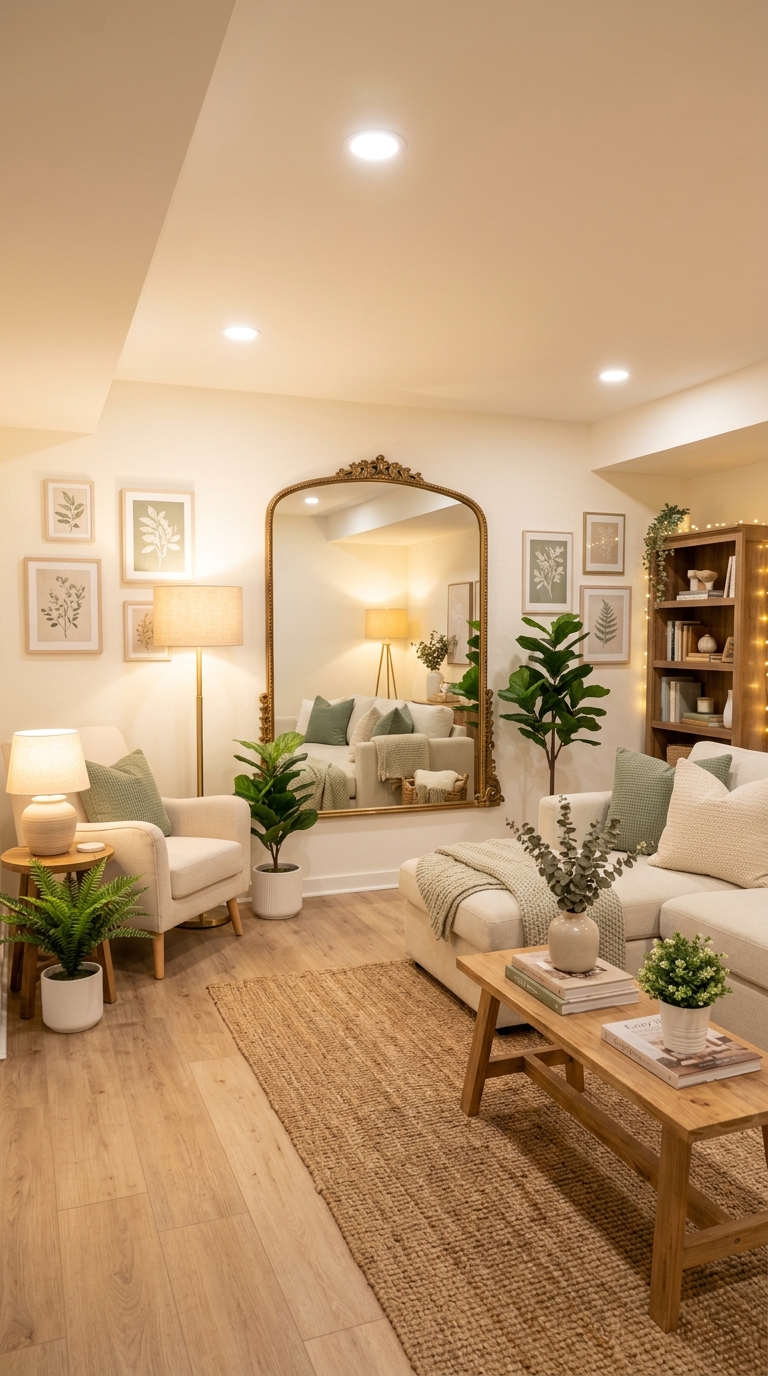
Windowless basements are genuinely challenging — but they’re far from hopeless. The goal is to create the feeling of light and airiness even when natural daylight isn’t available. The first tool is color: warm whites, soft creams, and light warm greys on walls and ceilings reflect artificial light beautifully and make the space feel bright without requiring a single window.
Daylight-spectrum floor lamps and table lamps placed strategically around the room can replicate the quality of natural light to a surprisingly convincing degree. Use them in corners, beside the sofa, and on any surface that feels dim — multiple light sources at different heights create the kind of warmth and dimension that overhead lighting alone simply cannot achieve.
Mirrors are the most powerful tool in a windowless basement. A large mirror on one wall, or a gallery of smaller mirrors, bounces light around the room and creates the visual impression of depth and openness that makes the absence of windows feel far less noticeable.
Styling Tips:
- Paint walls and ceiling in warm white or soft cream to maximize light reflection
- Use daylight-spectrum bulbs in floor and table lamps for the closest approximation to natural light
- Position a large mirror directly across from the brightest lamp to bounce light across the room
- Layer at least three light sources at different heights for a warm, dimensional glow
- Add artificial plants or botanical prints to bring the feeling of the outdoors inside
Industrial Basement Living Room with Exposed Pipes, Brick, and Edison Bulbs
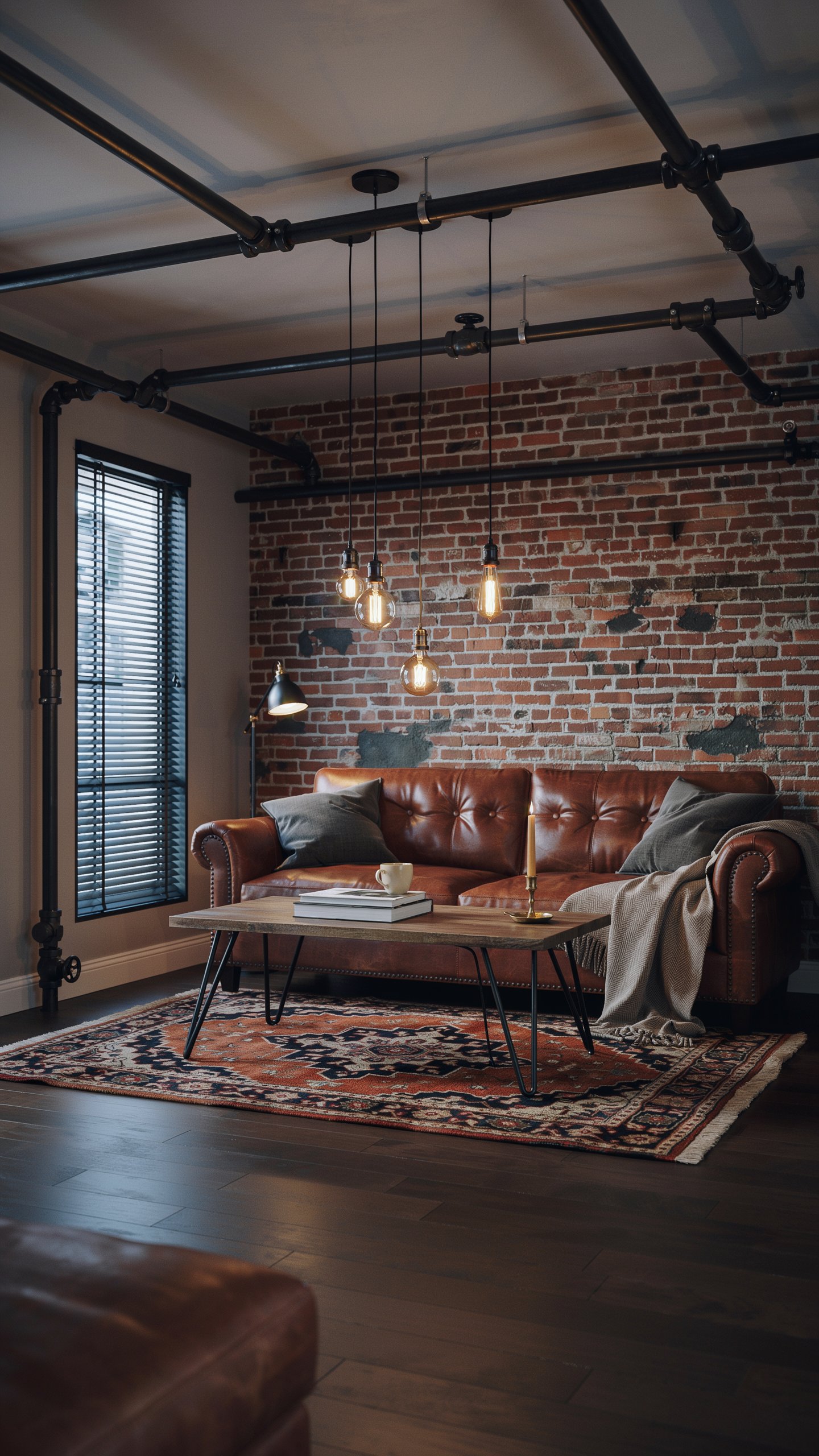
Industrial design was practically invented for basements. Exposed pipes, raw concrete walls, metal ductwork, unfinished ceilings — all the things people usually try to hide in a basement are actually the defining features of the industrial aesthetic. Embrace them, paint them, and they become the most interesting design elements in the room.
Paint exposed pipes and ductwork in matte black or dark gunmetal — they go from eyesore to design feature instantly. Add a brick accent wall (real or faux), Edison bulb pendant lights or string lights, and a mix of metal and dark wood furniture, and the basement transforms into a genuinely cool, editorial space.
Leather, dark denim, and raw linen upholstery all feel right at home in an industrial basement. Add a vintage-style area rug in a muted, worn-in pattern, and the hard edges of the industrial elements get softened just enough to feel livable and inviting.
Styling Tips:
- Paint exposed pipes and ductwork in matte black to turn them into intentional design features
- A faux brick panel on one wall adds authentic industrial texture without major renovation
- Edison bulb pendant lights or string lights are the perfect industrial lighting choice
- Dark wood and metal furniture — coffee tables, shelving, side tables — reinforce the aesthetic
- Add a vintage-style rug in muted tones to soften the hard industrial edges
Cozy Basement Family Room with Kids’ Zone and Adult Lounge Area Combined
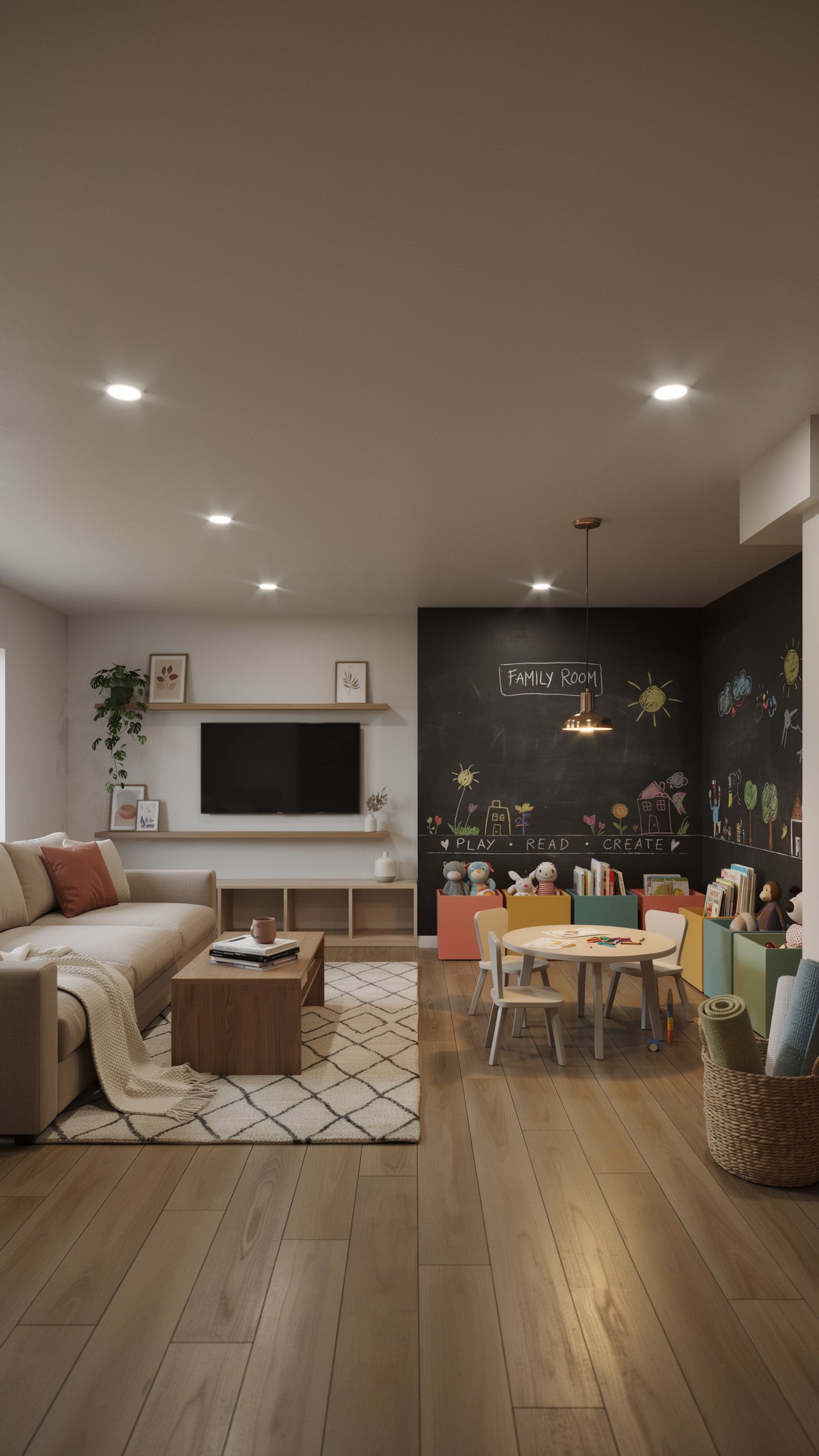
A basement is the perfect place to create a family room that actually works for everyone — kids and adults alike — without either group having to compromise. The key is zoning: define a clear kids’ activity area on one side of the space and an adult lounge area on the other, with design elements that make both zones feel intentional and cohesive.
Use a large area rug to define the adult seating zone and a different, more durable rug or foam flooring tiles to define the kids’ play area. A low bookshelf, a curtain, or even just a change in flooring material can create a visual boundary between the two zones without building a wall.
The adult zone gets the sectional, the accent wall, and the good lighting. The kids’ zone gets built-in toy storage, a small activity table, and washable, durable surfaces. Both zones share the TV wall — a single large screen works for movie nights when the whole family wants to be in the same space.
Styling Tips:
- Use area rugs to visually separate adult and kids’ zones without physical barriers
- Built-in cubbies or low bookshelves along one wall provide kid-friendly toy storage that looks tidy
- Choose performance fabric for the adult sofa — spill-proof upholstery is essential in a family space
- A small chalkboard wall in the kids’ corner adds creative play without permanent paint damage
- Design the space so both zones face the same TV wall — unified entertainment, separate functions
Basement Living Room Color Palette Ideas — What Colors Actually Work Underground
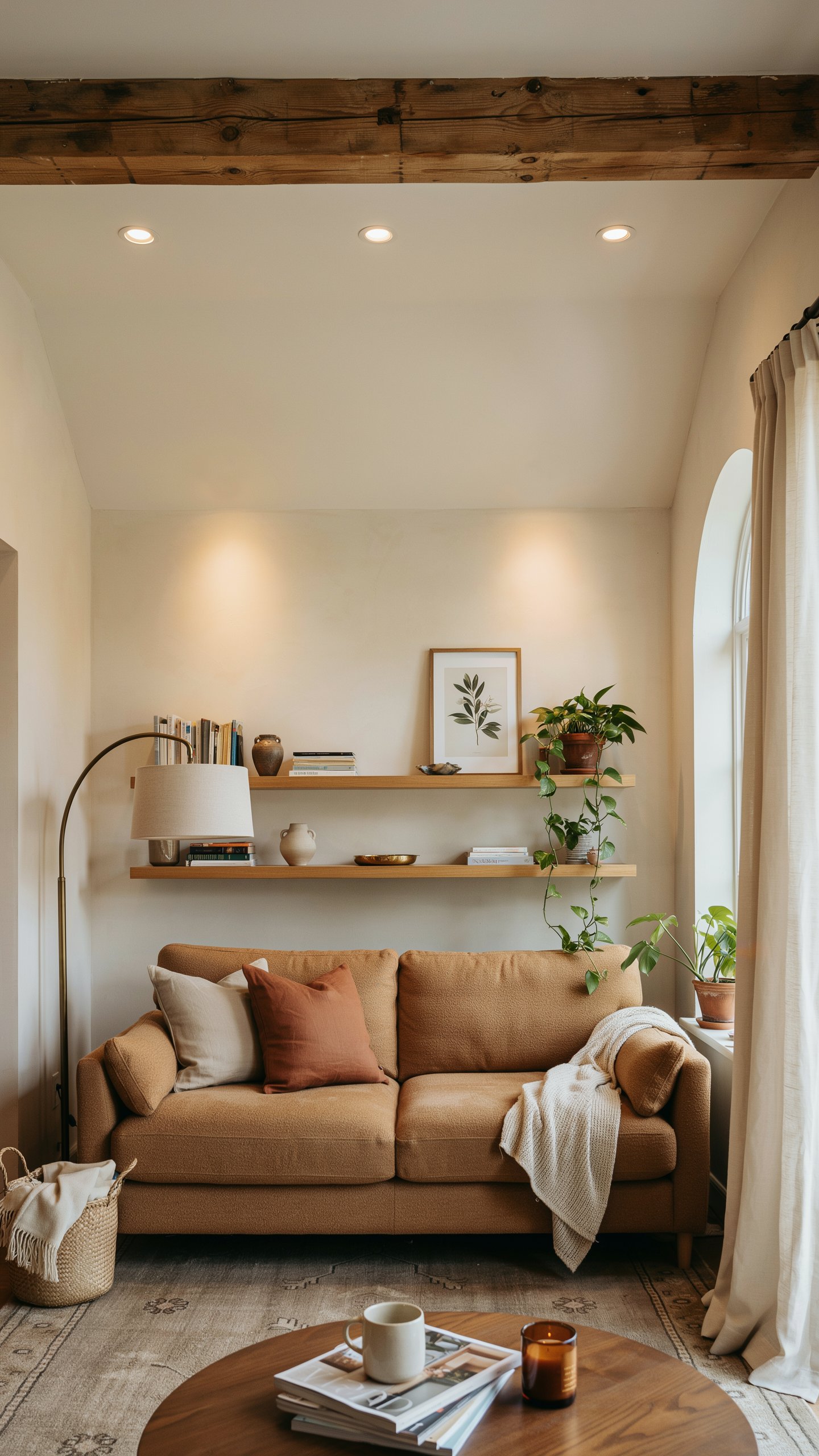
Color behaves differently in a basement than anywhere else in the house. Without natural light to shift and warm colors throughout the day, certain shades that look beautiful upstairs can feel flat, cold, or unexpectedly dingy underground. The colors that consistently work best in basements are warm neutrals — creamy whites, warm greiges, soft taupes, and warm light greys — because they reflect artificial light warmly and prevent the space from feeling clinical.
If you want to go darker, go intentionally dark. Moody charcoal, deep navy, forest green, and rich terracotta all work beautifully in basements when paired with warm lighting and lighter furnishings. It’s the middle range — medium grey, cool beige, or standard white — that tends to look flat and underwhelming without natural light to bring it to life.
Warm wood accents, plants, and warm-toned textiles help any basement color palette feel more alive. Even a warm neutral basement with plants and amber lighting feels far more inviting than a cool-toned basement with identical furniture and harsher overhead light.
Styling Tips:
- Warm whites and creamy neutrals are the safest, most universally flattering basement wall colors
- Avoid cool grey or stark white — without natural light, both look flat and slightly cold
- If going dark, commit fully — deep charcoal, navy, or forest green all work better than medium tones
- Test paint samples under your specific artificial lighting before committing to a full paint job
- Warm wood tones, plants, and amber lighting make any basement color palette feel more alive
Basement Flooring Ideas That Look Expensive But Aren’t
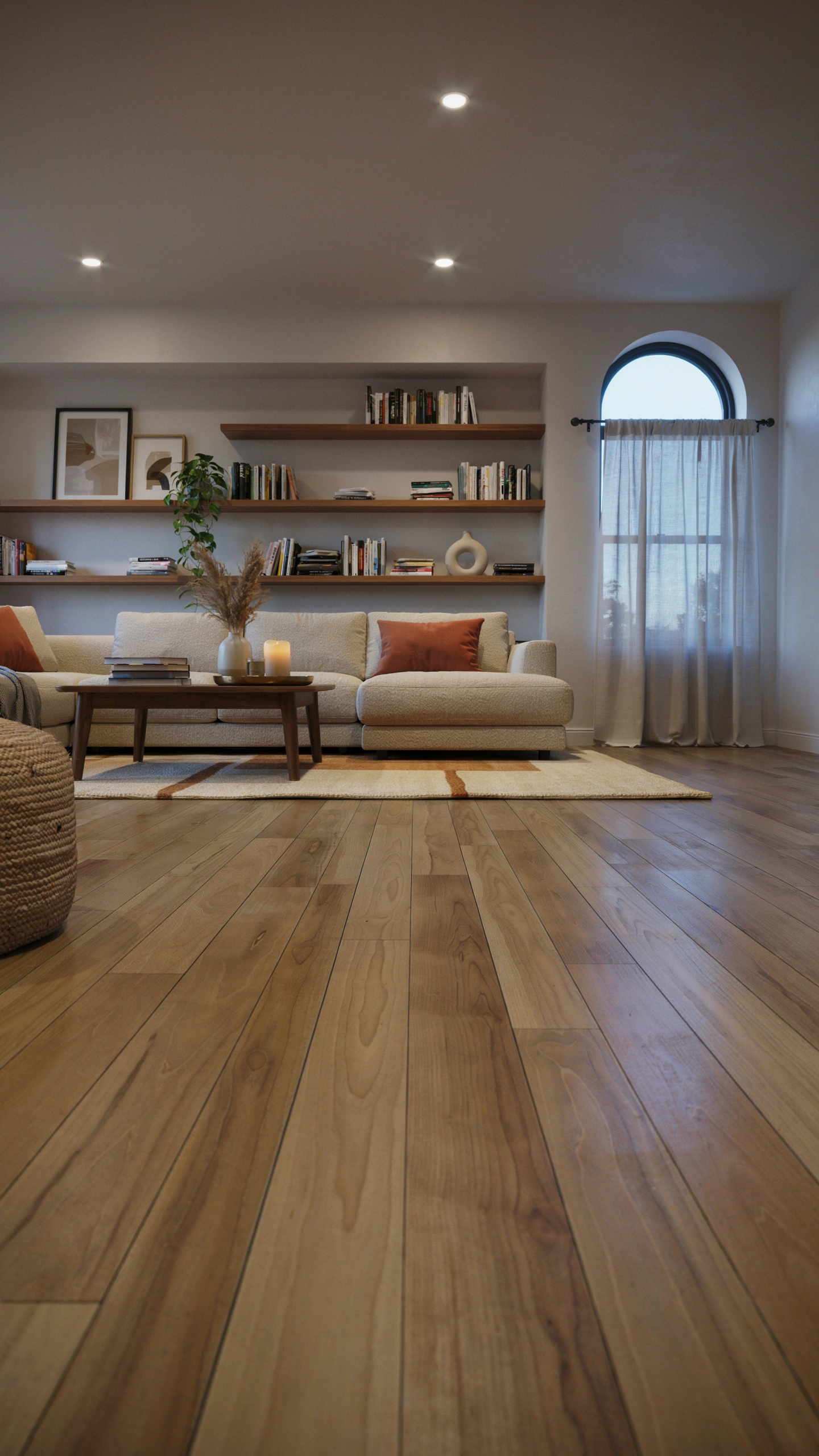
Flooring is one of the most transformative upgrades you can make in a basement — and the good news is that the best-looking options are also surprisingly affordable. Luxury vinyl plank (LVP) flooring is the top choice for basements because it’s waterproof, durable, comfortable underfoot, and comes in wood-look finishes that are genuinely difficult to distinguish from real hardwood at a normal standing distance.
Carpet tiles are another excellent basement flooring option — especially in the lounge or seating area. They’re soft, warm, easy to replace if damaged, and available in a huge range of colors and patterns. Mix two complementary carpet tile colors to create a custom rug effect that looks intentional and stylish.
For a completely seamless, modern look, polished concrete or concrete-look LVP throughout the entire basement gives the space an industrial-chic finish that photographs beautifully and ages incredibly well.
Styling Tips:
- Luxury vinyl plank is the best overall basement flooring — waterproof, durable, and wood-look beautiful
- Choose LVP in warm oak or walnut tones rather than cool grey tones for a warmer basement feel
- Carpet tiles in the seating zone add warmth and sound absorption without a full carpet installation
- Layer a large area rug over LVP in the living zone for added coziness and visual definition
- Polished concrete or concrete-look LVP gives a modern industrial finish that ages beautifully
Basement Living Room with a Reading Nook — Carve Out the Coziest Corner
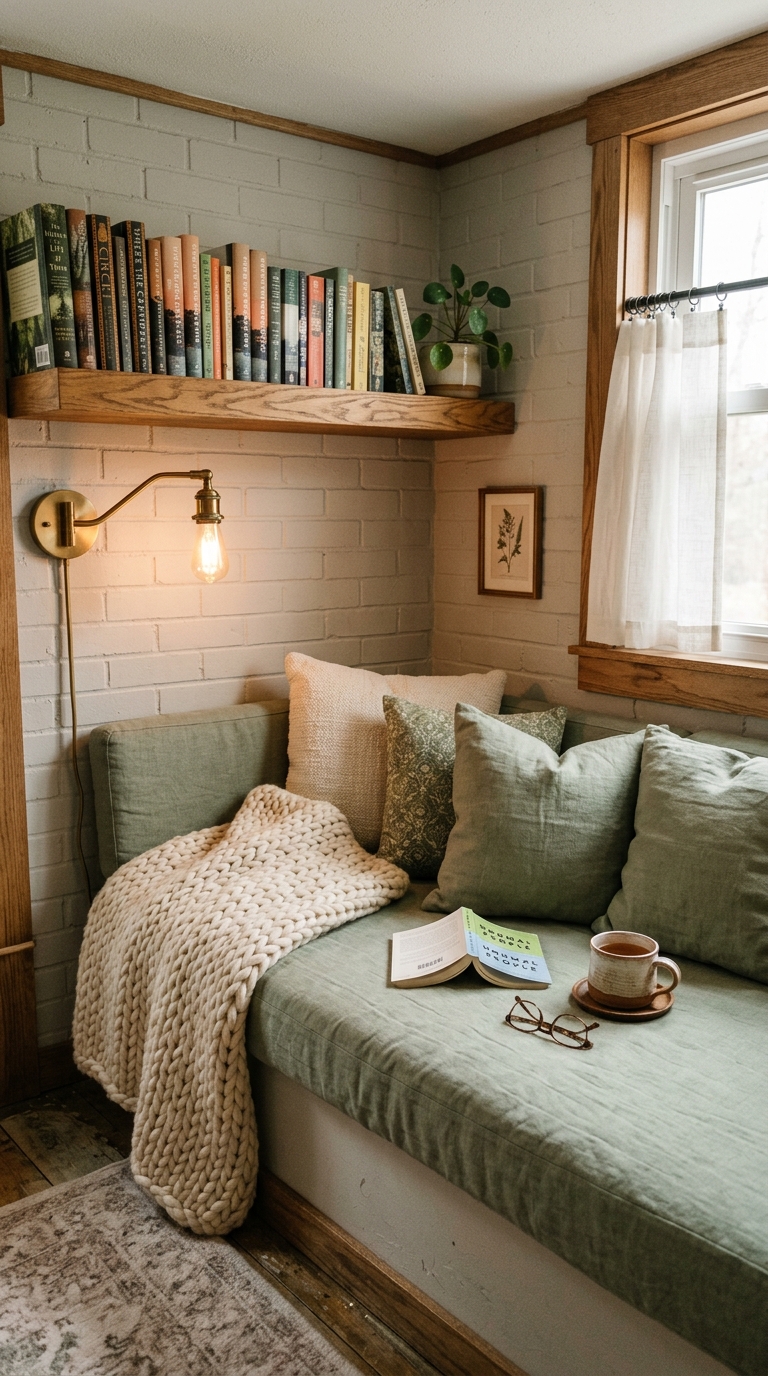
Every basement has at least one awkward corner that doesn’t quite know what it wants to be — and a reading nook is the perfect answer. A built-in bench with cushions and storage underneath, a floating shelf for books above, a good reading lamp beside it, and a throw blanket draped over the cushion — that’s the entire formula, and it costs very little to execute.
What makes a basement reading nook especially appealing is the sense of enclosure. Basements already have that cocooning quality, and a reading nook amplifies it. Add sheer curtains on a tension rod to create a soft, closeable boundary around the nook, and it becomes genuinely one of the most private, peaceful spots in the whole house.
Use the space beneath the bench seat for built-in storage — drawers or lift-top benches hold blankets, board games, or seasonal items and keep the rest of the basement tidy.
Styling Tips:
- Build or buy a window bench with storage drawers underneath for maximum function
- Add a floating shelf above the bench for books, a small plant, and a reading lamp
- Install a sheer curtain on a tension rod to create a soft, closeable nook boundary
- Choose a cushion in a durable, slightly textured fabric — performance velvet or canvas both work well
- A wall-mounted swing-arm lamp keeps the surface uncluttered while providing perfect reading light
Bohemian Basement Living Room — Layered Rugs, Warm Lighting, and Eclectic Personality
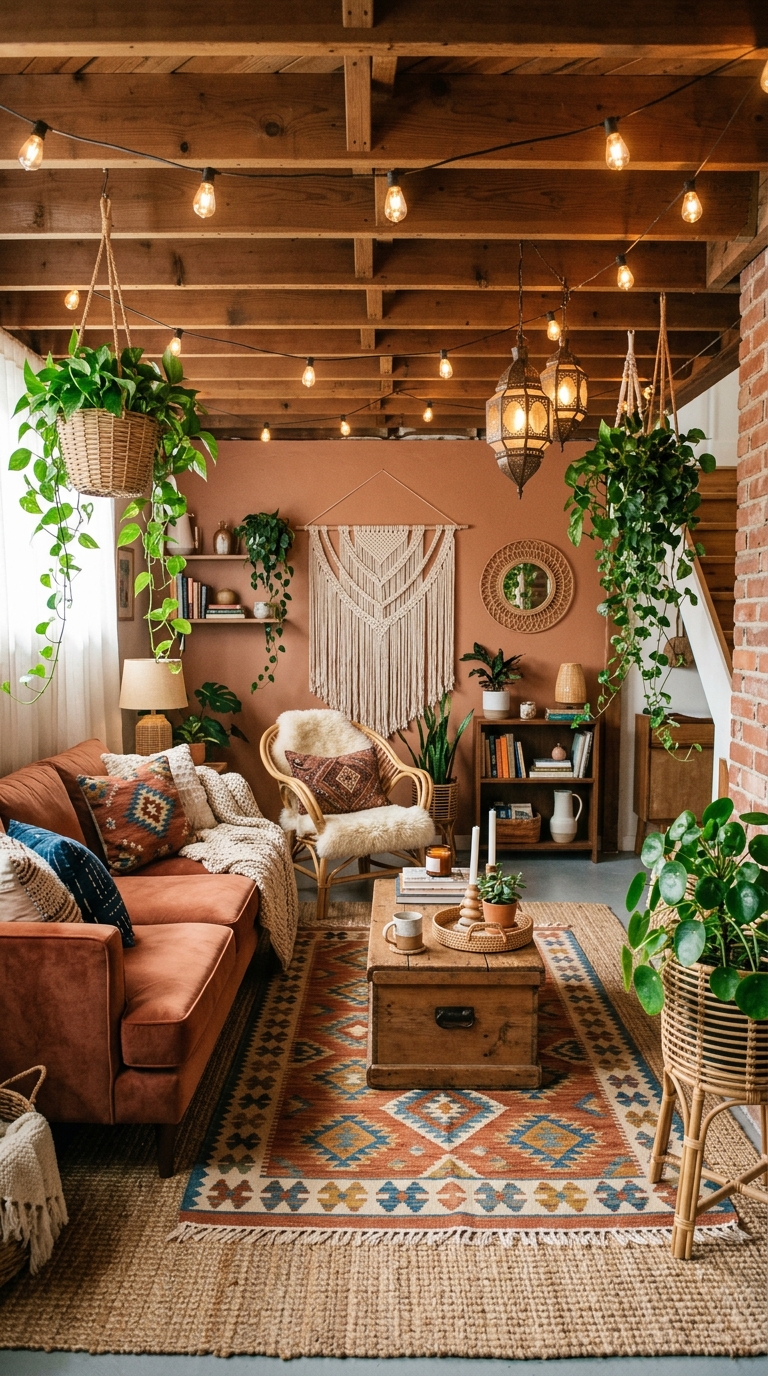
Boho style is genuinely forgiving — it celebrates imperfection, layering, and eclecticism, which makes it one of the best aesthetics for basements that have quirky layouts, low ceilings, or odd architectural features. Instead of fighting the space’s imperfections, boho design incorporates them and calls them character.
Start with layered rugs — a large jute or sisal base with a smaller Moroccan or kilim-style rug layered on top. Add a mix of seating: a plush sofa, a couple of floor cushions, a rattan chair. Hang macramé on the walls, fill every corner with trailing plants, and light the whole thing with a mix of string lights, Moroccan lanterns, and warm floor lamps.
The beauty of boho is that there are no rigid rules. You can mix patterns, mix eras, mix textures freely — as long as the colors are warm and earthy, the result feels intentional and beautiful.
Styling Tips:
- Layer two rugs — a natural jute base with a colorful kilim or Moroccan pattern on top
- Mix seating types — sofa, rattan chair, floor cushions — for an eclectic, relaxed living arrangement
- Macramé wall hangings and woven textiles add bohemian texture to any wall
- String lights and Moroccan lanterns are the essential boho lighting sources
- Trailing plants — pothos, philodendron, or string of pearls — bring the boho space to life
Basement Living Room with Shiplap or Wood Paneling — Texture That Transforms Everything
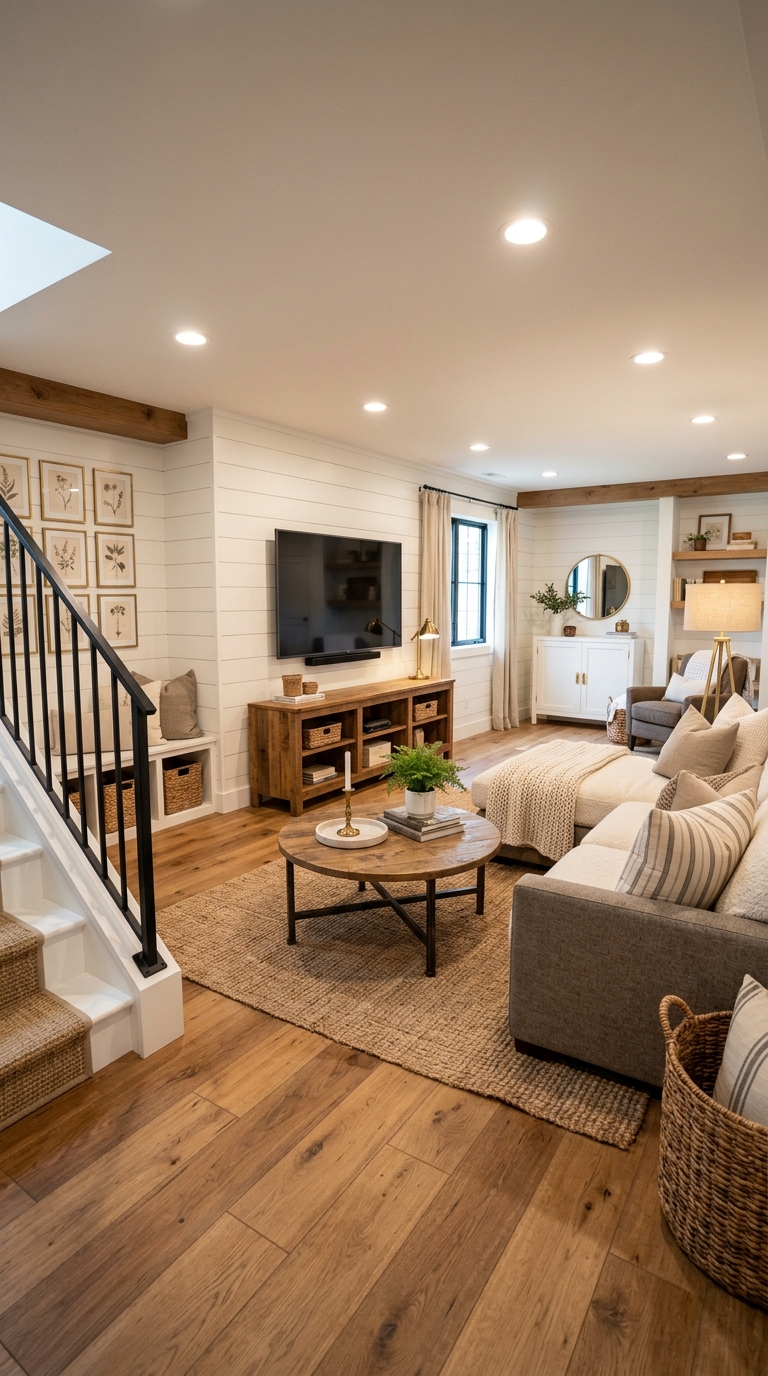
If there’s one surface treatment that consistently elevates a basement living room from plain to polished, it’s shiplap or wood paneling. Adding horizontal shiplap to one wall — or even wrapping the lower half of all four walls in board and batten — immediately gives the space architectural interest and texture that paint alone simply cannot deliver.
White-painted shiplap makes a basement feel clean, bright, and surprisingly charming — like a beachy cabin or a modern farmhouse. Natural wood paneling in a warm walnut or cedar tone creates a richer, more enveloping atmosphere. Both work beautifully depending on the overall palette and style direction.
The cost is lower than most people expect. Shiplap can be installed as a DIY project using standard lumber, and the impact it makes relative to the investment is genuinely hard to beat.
Styling Tips:
- White painted shiplap brightens a basement while adding architectural texture — perfect for lighter palettes
- Natural wood paneling in walnut or cedar creates a warm, cabin-inspired atmosphere
- Board and batten on the lower half of the walls with paint above creates a classic wainscoting effect
- Mount the TV directly on the shiplap wall to make it a true design feature rather than an afterthought
- Pair shiplap with warm brass or matte black hardware and fixtures for a polished, cohesive look
Open Concept Basement Living Room and Kitchen Combo — A Layout That Feels Intentional
An open concept basement with a small kitchen or kitchenette alongside the living area is one of the most functional and impressive basement configurations you can create. It transforms the basement from a secondary room into a fully self-contained living space — perfect for entertaining, for guests, or for creating a secondary suite.
The key to making an open concept basement feel cohesive rather than chaotic is continuity. Use the same flooring throughout both the kitchen and living areas, pull the same hardware finish through both spaces, and choose a color palette that flows seamlessly from one zone to the other. A kitchen island or peninsula with bar stools acts as a natural boundary between the two spaces without requiring a wall.
Design the kitchen area with the same attention to detail as the living space — open shelving, warm pendant lighting, and quality finishes make even a small basement kitchen feel like an intentional design choice rather than an afterthought.
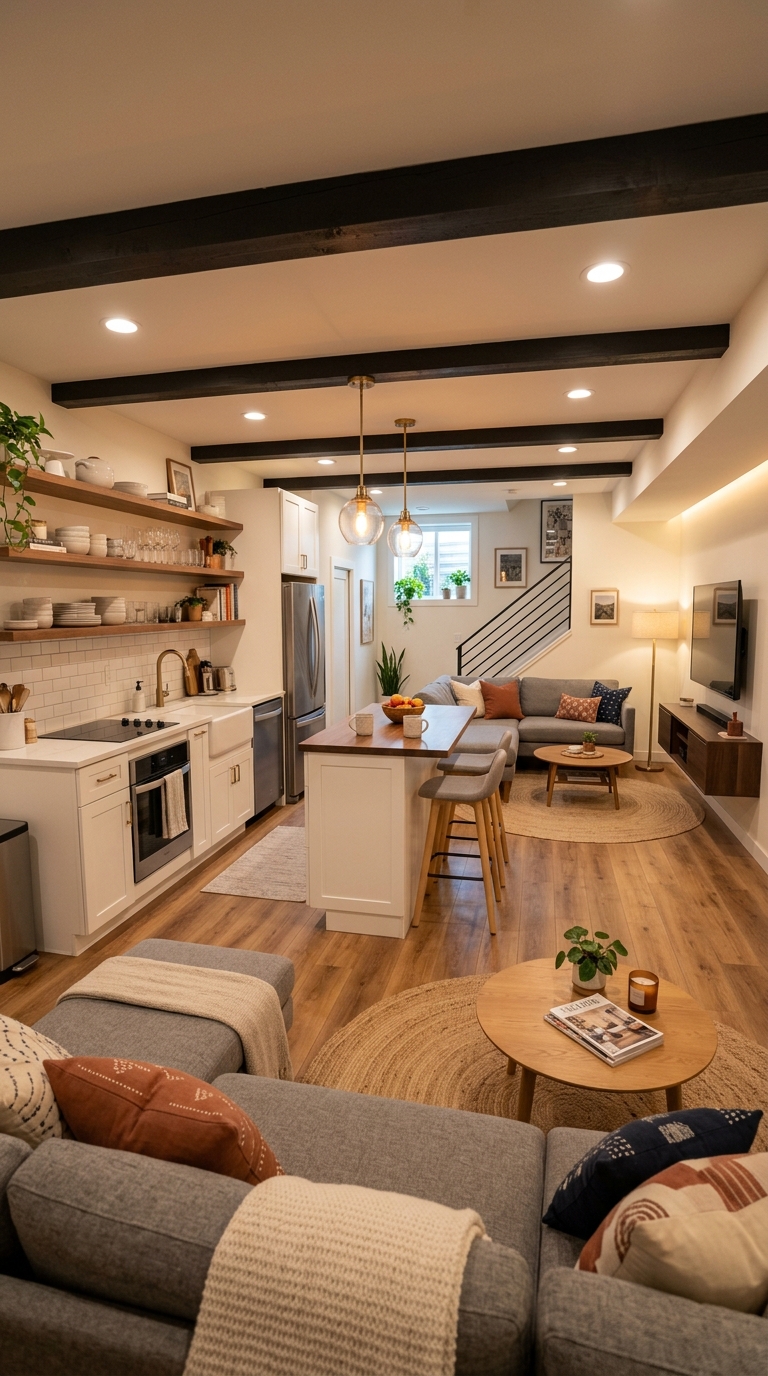
Styling Tips:
- Use the same flooring throughout both the kitchen and living zones for visual continuity
- A kitchen island with bar stools creates a natural boundary between the living and kitchen areas
- Match hardware finishes across both spaces — brass, matte black, or chrome throughout
- Pendant lights above the island tie the kitchen zone into the overall lighting scheme
- Keep the kitchen palette consistent with the living room — same tones, same textures, same vibe
Budget Basement Living Room Makeover — Big Impact, Low Spend
Transforming a basement doesn’t have to mean a full renovation. Some of the most impressive basement living room makeovers happen with nothing more than paint, lighting, and a few well-chosen pieces — all of which can be done for a fraction of what a professional renovation costs. The key is knowing where to put your money and where to get creative.
Paint is always the first investment. One dark accent wall or a full room refresh in a warm neutral costs very little but changes the entire atmosphere of a space. Follow that with updated lighting — swap harsh fluorescent fixtures for warm recessed lights or plug-in sconces — and the basement already looks like a completely different room.
Shop secondhand for the big pieces: sofas, coffee tables, and bookshelves all show up regularly in excellent condition on marketplace apps. A good cleaning, a coat of paint, or new throw pillows can make a thrifted piece look completely intentional and stylish.
Styling Tips:
- One can of paint on an accent wall is the highest-impact, lowest-cost basement upgrade
- Swap fluorescent overhead lights for plug-in warm sconces — no electrician required
- Shop Facebook Marketplace or thrift stores for sofas and coffee tables in good condition
- New throw pillows and a large area rug transform the look of any existing furniture
- String lights and candles cost almost nothing but add enormous warmth and atmosphere
Moody Basement Lounge Aesthetic — Deep Colors, Velvet Furniture, and Seriously Good Vibes
The basement is the one room in the house where you can go full moody lounge aesthetic without anyone questioning the design choices — and that’s a freedom worth taking advantage of. Deep jewel-toned walls, velvet furniture, low ambient lighting, and a bar cart in the corner — this is the basement that adults actually want to spend time in after the kids are in bed.
Choose one dominant deep tone — midnight navy, deep plum, forest green, or rich charcoal — and build the entire palette around it. Bring in velvet through the sofa, accent chairs, or throw pillows. Add a large ornate mirror on one wall to bounce light and create depth. Keep the lighting warm, layered, and dimmable throughout.
The moody basement lounge isn’t about darkness for its own sake — it’s about creating an atmosphere that feels intentionally intimate and adult. It’s the room that makes people sigh when they walk in and immediately reach for a drink and a good conversation.
Styling Tips:
- Choose one dominant jewel tone and build the entire palette around it — don’t mix too many deep colors
- Velvet sofa or accent chairs in deep jewel tones are the essential centerpiece of this aesthetic
- A large ornate mirror reflects light and adds depth to a moody, windowless basement space
- A styled bar cart in the corner completes the lounge atmosphere and makes the space feel like a destination
- All lighting should be warm, dimmable, and layered — never a single harsh overhead source
Conclusion
Your basement doesn’t have to be the room everyone forgets about. With the right lighting, a smart color palette, and a few intentional furniture choices, it can honestly become the most comfortable and stylish space in your entire home. Whether you went all in on a moody jewel-tone lounge, a rustic exposed-beam retreat, or a clean minimalist setup — every single one of these basement living room ideas proves that below grade doesn’t have to mean below beautiful.
The best part? You don’t need a full renovation to get there. Sometimes all it takes is one dark accent wall, a warm area rug, and better lighting to completely transform how a basement feels. Start small, layer thoughtfully, and let the space evolve naturally over time.
If this post gave you ideas, save it to your Pinterest board so you can come back to it when you’re ready to start. And if you’re already mid-makeover — drop a comment below and tell me which idea you’re trying first.